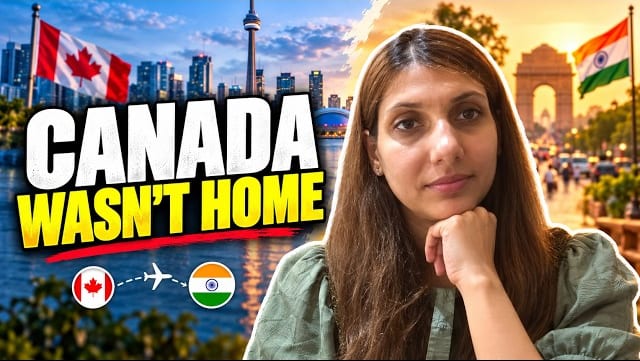
Nine returnees and families moved back to India and later chose to live abroad again. They explain what made them rethink, and what it means for anyone planning a move.
Check your move date and India travel history with the RNOR status calculator.
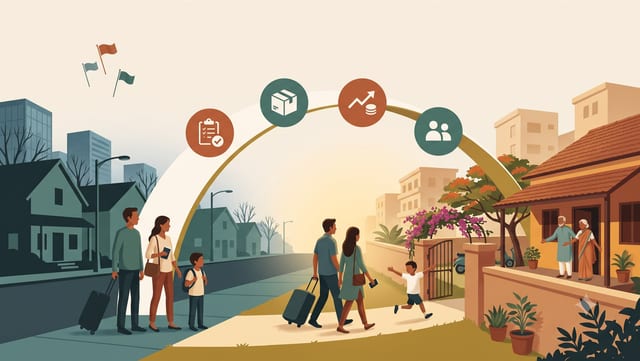
Some NRIs who move back to India decide to leave again. Nine returnees explain what changed their minds: emergency care, air quality, their children's paths, work culture, a business that would not take root and a family that was not ready.
Nine returnees and families moved back to India and later chose to live abroad again. They explain what made them rethink, and what it means for anyone planning a move.
Check your move date and India travel history with the RNOR status calculator.
Most of our conversations are about moving back to India. This video asks a different question. What happens when people move back, and then decide to live abroad again?
It is a compilation of conversations with nine individuals and families. Their reasons are specific and personal. The video asks what really decides whether a return to India succeeds or fails. These are real experiences, not reasons to discourage anyone from returning.
If you want the wider picture, our article on regret and success after moving back to India sets these stories beside others.
One mother says everything was going well until her son's medical issues grew harder to manage. The challenge, she says, was getting a 911-style emergency service. It did not exist where they lived, and she worried because he needed emergency care at times.
Her husband travelled a lot for work. On one night he was in London, and she had to drive her son to the hospital herself at about 10 PM. That was the night she decided it was time to move. The doctor had said her son would grow out of the condition, so she wanted to give him the medical facilities he needed until then.
Her reasoning was about responsibility. She says you would fail as a parent if you could do something for your child and did not do it, especially with a medical condition. The family moved back abroad in 2014.
Another returnee points to two things: road rage and air quality. He describes parking disputes in Delhi turning violent. In one incident, four people attacked his driver. He stepped in to rescue him and took a few blows himself. At the hospital the doctor told him that if the rod had landed half an inch higher, he would have been dead.
His wife has asthma. The first nine or ten months were good, he says. After Diwali the pollution became so bad that she was in hospital almost every second day, with an attack every evening. The family moved back to Canada soon after. They have been there for 14 years now, and he says she has not had a single asthma attack since.
His summary is plain: health and safety were the two major concerns. This is one family's account of one city. If air quality matters for your family, check it across seasons in the exact neighbourhood you are considering, not only in one month.
A parent describes a gap between the family's plan and what the children wanted. The younger son did not want the traditional route. He wanted to build robotics, and he was not keen on engineering or medicine. The elder son planned to finish his undergraduate degree and go to the US for a master's.
That is when the family understood both children would probably be heading towards the US. She did not want to move because everything was going well, so her husband moved first.
Her view of the education system is balanced. If a child takes the traditional engineering or medical route, she says, the academic rigour and the exposure are really good. For a non-conventional path, she says, the options in India are still evolving. For more on how children cope with a change of country, see why children struggle when they move countries.
Another returnee worked in India while her parent company and most customers were in the US. She worked day hours, but she also had a team and was working across the globe around the clock, available late in the evening and sometimes at night.
She says the work-life balance was not great. Then her family chose to move back to the US and went ahead of her. She stayed in India for a while and travelled back and forth, which she calls a long journey.
If your employer is overseas, ask early what hours the job will really demand. Our guide to career moves and work culture differences between the US and India covers what to compare.
One returnee set up a business in India. He tried to replicate the style he used in the US. He admits he failed a bit. In his words, India has a different approach to leadership and to the style of operating and working, and he did not work the way he should have.
He eventually decided it was time to go back to America while keeping his connections in India. His wife was upset. She said the children were happy, she enjoyed her work and they had a fantastic life there. His story shows that the business and the family can want different things.
One woman says it was really hard to adjust to the work environment. She is clear that work in the US is not all roses. But being looked at as a professional, she says, is very different from being looked at as a woman. However technical she was, she sometimes had to go to war to prove herself.
She says traffic and pollution are the superficial things that could be handled. What mattered more was how she was treated as a person, as a professional, as a mom and as a wife. That played a big role in her decision to go back.
A woman who has an autoimmune disorder describes how hard it was to see a specialist. She had to wait an entire night to get an appointment with a doctor in Ludhiana. For another specialist she had to go to Delhi.
She says the doctors kept experimenting on what the problem was, and she was treated for multiple things. She was finally diagnosed in Canada, and the treatment she received there helped her recover. This is her own account, and experiences differ by city and by doctor. It is not medical advice.
If you or a family member has a long-term condition, find the specialist before you move, and read our guide to health insurance for a returning NRI family.
This is the most personal story in the video. A father remembers Christmas 2019. He was working abroad, shuttling between countries, and he bought his son the Iron Man toys his son liked. His son did not touch them. He says it might sound silly, but it broke his heart.
He came to a conclusion. Maybe the wish to go was his own, and his family was not ready. Looking back, he says he should have involved all three children, and held a family meeting before going. They might have anticipated the move and been prepared. He had thought small children would adjust, and now he calls that a blindfolded thought.
He uses the picture of a tree. Uproot it and plant it in a richer environment and it still takes time to settle. Uproot it again and it is disruptive. He has seen families on an average income who stayed steady in one place and focused on their priorities, and he says their next generation flourishes.
The same father says it worked out for him, luckily. But if he had to do it again, he might not do it the same way. For a family to flourish, he says, you have to think about the whole family, not only yourself.
That is the thread through most of these stories. The decision to leave was not made against India. It was made around what the family needed at the time.
One of the most interesting parts of the video is what happens next. Some people who moved abroad again are already thinking about another return.
One speaker says he feels going back to India would be a good decision for him in the long term. He says India has changed so much, even in office culture. Compared with 2012, he says there are a lot more women in the workforce today, and he finds that amazing and nice to see.
The last story in the video is a feeling many returnees and NRIs share. One speaker went to India after four years. Leaving again was heartbreaking, even though she is very happy where she lives now. Leaving her home, her street and her room, she says, was leaving her place.
Her conclusion is that two places can be home. Canada is home too. In her words, home is people.
The stories are different, but they point to the same questions. Use them as a test of your own plan. This table pairs each reason from the video with a question to answer before you set a date.
| Reason in the video | What to check before you move |
|---|---|
| Emergency care at night | How far is the nearest hospital with emergency care from your home, and who can drive you if one parent is travelling? |
| Air quality and road safety | What does the air quality look like in your city across the seasons, and how will you commute? |
| A child's study path | Does the school and college route your child wants exist where you will live? |
| Hours across time zones | Which hours will the job really need, and who is on the other side of the call? |
| A business style that did not travel | Have you spoken to people who run a similar business in India about how decisions and leadership work there? |
| Treatment at work | Have you spoken to people in your role, especially women, about what the workplace is like? |
| A long-term health condition | Is a specialist for your condition available in your city, and does your insurance cover it? |
| A family that was not ready | Has every family member, including each child, agreed to the move? |
If you are not sure where you stand, try the should I move tool. It scores the move on your own situation. You can also build a personal checklist with the Return to India planner.
The compilation draws on nine longer Desi Return conversations. You can watch each of them on YouTube:
Score your plan on money, family, work and timing before you commit to a date. Open the should I move tool.
Eight questions on money, family, work and timing. You get the gaps named, not a generic yes.