Desi Return
ServicesToolsResource HubBlogAboutContact Us
Plan Your Return
Blog / Comparisons / Comparison
Comparison

Should You Move Back to India? 25 Regret vs 25 Success Patterns (2026)
Should You Move Back to India? 25 Regret vs 25 Success Patterns (2026)
Avinash, article author
Avinash
24 Sept 20269 min read
  • Should You Move Back to India? 25 Regret
  • 25 Success Patterns (2026)
Our take

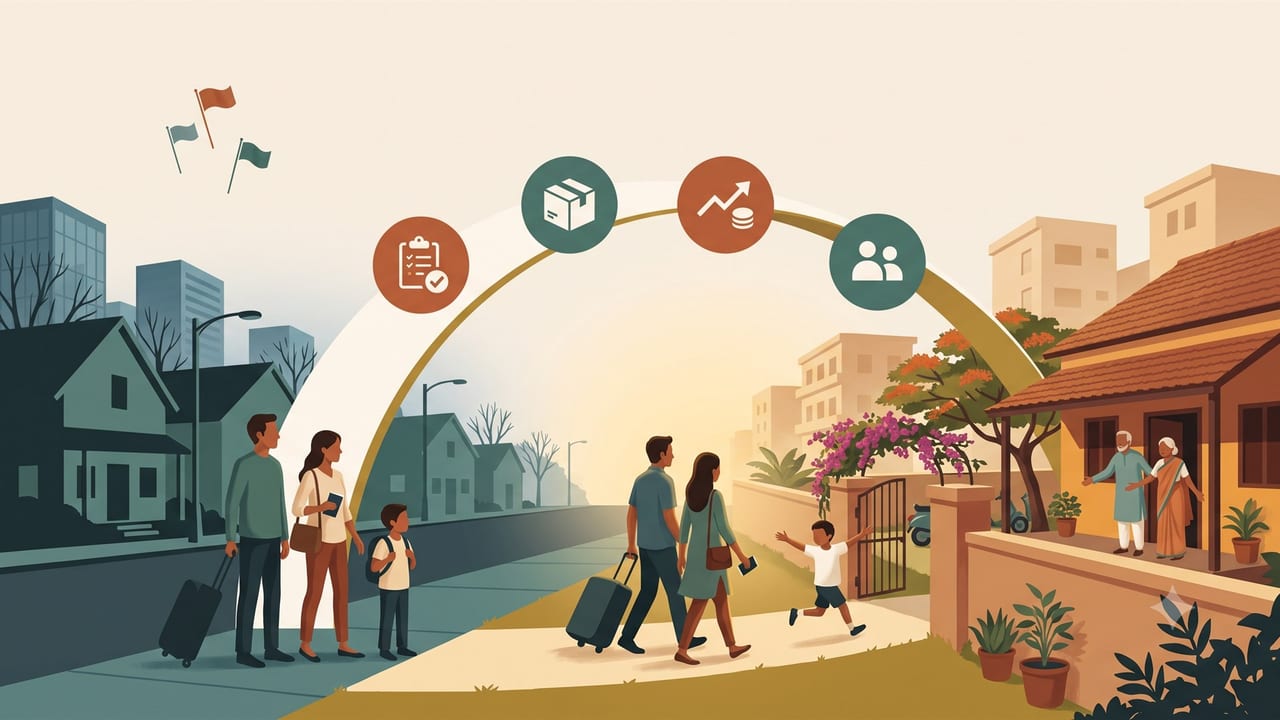
Returning to India is rarely an unmitigated triumph or an utter disaster. Studying 50 real return journeys reveals clear patterns: why some families thrive and build generational wealth, while others pack their bags back to the airport within two years.

Compared on
  1. 01Deconstructing 50 NRI return journeys
  2. 02Key behavioral patterns: Successes vs Regrets
  3. 03The teenager factor: The #1 driver of reverse migration
  4. 04The 9-month emotional trough
  5. 05Sources
Free tool · no signup

Should I move back?

Compare the two options that actually matter — staying put and coming home — on your numbers.

Open the tool
Compared on
  1. 01Deconstructing 50 NRI return journeys
  2. 02Key behavioral patterns: Successes vs Regrets
  3. 03The teenager factor: The #1 driver of reverse migration
  4. 04The 9-month emotional trough
  5. 05Sources

Deconstructing 50 NRI return journeys

Every year, thousands of non-resident Indians pack up homes in the US, UK, Canada, and the Gulf and land at Indian airports. Two years later, the outcomes diverge sharply: roughly half the families establish flourishing careers, deep social circles, and immense gratitude for proximity to aging parents. The other half experience profound frustration, marital strain, and reverse culture shock, eventually re-emigrating.

Analyzing the underlying variables across 50 detailed return journeys reveals that success or failure is almost never about money. It is governed by expectations, children's ages, and operational preparation.

Key behavioral patterns: Successes vs Regrets

Dimension Families Who Thrive (Success Pattern) Families Who Regret (Re-Emigration Pattern)
Children's Age at Move Ages 0 to 10 (Elementary school transition); adapt within 6 months Ages 13 to 17 (High school adolescents); intense peer and academic friction
Housing Strategy Rented for 18–24 months in modern gated township near school Bought an under-construction apartment or moved directly into in-laws' home
Career Mindset Leveraged US experience to lead GCC teams or launch startups; accepted Indian corporate quirks Expected identical US 'at-will' egalitarian culture; constantly complained about hierarchy
Civic & Pollution Tolerance Built an indoor oasis (air purifiers, water RO, gated community living); vacationed in nature Obsessed over outdoor civic pollution, traffic chaos, and bureaucratic friction
Financial Planning Secured RNOR tax runway; maintained diversified USD investments abroad Cashed out US 401(k) early, paid penalties, and dumped all capital into speculative Indian land

Done with you

The whole move, one plan

Most people assemble a move from six providers who never speak to each other. This is one plan and one quote covering the parts that actually depend on each other, built for your family.

Question 1 of 3

No spam. Unsubscribe whenever you like.

The teenager factor: The #1 driver of reverse migration

Across the cohort of families who returned to the US or Canada within 24 months, the single most powerful driver was adolescent child rebellion. Children who enter India after age 12 often experience profound alienation: they miss sports leagues, struggle with academic pressure and second-language testing, and feel disconnected from domestic social hierarchies.

Families with children under 10 almost uniformly report smooth integration. The children learn Hindi or regional tongues effortlessly, enjoy active outdoor play in gated societies, and develop strong bonds with grandparents.

The 9-month emotional trough

Every returnee experiences the classic transition curve: Month 1 to 3 is the 'honeymoon phase' filled with festive food, visiting relatives, and cheap domestic luxuries. Month 4 to 9 is the 'trough of disillusionment' when real-world frictions hit — water supply disruptions, unpunctual contractors, traffic bottlenecks, and office politics.

Those who commit to a strict two-year rule before making any irreversible decision almost always stabilize and thrive. Those who judge India during Month 6 end up booking one-way return tickets prematurely.

Sources

  • Desi Return — Comprehensive US Returnee Longitudinal Study
  • Pew Research Center — Indian Diaspora Demographics and Migration Trends
Share this article
WhatsAppLinkedInXFacebookEmail

Done with you

The whole move, one plan

Tax, money, logistics and paperwork — quoted together for your family.

Question 1 of 3

No spam. Unsubscribe whenever you like.

FAQ

Questions people ask

The most common triggers are civic friction (traffic, pollution, bureaucracy), severe difficulty in adolescent children adapting to Indian schooling, and interpersonal friction from living too close to extended families without boundaries.
Children under age 9 or 10 transition with the highest success rate. Once children enter Middle and High School (ages 12+), academic curricula and social dynamics become significantly harder to navigate.
Most adults experience acute reverse culture shock between Months 4 and 9. It typically subsides by Month 14 to 18 as domestic routines, community friendships, and domestic staff integration solidify.
Yes. Retaining an OCI card or valid re-entry permit (Form I-131 for Green Card holders) provides a crucial psychological safety net, preventing feelings of being trapped during challenging transition phases.
A commitment not to buy real estate, liquidate overseas pensions, or make irreversible decisions for at least 24 months. Over 80% of families who stay through the two-year mark choose to remain in India permanently.
Keep reading

Related guidance

RNOR Status Tax Benefits: Eligibility, Duration, Foreign Income Rules guide image for Desi Return readers
Guide · Financial Planning

What Is RNOR Status in India? Benefits, Duration and Rules

Guide to NRE vs NRO accounts for returning NRIs, including account choice, redesignation timing, repatriation rules, and post-return deposit handling
Podcast · Financial Planning

What Happens to NRE & NRO Accounts When You Return to India?

Top 10 Retirement Homes in India: 2026 Real Prices & Facilities
Comparison · Comparisons

Top 10 Retirement Homes in India: 2026 Real Prices & Facilities

Your own numbers

Score the move on your situation

Eight questions on money, family, work and timing. You get the gaps named, not a generic yes.

Open the tool
Desi Return

We help NRIs and the Indian diaspora who are considering moving back or retiring in India make their transition smooth and successful with expert guidance, community support, and tailored resources.

Useful Links
AboutServicesContact UsFind Us Online
Explore
Resource HubToolsPlannerBlogPodcastFAQ
© 2026 Desi Return. All rights reserved.
Privacy PolicyTerms and Conditions
Partner services are fulfilled directly by the independent companies named above; Desi Return may earn a referral fee at no extra cost to you. Nothing on this page is tax, legal, or financial advice — always confirm specifics with the partner or your own advisor.
Your bag

Your bag is empty. Add a service to get started.