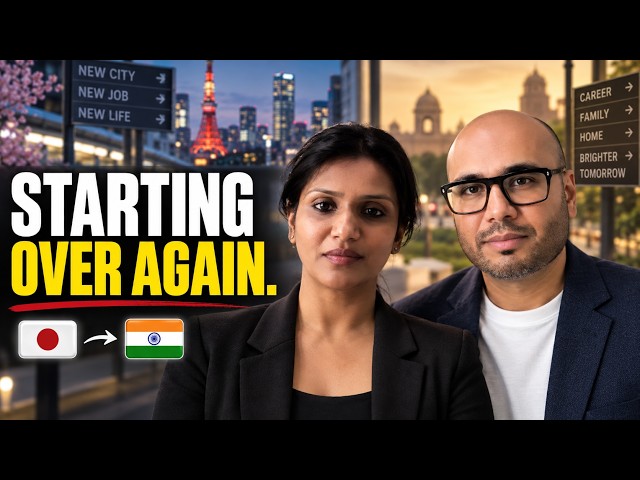
Watch: Why We Moved Back to INDIA After 15 Years of H1B Uncertainty in US
Anup and Akshaya left 15 years of H-1B uncertainty for Bangalore with a 6-year plan, CBSE school choice, freelancing, and calmer family life.
The full write-up, with the numbers and the links.
Chapters
- 0:00 Background
- 1:14 Life in US
- 3:15 Professional life
- 5:17 Why move to India
- 9:47 Healthcare India vs US
- 13:44 Planning the move
- 16:56 Planning timeline
- 20:27 Financial planning
- 21:42 Kids curriculum
- 24:51 Career transition
- 28:50 Freelancing in India
- 30:09 Life in india
- 32:48 Career growth opportunities
- 35:24 Anything you miss from the US?
- 37:17 Advice for future aspirants?
Transcript
Auto-generated captions, lightly cleaned
0:01 Meet Anup and Akshaya. I went abroad in 2010 as a student. They talk about their life in US for 15 years. Spouses are working which was in our case. Then it becomes even more constrained. There's more freedom here in India. Given the visa constraints there in the US. There no scope for being gone in next 15-20 years. And that is a longer time. And you know you know it's just like you know it adds on to your daily How much you can tolerate this uncertainty. And the reasons they decided to move back to India. It is not one thing that forces you but it's all a combination of all of this. They also talk about how they selected the school for their kids. So we did our research but finally we ended up in a CBSE school. When the reason that is the deal breaker criteria.
0:54 And how they plan their career. I took to freelancing for a couple of reasons. I have more opportunities here given the lack of visa constraints. I have more freedom here. I can take some time off and so on and so forth. You wouldn't have the work-life balance is what point that always been told. But that is not the case of And finally they talk
1:16 About their life in India. It pan out so yeah. The biggest apprehension was India is not US. You have to be a Roman Roman. So this is what India has to offer right now. It is growing. Thank you very much for joining us today. So let's start a bit about your background and what made you to go abroad. I I went abroad in 2010 as a student and basically I did not do much of a research. I mean it is basically what a lot of my students in my generation did.
2:07 And there was there was a sense that going abroad the education is better and there is a good chance that I can get a job in my core area core engineering area which was electrical engineering back then as opposed to jumping into IT. And also the sense that I mean there is the life out there is better and all of that. So that is what pushed me to go abroad. And and since then it's been it's been a good journey. I'm pretty sure we'll get into that as time goes on. Well let let Akshaya answer her story. Mine is probably very straightforward. I got married and I had to go no other choice. So I just moved post marriage very straightforward then.
Read the full transcript (49 more sections)
2:55 Got it. Thank you for that. So how was life in US? I think you know maybe Anup you can start and Akshaya can you know Sure sure. So I mean life in the US we can overall was pretty good. but I mean we can see it in different stages. You know there is an initial
3:15 Student phase where you go where you kind of stripped for money and you try to make ends meet somehow while juggling course work and job search. Then you enter the work life work phase where you start earning decent money and you're happy and you know you can you have all the freedom which continues through marriage. And then the last phase is when you have kids you know starting with one and then our case we have two. Where it again starts becoming a bit tougher and constrained and what not. And if if both of us are working both spouses are working which was in our case then it becomes even more constrained. So overall it was good but it it does get tougher as time goes on and on.
4:08 Yeah. Same actually I also agree with him. For me also the experience has been you know a combination of highs and lows. There are moments where it is really high and then there is moments where you know you will feel like what am I doing here? So same you know when in initial phase when everything is new you're abroad you know it's exciting. So that is a very nice phase and then you travel it gives you a lot of opportunities to travel. And then you face the reality right? After that you know you have to do something with your life. You have to do masters find a job and then you are also your kids also join you along the way. So then it becomes a little bit of you know combination of hectic and good moments. So overall it was all right. It's a very nice experience has given us an exposure that we might have not had if you were here.
4:55 Yeah overall was a good experience. Fantastic. So Anup just to confirm I think you know one of the reason you went to US was to work in the core engineering. So I know we didn't touch on the professional side just wanted to confirm. So you did end up working in the core engineering. Is that right? Yeah maybe you can talk about Initially at least initially
5:18 And also sporadically since then. But this is also the other point I wanted to make. I mean I somehow feel at least mid-career there is more freedom here in India. Given the visa constraints there in the US. There if you don't start on the right foot it becomes very hard to pivot. And and kind of get back into the right track given all of the visa constraints. Plus I we were in San Diego where there weren't a lot of opportunities as well. So if we had to move we had to move to let's say a Bay Area or one of these big East Coast cities which becomes difficult as life goes on. So yes you're right that I got quality education in my core area and I also briefly got to work in that area. But eventually I had to pivot which in hindsight I should have you know started with So I'm basically now on the software side and that is what I should have started off with I feel.
6:19 So all in all I would say mixed reviews when it comes to career. I'm certainly thankful and I don't think I could have had a better start to my career but at this stage 10-12 years into my career we I and we both feel that there is a better chance of making it better here in India. Got it. And Akshaya like you are into IT just to confirm on that. Yeah. Yeah I'm into analytics product analytics. So I also did my masters in the same domain and then I also did my job continued my profession also in the same domain. Makes sense. So I know I think you kind of explained the highs and lows at the different phases of life and you know the experience I think people can correlate to that experience in US.
7:11 What made you to think about going to India? Has it been there for some time or is it like you know when you have the lows that's when the you know the thought occurs and then you know it kind of fades away like maybe you can give a background about like when this idea has started or why and you know what happened there. That's a million dollar question right? So we we never had well so to begin with we were very ambivalent about returning. We were okay either way. That's how a lot of people are you know? And this has been my stance since three years into my stay in the US I guess or maybe four. Initial three or four years you don't want to return you know? You are you want to hold on and we I wanted to hold on to it desperately you know having spent money and having seen life there and all of that.
8:04 Then we come to a phase where we are ambivalent. We are okay either way. And then around the time my son was born. He's six right now but around five six years back is when we realized that Well there are many triggers. One of them is as kids grow older it is harder for them to adjust. I mean we hear stories both ways but we don't want to put that stress on him. So that is one very solid trigger. The other is aging parents. The other is like I said I feel I have a better chance of I have more opportunities here given the lack of visa constraints. I have more freedom here. I can take some time off and so on and so forth. this is before we have even gotten into the visa issues which which were sporadic but still enough to kind of stress you out you know? And then you suddenly wake up one day and realize you know my gosh I don't see this improving. This is you know I'm maybe 30 now or 35 now and I see life
9:08 These issues lingering for the next foreseeable future perhaps even until I turn 50 you know? And then I don't want to look back and say oh my gosh you know I've been under this visa stress. You know I wanted to maybe do a startup I'm not able to do it. So all of these things put together I mean I guess that's how it is right? It is not one thing that forces you but it's all a combination of all of this. So we started planning back then and since then we we wanted to take it slow. We wanted to be really sure. We wanted to have the groundwork done before we actually pull the trigger and get back. for me also you know it's multiple small
9:48 Things. Like you know health care was all all tiny tiny things. But the major push was always there for me. Ever since I went there, I could never, for some reason, could never see myself settling down there for a longer run. I don't know what it was. And then, it got more and more reinforced with COVID. And you know, with kids, having two kids, and also the stress of tied to a visa, and you know, the pressure of holding on to it if you had to stay there. Because there's no There was no scope for being calm in that 15 to 20 years. And that is a longer time. And you know, it's it's you know, it's just like you know, adds on to your day-to-day pressure. You know, you have to hold on to your work dearly. And you know, thinking about investments, do you invest here or settle down there? So, all that pressure was I don't think it was worth it for us. And so, that was actually the major push. So then, it got
10:49 Reinforced that you know, we had to move. We're probably not going to This is not This pressure is not going to work for us. Then when do we move? We have kids. So, the sooner the better. When kids are in picture, the sooner the better. Because this is a whole different world and whole different universe for them. So, you know, if I bring him when he's 10, he's probably not going to like this experience. Or you know, he's going to have his own friend circle. He'll have to It's It's very immoral or you know, very not fair for him. So then, the timeline came into picture. So, that is when we thought this is the time. We probably have to move before he starts first grade. Okay. So, he came and he started his first grade here, actually. Makes sense. I think all the points that you have mentioned, I think again, the key thing is it's not one main driving factor, it's cumulative of all these different factors.
11:39 I I think I understand about all these aspects. One thing I wanted to dive in a little bit, if you're okay, is the health care. I think you kind of slightly touched about the health care, because some people think health care is better in US because it's advanced, it's all the other stuff. Some people think, you know, accessibility is much easier in India. I know you kind of mentioned health care is one of the reason, maybe the trigger point in a minor way. Anything that you want to expand on that, maybe from your experience of health care in US? There are two reasons broadly why why you might require health care, right? One is if you have a major illness, major acute illness, like somebody got forwarded as a cancer or something. What is your everyday illness? You had something and you have a you have a you have a grumbling tummy, or maybe your son broke his foot or anything of that sort. it's I mean, it's for most people, I would assume it is a second category which predominates. And that part is really hard in the US. I mean, if I can't predict when my son will break his foot, but they they're not going to give me an appointment the
12:40 Same day pretty easily. I mean, we there are occasions where we waited like 6 hours in the year to just get an okay >> have someone look at his broken foot, or a flu, or a cold, or something of that sort. I mean, we never had any major issues. I mean, maybe childbirth and pregnancy is one major issue you could say. And there, no doubt, the care was care was really world class. And we really I don't think you know, there's anything to complain there. But for these minor issues, which is what most of us face very often, it is very difficult. Okay, I think it's bottom line is the accessibility for you know, on a regular need of visiting a doctor. Yes. Right. Yeah. So, there's one more difference, sorry. One more difference I feel in terms of health care way. Here, doctors have the liberty to assure you. You know, they say, "Don't worry. I don't think this is big." But there, you know, with multiple visits that I have, just my experience, they have their inhibitions to openly say, "Don't
13:40 Worry." You know, they are afraid to quote give their quote. So, you know,
13:44 They just you have to you have to take the 10 tests. It is good in a way, you know, it is good, but sometimes that reassure them absence of reassurance puts you in a whirlwind of emotions. So, that I feel here, you know, "Don't worry. This is nothing. We've seen multiple cases. You'll be fine." So, that reassurance is very timely, and that is needed. So, there we have had instances when my son was a newborn. And you know, he had a little bit of some skin issues. And as a 45-days-old baby, he was admitted in hospital. And they can't say anything right now. We have to run these 10 tests. So, that day or two is kind of like you know, "Oh my god, your heavens are falling." That kind of feeling. So, those things I think it's their restrictions, you know, you can't quote openly because you will then hold the doctor accountable. So, that is why they are So, that is also one big difference.
14:37 As a patient, you know, you need that timely reassurance. So, that I For my for our attitude, I think it suits us here. Yeah, definitely makes sense. So, let's I think talk about I think the planning, right? So, you kind of had this trigger based on these different factors when your son was born in 2019. And I think, you know, you had the timeline to make the transition before he joins the first grade. So, it's about 6 years. Maybe you can talk talk us through like how you planned the different aspects of it on a financial side, career side. Yeah, maybe we'll start with the financial side. If we can talk anything on that aspect, that would be fantastic. Yeah, well, I mean, there wasn't much planning to be done on the financial side.
15:22 But I can touch upon that as well. The biggest aspect was to decide where we want to relocate. And we kind of had a difference over there. I was very excited about relocating to a small town. But we had a lot of discussion on that. And then, ultimately, we both decided to kind of home in on the best of both worlds. You know, we ended up in a suburb of Bangalore, which kind of has a small town feeling to it. But yet, the Bangalore city is quote-unquote accessible. I mean, if And this is if we ever have to return back to work, get into job, and we have to go to work 5 days a week, then it is still feasible. It's not the same as relocating altogether. So, that was one big decision. And why Bangalore? Of course, there is a lot of IT jobs over here, and not to speak of the weather. The weather is kind of unparalleled.
16:19 At least right now. Got it. In the foreseeable future, I would say. So, that was Maybe just to expand on that. So, are parents also somewhere close to Bangalore, or is it more from a career perspective you choose Bangalore? Maybe if you can, yeah. >> Well, both both I would say. Parents are also close by, and work prospective also. So, it kind of it was a happy coincidence. So, that's why we chose Bangalore. And so, that was the biggest decision. Once we made that decision, then it was all about looking at our living arrangement. Should we purchase something, or should we rent initially? And then, once we decided on that,
16:58 Then move on to the kids' schooling, which we wanted to be close to where we lived. So, he doesn't have to deal with the traffic and all of that. So, I mean, broadly speaking, the major issues were one, where do we relocate? And then, where do we live? And then, my kids' school. And then, when it comes to work, we both decided that we'll take a temporary break. Again, for a couple reasons. I mean, one is Most recruiters don't entertain you when you try to engage with them from abroad. And for good reasons, I mean, they don't It's hard for them to set anything in motion without any certainty that you'll move back. So, that is one. And second, we also, after having worked for a decade and a half, we also wanted to both take some kind of a break.
17:46 So, I mean, we had a sense of the job market, but nothing really on that front as part of the move itself. These were the broad issues. Got it. I know I think you kind of mentioned. So, I think you made the decision about the city. So, if you can put like a timeline, I mean, if if it make if it's okay. Like I think, you know, in the 6 years, I'm guessing the city is the major important one. And then, in terms of renting versus buying, like when was the decision made? Like you know, which suburb in Bangalore? Maybe if you can, like you know, the school, is it like within 1 year, or like 2 3 years before I and and and if we can talk about it. So, actually, in that 6 years, the first 2 years, we just spent on listing the pros and cons. What are pros? So, the first 2 years are you know, most of the dinner table conversation would always be like, "What would we miss? What would we gain?
18:43 Are we being I mean, there is nothing to miss if we move back to India. But are we being unfair to the kids? Are we taking the opportunities from him? What would we deal with if we stayed here?" So, that was the first 2 years. renting versus buying was you know, that also we spent a pretty long time talking about. But at the end of the day, you know, if this is where we wanted to see There, you know, we spent almost more than a decade. But you know, because of this ambiguity, we never could settle down on a home because we were on the verge of we we're going to move, so we're not going to But so, you know, finally, we thought this is the time for us to probably have a proper home home where kids could grow up and everything. So, we had kids, and we thought, "Okay, if this city doesn't work out, we'll then see. But let us take this bold step." Finally, you know, we've been we've been married for a decade. Let's have something. That is an emotional actual decision for me. But he may have had some something financial or something. No, well, I mean, when it comes to a timeline, which is what you
19:44 Asked, so around 3 4 years back is when we started zeroing in on the city and the home. City first, and then when it comes to property, I mean we look at various locations in the city. I mean where where where are the properties coming up? Where do we have you know some kind of a decent infrastructure? What is closer to offices, you know, if we have to go back to work? All of that is what we decide. And then school around a year and a half back is when we decided on the school. so, school is once you decide on the home, you look we look for schools within a 5 km radius, let's say, of that location. So, you you know, kids don't have to endure a long commute.
20:28 And then these are big things, but there are a lot of other small aspects, right? I mean like you have to sell your property in the US and your vehicle. You have to think about shipping. You know, you got to think about when do you resign your jobs. When do you book that ticket? So, the last year, I'd say, was pretty hectic. You know, no no major issues to decide on, but a lot of small things to take care of. Understood. cool. Anything that you can talk in terms of I know you've been there for a long time. You know, almost 15 years. Anything you can talk about like your you know, the stocks, 401ks, anything on the bank accounts, anything that you wanted to share from a planning perspective. >> I mean I'm I'm sure you and your listeners might be aware of this, but there is that window where you were an OAR in India and we can get into what that means. And you are a non-resident alien in the US where you your
21:29 Your stocks and mutual fund profits are not taxed. So, that is something people should look up on and try to capitalize. they might have to time their move so that they have a significant significantly long window to pull that
21:43 Off. so, that is one big thing. Other than that, there is nothing I mean people then have to also choose whether to keep their funds in the US or in India. Moving it back is in my opinion, it's a lot of work. And I mean there may be pros and cons over there. but for the most part, it is this OAR overlap which you know, people should really look into. Yes, got it. So, let's I think switch gears a little bit. I think you talked about a kid's school. Maybe you know, what curriculum have you selected? How was your criteria? Because I think you kind of looked at it well ahead, right? 1 and 1/2 year is a good time. So, anything that you would suggest like how you went about selecting a school? Any suggestions for parents who are in a similar boat?
22:30 Yeah. So, we have a very controversial or very non-commercial take on that. So, we have actually put him in a CBSE board. we've researched about other boards as well. I mean in Bangalore, the other reason why we selected Bangalore was the opportunity for kids' education, right? You have ample schools, IGCSE, ICSE and you know, what not boards. You have tons of international schools. So, we did our research, but finally we ended up in a CBSE school. and the reason being you know, the good IC IGCSE or IB schools depends majorly on the teacher and the philosophy of the school. So, if the school that you are selecting and the teachers ends up being you know, very very you know, the chalk and talk method of teaching, the philosophy of IB and IGCSE doesn't reach the kids.
23:26 So, you then that kind of handful of schools, one thing you know, which actually stands up to the mark of IB or IGCSE, the fees become over the roof. It's very a huge sum of fee. You can spend it if you choose to, then you get the opportunity, but we but our take, you know, it's that at this age we want something which we don't want to confuse him where you have the opportunity where he could adapt to the Indian education system and also if we were to move back, you know, he's able to adapt to that. So, finally we also we chose a CBSE school. And within CBSE you have range of schools. You have schools which is like very high-end, very schools where chefs design the nutrition menu and uniforms.
24:11 Then there is normal old school method where we grew up in. We chose something in the middle where there is no not very high pressure. It is a very they call it a progressive school where they enhance play-based learning. There is not much emphasis on exams and homework in the primary grade. And then gate pick up. So, for us the main criteria for school is it has to be within 2 km radius of where we are planning to settle down. That is the deal breaker criteria. The second thing is where there is not pressure of that Indian schooling system. There's no he's he's able to freely ask questions and these days the schools have adapted well to that. Many schools do that. So, then
24:51 We selected this one particular CBSE school which fits all our criteria. The fee was also all right and there's not high pressure environment. Kids come from all backgrounds and you know, it's also very closer to where we are settling. So, he only spends like 5 5 minutes traveling to school. That's fantastic in Bangalore. Yeah. So, that is the main deal breaker. He could also walk to school if he misses the bus. Yeah. Cool. yeah, thanks for that. So, maybe we can switch gears a little bit to the careers. I know you kind of mentioned about you intentionally took a break and you also mentioned about you know, people not taking seriously if you're applying from abroad. So, maybe you can talk through your journey about finding the opportunities after moving.
25:37 Yeah, so in my case, I I took to freelancing for a couple reasons. One is I wanted more freedom. I didn't want to get back into a 9-to-5. I wanted more freedom to kind of re-image my career, develop new skills and also explore a couple other income streams like you know, content creation and whatnot. when it comes to freelancing, my my like I said, my expectations were not huge. It was not like I was trying to you know, charge astronomical rates per hour or anything of that sort. So, that being the case, it was I mean it was relatively easier. It was relatively easier compared definitely easier compared to getting a full-time job in the US. But even easier compared to getting a full-time job here in India.
26:25 It was all about marketing myself for a few weeks and then I landed an opportunity. she went for a full-time role. So, maybe she can throw some light on that. And for me, compared to US, I mean hunted for job in US three times in total. Compared to all three experiences, this has definitely been easier. although the the job market right now in even in India is on a decline right now. That's what I've been hearing. So, even compared to that, you compared to US, it was easier. So, yeah I got opportunities lined up. The interviewing experiences was a little bit different from there. And then your my priority was I wanted something remote. I didn't want or hybrid at max. So, all the companies right now are moving back to work mode, at least hybrid. So, that remote was very short. So, that actually remote jobs are shrinking right now in Bangalore. So, that probably took a
27:27 Longer time for me. But apart from that, I wouldn't complain. It was compared to what I've experienced, it was a simple process. It took 2 months, we can say. Yeah, a month to two months job. I am also satisfied with Yeah. Got it. So, are there any tactical tips like you know, which portals have you used to for searching the jobs or have you reached out your network? Any tactical tips that you can suggest like while you are trying to find your job in India? Referrals definitely help. Having a first-hand referral, you know, I think that applies anywhere all over the world. But the second thing is my experience in the US is if you apply online, your responses is almost zero. You know, it goes into the black box. But it has been slightly better here.
28:14 I've used I used all the portals. I used Naukri, InstaHire and multiple. I just put I put my full-time job was to find a job when I was not working. So, I used all of them. And there are also like here there are multiple paid service where the portal itself will highlight your profile. So, the higher you pay, your your profile will be highlighted and all those things. So, referrals and being active on all almost all the job portals definitely increases your opportunities. Okay, makes sense. And Anup, if you are open, I know this is not very common. I
28:50 Know people would love to have that kind of a flexibility with the freelancing. So, you had mentioned about the marketing. Is it through primarily LinkedIn or your networking? Anything that you can share? Maybe someone who is considering about doing the freelancing from a flexibility side. Anything that you can share from your side. Yeah, couple things. One is to have to have the right or I could say the hard skills. Right now, data analytics and data engineering is pretty hot. software I believe has always been hot. I I my freelancing is in the area of data science and data engineering. so, that really helps. So, I mean those who are planning if I mean they should find what field is hot when they are planning to come and then try to gravitate towards the one that is closest to what they are doing right now. That will solve a lot of your problems.
29:46 And then it's all about aggressive marketing in all of these various platforms. You're right from top talent to Upwork, Fiverr and all of that. And then you got to build that reputation. Initially, you may have to, you know, offer some discounts, give you give some work samples. And then work your way up from there. So, those are those are the three things I would say.
30:10 So, how is life in India now? I mean, 15 years is a long time in US. Did you have any apprehensions moving to India? If so, you know, how did it pan out? So, yeah. The biggest apprehension was traffic in Bangalore. and that is why we were conscious to not have a long commute for our son to begin with. And then eventually for ourselves as well in terms of not, you know, not going in for a for a choosing a remote job. You know, that's what we did. Once that was out of the way, and when I say commute, what it essentially is is the public infrastructure. You know, that is what the issue is, especially in urban areas. That was not a surprise. We we knew what to expect and it was pretty much at par with that.
31:01 Other things we were we hoped they would be good. We kind of also felt they would be good, which has all which has only been reinforced. I mean, when I say other things, I'm talking about we live in a gated community. the immediate environment is pretty good. Social life is pretty good. We have services, unparalleled services. I mean, we have Blinkit, Zepto and all of that. And we have We have house and plenty of house help. Our kids have a better social life than in the US. It's easier for them to make friends over here. So, those were all the cons. And but again, you know, the traffic was a big question. The infrastructure was a big question. My Now, 6 months into the move or almost 6 months, it's not it has not bitten us as hard at least yet. So, overall we are very happy.
31:55 Makes sense. And the kids enjoying their life, I'm assuming like, you know, they're enjoying the social life. So, the both kids? Yes, they do. And one more thing to add to that is the sense of belonging. The moment we stepped in, you know, you are in your home country. The sense of belonging is something that is always not talked about. In the US, you are always here or there, neither here nor there. But here, the ones the accessibility to your family, meet your folks, and you know, having touch. You you belong here. So, that and then you you're not tied to any visa. Nobody's going to kick you out from from this country. You know, it's your life. You plan accordingly. So, that sense of has brought a lot of calm and peace of mind to us. That is the reason actually, you know, at the core that was the reason to move back. Got it. That is there. That is not going to happen. So, yeah.
32:48 I know I think there is one point I think we I was supposed to check maybe if we can go back. I think this is the career opportunities, right? I think, you know, Anoop, you have kind of indicated because of the visa restrictions the career growth might be a little bit more challenging in abroad than in India. So, maybe anything that you can share from what you have experienced so far. Yeah. Yeah. Yeah, I I just encountered it, right? I mean, you have all these big companies which you feel you can work work with and all of that. visa constraint presents itself in many form in many different forms, right? One is the number of opportunities themselves are less. A lot of roles out there, let's say you want to move to some other domain and you know, there are a lot of companies who might be open to hiring you if not for this visa issue. Now, they are, you know, off the plate. They say it is it is hard for you to break into some other role.
33:45 And then then of course, I mean, if there is a layoff and all of that, then you your focus is on how do I stay within the country? You know, so if you have an opportunity coming up which may not align, but you still got to take it because you're under time constraint. You can hold it at par for like, you know, a month or two or maybe hold it at bay for a month or two and, you know, try your luck with what you really want to do. But then again, it comes to individual tolerance for risk. You know, do you So, you know, it's always like a musical chair. You know, you want to move next to the chair as fast as possible. There is no really any time to explore anything else. So, that is that is how it constrains you. But having said that, if you start in the right track and if you have the right profile, you have better chances. And it's one of those things where it's it's ultimately it's it's luck based. I mean, you could you could have a career spanning 30 years and not be affected with any visa issues. Find or layoffs. Find or maybe
34:48 You're able to find another role before a layoff. And and the one that you like at that, one after the other. Or, you know, you could fall into a pit within the first 3 years itself. You know, and then you'll have a totally different opinion. So, it boils down to how tolerate how much you can tolerate this uncertainty. Because even if you are not affected at all, the uncertainty does take a toll on you. Got it. And then I think on the immigration status, I'm assuming you both were on H1 at the time of Yes, got it. Cool. I think
35:25 Is there anything that you miss, you know, from US? You know, it's been 15 years is a long time. You know, you got adjusted to certain lifestyle, certain way of living. Is there anything that you miss or yeah, from from US? I would say the the national parks and other natural surroundings which were pretty accessible. Which we also have plenty of that in India as well. Not to say that it's exclusive to the US. That is one, but the other bigger thing I maybe sometimes kind of mixes misses being able to hop into my car and go to a Starbucks without much of a hassle. Here it's not it's not something I would do for recreation. You know, so that's that's the only thing that I miss.
36:15 But then again, I mean, there is I don't get the chai that I get here at Starbucks. You get chai latte. Right. Right. Which is not quite the same as the ginger tea and LIC tea that I get over here. Yeah, for sure. For me, it is you know, the shopping experience. You know, it's the shopping experience definitely it's here as well. You know, you but the accessibility to brands in one store. For example, if you take Target or Costco, you have multiple brands in one place. And it's very probably if you're living in a metropolitan, very close to a Target, you just walk there or take a car and but here, you know, if you had you'd have to go to a mall. We are living right now in the suburbs, so we don't have any malls close by.
37:01 So, we'll have to it's it's a day event. You have to play a plan there, go to the mall. So, it's a day event. You definitely have that experience, but you know, the the freedom to just hop on and go anytime, that is a Not as smooth. Yeah, as smooth as. Apart from that, I think
37:18 Is there any topic that we haven't covered that you want to bring up? I mean, well, maybe for students who are thinking whether they want to whether they should go or not. I Because it's a common question that they ask, you know, not just students, in fact, people at all stages of their career. But it's I think it it is there there is no yes or no answer that will pop out of an algorithm. I mean, everybody has to evaluate it individually at a high level. Factors What is at stake? You know, what is amount of money at stake? And what is a plan B? You know, if things don't go as per plan. You know, if there is a layoff or if there is a visa change, rule change that impacts them.
38:10 What is the plan B and can they live with that plan B? You know, that's I know it is very abstract. And but this is really where people should start from and you know, work towards their individual situations to come up with an answer. Got it. Yeah. Any advice for future aspirants who are considering moving to India? I would say they they should I mean, they have to take care of the big things first. Big things being where do they want to relocate? Do they want to buy a property there or rent initially? If they have kids, what about kids' schooling? And finally, their career. So, these are these are the big things to take care of. And then if they have a home in the US, do they want to sell that? So, it's it's fine. These these are things they should take care of first, I feel.
39:02 Then stuff like selling, moving, etc. Those logistical issues are best kept for the last year. There is no point spinning your wheels on them before you actually have close to that home run. Got it. From that's logistically, but from a mental peace point of view, it's to having the expectations right. I mean, you know, you cannot I mean, in terms of job, be it the job and the job market and also in the life in general, expect what you can expect out of India, right? I mean, India is not US. You have to be a Roman Roman. So, this is what India has to offer right now. It is growing. This is how the life will be. it is my It would be great if they can come, visit, spend some time, probably a month or so, to get a feel of what life would be.
39:50 So, then you're you're not expecting something off the roof of India. This is how it is. The traffic is not orderly. you know, people could cross their lines sometimes. There's no surprises. Yeah. It's all a known issue. Or you will be surprised and it won't The move back won't be a pleasant experience if you are having a different experience. Then it won't be a pleasant experience. Even in terms of job, right? if you're moving back from US, you you're still The job market people here are also very bright minds and job Everything has changed. So, many people when we were moving back, the question that we The job market is the job or the quality of job is going to be very difficult. You're not going to have this life. It's going to be very hierarchical. It is probably true in some cases, but it is evolving. There are also places and product-based companies where you have the same freedom. People question in meetings and The things are changing. So, that is one thing. Every time this had come in discussion, all our friends back home
40:53 Well, the main point would be the job or the work-life balance. You wouldn't have the work-life balance is what the point that always reinforced. But, that is not the case always. It is changing. You can pick and choose. Yes. I think everybody has different experience, especially with these Yes. companies. That's where you can be very selective in which companies you join. And it's evolving and it's definitely getting changed. Yeah. Yes. And No, thank you very much for taking the time and sharing your story with us. A lot of insights, a lot of things to take away. So, really appreciate you being with us today. Thank you so much. Thank you. Thank you. I have a question for you.