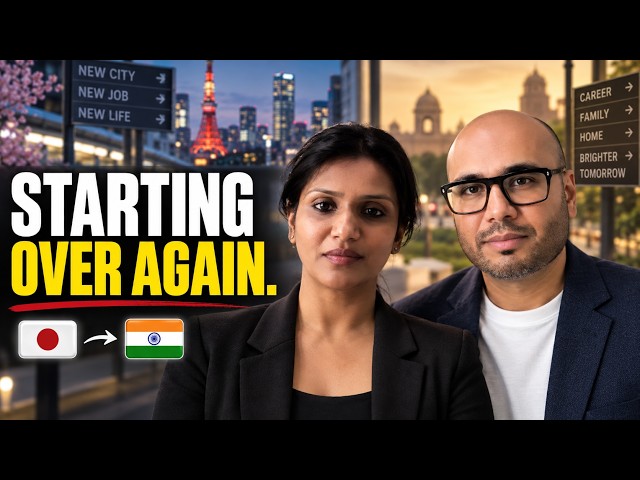
Watch: After 12 Years in the US, Why He Finally Moved His Family Back to India
After nearly 12 years in the US, Rajesh and his family moved back to India. The fifth-grade cutoff, a staggered family move, choosing a native town over a metro, an Ooty boarding school, and an unexpected 401(k) lock.
The full write-up, with the numbers and the links.
Chapters
- 0:00 Rajesh’s journey: Chennai → UK → US
- 0:52 Why the return to India kept getting postponed
- 2:27 Kids, aging parents & the fifth-grade cutoff
- 4:27 Why he always felt pulled back to his native place
- 5:12 Planning for the return years before actually moving
- 6:26 Native town vs metro: avoiding another uprooting
- 8:03 Making work travel from the hometown possible
- 9:03 Preparing the kids for India: language, family & adjustment
- 11:36 Financial planning, rental income & backup plans
- 13:35 Tax residency, move timing & internal job transfer
- 15:46 What happened to the US house and 401(k)
- 18:03 Wife and kids moved first: the difficult first months
- 22:17 Boarding school, schooling choices & settling the children
- 25:02 His wife’s role, small-town life & the reality after returning
- 29:02 Biggest lessons from the move
- 30:30 India vs US work culture after the return
Transcript
From the published captions
0:00 How muchever we plan, not everything is going to go according to our plans. That also I realized in many things, like when I started moving the housing market was really going down. A lot of people were asking like why did you move back, you're wasting a lot of your hard work and you're losing lot of opportunities. Fifth grade is the cutoff that we should have, and then after that we should settle in a place like either in US or come back to India.
0:26 We don't know if kids will adjust even though we tried, so we were trying to test the water. So we thought okay, maybe my family will move first and then based on how things go, then I will move later. Kids every day morning they cry, they say oh I will not go to school. That happened for almost three months non-stop. Vacation is a vacation, so whatever we saw during vacation is not their true self. There is only one way going forward, there is no two ways.
0:53 Work culture plays a big role for a lot of people in making the decision. How do you see the work culture, especially at Apple? Thanks a lot Rajesh for joining us today. Let's start a bit about your background and what made you go abroad.
1:13 Thanks Ashwin, I'm very excited to be part of this podcast. To start with, after I finished my engineering I was working here in Chennai for almost 10 years, and then like all others I got an opportunity as part of the company that I was working for. I was in the UK for 2 years and then I came back to India, been here for almost a year, then I went to the US. In the US it's almost 12 years now. We moved last month.
Read the full transcript (17 more sections)
2:01 12 years is a long time. When you went to the US, were you having a certain plan when you want to return back, or how did the idea about moving back to India start and what triggered it? I got US opportunities so I'm going there, it was like that. We thought okay at some point we'll return, but that goalpost was moving, moving, moving, and then finally this is the time we stuck to that.
2:37 Why this time, why not after 8 years or 16 years? A few factors. When we went to the US I had one kid already, so three of us went and we thought maybe 3 to 4 years we will come back, so there were no fixed timelines. After going there I got a very good opportunity at Apple, so I joined there and I was not ready to come back. It prolonged and then we had another kid. Life got busy, we got a house and started doing school. We were very busy, but in the back of the mind the thought to go back was always there.
3:35 At some point we thought kids should not suffer much, we should decide in such a way that kids will not suffer. That is one solid point. And the next was parents' health. After every India visit we could see parents getting older and they were not similar to when we visited earlier. Especially the kids was the first factor because my older one was finishing fifth grade. We thought fifth grade is the time.
4:17 I was inquiring with a lot of members in the US, and everyone suggested elementary is the time, you need to decide before elementary ends. The next one I thought was looking back at my own childhood, most of the things I remember—my friends, my good memories—were after fifth grade. So fifth grade is the cutoff we should have to settle in a place. As soon as we were done with fifth grade, we decided to move.
5:12 What was the pull factor or push factor driving you to move back to India? Somehow when I went to the US for the first time, I always had the pull back to my native place. Maybe it's because I have a very big family in my native. And then parents—I am the only son in my family, and my wife is the only daughter, so that is another pulling factor. And at some point I thought I need to do something that I like, which I felt in the US I cannot do easily compared to India.
6:12 The planning was from the starting. Whatever decision I was making with respect to finance or my job, in the back of my mind I was always asking: what is my long-term strategy behind this? Can I sell the house easily, and if I cannot sell it what's going to happen? I always tried to think in that perspective, and all those things helped me towards the end when the time came to move.
7:06 How did you choose where you wanted to move to? You were in Austin when you decided to move back, with a great friends network and settled life. We had a lot of back and forth discussing pros and cons. The first thing on top was our native place. My wife's native place and mine are just 1.5 hours apart. Both are very close by. If we moved to a metro like Bangalore or Chennai and then at some point came back to our native town, we would be uprooting the kids twice. We thought that would not be good for our family.
8:03 To make moving to our native town possible, I decided to continue my job with an internal transfer. Living in our native place and commuting to Hyderabad could be hard, but luckily I found Coimbatore to Hyderabad has five daily direct flights to and fro. That made the decision much easier.
9:03 For kids' adjustment, every two years we came to India for the entire duration of the school summer vacation. I would return to the US earlier while my wife and kids stayed the full period. In the beginning they spoke only English, no Tamil, and took about a month to communicate. But vacation is a vacation—we knew that when we made the final move, real life would be different from vacation, so we kept an open mind.
11:36 On financial planning, passive investments in India helped me take the step strongly. I had invested in rental properties in Coimbatore a few years before moving. It went through ups and downs—COVID came and one rental sat empty for 3 years. Going through those downs helped me plan emergency backups. My native town is a tier-3 town of under 5 km radius, so I invested in Coimbatore where IT presence is high.
13:35 On the US tax side, I learned a lot from the Desi Return channel and WhatsApp groups regarding RNOR status and tax residency timing, deciding whether to be a US tax resident or Indian tax resident in that financial year. My office accommodated my internal transfer to Hyderabad with the dates I proposed.
15:46 What happened to the US house and 401(k)? When we started moving, the Austin housing market softened. Luckily I wasn't at a loss, but I couldn't sell immediately, so I rented it out through trusted realtor friends. On the 401(k), I had planned to withdraw it and invest in India, but HR informed me that because of the internal transfer I was still an employee of Apple, so company policy prevented 401(k) withdrawal until I resign.
18:03 Because we did not know how the kids would adjust, my wife and kids moved first while I stayed in the US. My family lived in India for two years while I wrapped up my career in Austin and visited every 3-4 months. My wife shouldered the whole transition in the native town alone—dealing with electricians, plumbers, laborers, and setting up the house. For the first three months, the kids cried every morning saying they would not go to school and wanted to go back to Austin. We held strong: there is only one way forward, no two ways.
22:17 For schooling, our native town lacked strong options. We enrolled our older son in a historic residential boarding school in Ooty. It has a clean hill-station environment, great sports, full boarding, and classes wrap up by 12:30 PM, leaving afternoons free. Our younger son enrolled in second grade at a local CBSE school and spent an entire year with his mother learning to read and write Tamil and Hindi from scratch.
25:02 Life in a tier-3 town took adjustment. Civic sense, littering, and the relaxed pace were hard initially. But I realized I was projecting US standards onto India. Once I made peace and remembered who I was before leaving India 12 years ago, it became comfortable. The relaxed pace gave us breathing room to reflect on how fast we want to run.
29:02 My biggest advice: expect 50% to go according to plan and 50% not to. Take things one at a time. And once you decide, convince yourself there is only one path ahead. If you keep looking back at the greener side in the US, you will lose your peace.
30:30 Comparing Apple US and Apple India: In the US, my team was senior long-timers with deep domain knowledge. In India, there's a fresh vibe, younger crowd, and incredible energy. People are hungry to learn and bring new ideas, though I spend more time guiding and mentoring.