Real Stories | Episode #202

Moving Back to India After 25 Years in the US: Why She Finally Returned

She did not leave the US because life had collapsed. She left after a slower realization: a child, a growing India-side business, one funeral flight that hit differently, and the sense that convenience in America could not fully replace family, community, and easier access to care.

Related planning guides: If this question is part of your broader return plan, also review moving back to India from USA guide and moving back to India from Canada guide.

Short answer: why did she move back to India after 25 years in the US?

Because the equation changed. Her son was growing up far from extended family, her India business had reached a point where repeated San Francisco-to-Bangalore trips felt backward, and a flight home after her father's death made the distance impossible to ignore. If you need the broader US return sequence rather than one family's lived story, start with our moving back to India from the USA guide.

Key Highlights

  • The guest first lived abroad when she went to the UK, earned an economics degree from the University of Cambridge, then moved to the US for marriage and spent about 25 years abroad.
  • Her career path was unusually broad: finance and stock markets, food writing and importing spices, and then the last 10 years in home textiles.
  • The first seed of return started after she had her child and began thinking about multigenerational family life.
  • A major practical trigger was business growth in India, which forced frequent San Francisco-to-Bangalore trips with a small child.
  • The emotional last straw came after her father's death, when she realized how hard it was to be so far away during an emergency.
  • She reduced risk by treating the move one academic school year at a time and delaying the US-house decision for six months.
  • She moved to Madurai, used a house she had already built during COVID, kept only critical items in storage, and rented out the furnished US house later.
  • Her biggest gains after returning were community, healthcare access, household support, and being closer to both family and business.

High-stakes note

This article reflects the guest's experience. Her comments on tax status, healthcare access, and cross-border decisions are not tax, legal, or medical advice. Use a qualified cross-border advisor for your own US-India tax and planning decisions.

What this story answers: What makes a long-settled NRI in the US finally move back to India after 25 years? In this case, not one single failure. It was a pile-up of truths: a child growing up without extended family, business gravity shifting to India, specialist wait times in the US, and the realization that living far from home feels very different once emergencies become real.

How did her 25-year life abroad begin?

Her story did not begin in the US. It began with study in the UK. She says she earned an economics degree from the University of Cambridge, and that was the first time she had lived outside India. After that, she moved to the US for marriage and stayed there for most of her adult life.

That duration matters because this is not a short-term expat story. She says she spent about 25 years outside India and that the US shaped who she became. In her words, the country influenced her formative experiences and her way of thinking, which she now sees as an advantage after returning to India.

Her career also cuts against the stereotype that every Indian in America is either an engineer or a doctor. She says she worked in stock markets and finance, then spent time in food writing and importing spices, and has been in textiles for roughly the last 10 years. Today, she runs a home-textiles business with factories in India and the US as the biggest market.

"I don't fit into any of that."

That detail is useful for search intent too. This page is not only for tech professionals. It is also for business owners, career switchers, and long-settled NRIs whose life abroad became more layered than the usual immigration narrative.

What changed after all those years in the US?

She says she did not seriously think about moving back to India until about four or five years earlier. The first seed came after she had her child. She started thinking about how different his upbringing was from her own and felt it would be good for him to experience multigenerational family love.

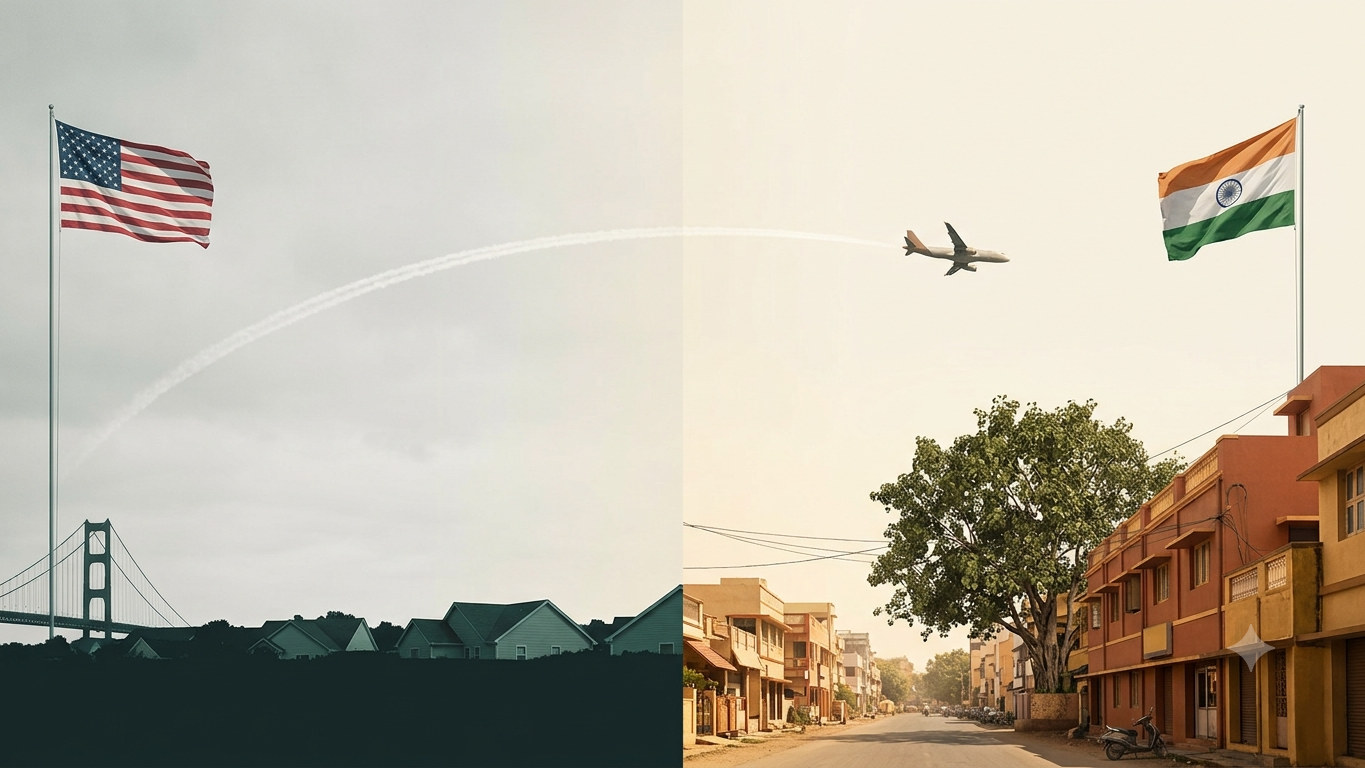
That idea stayed in the background for some time. The first major practical trigger was business. Her India-side textile work accelerated enough that she was coming to India every month for a period. She repeatedly took the nonstop San Francisco-to-Bangalore flight, often with a small child, and it became exhausting.

"I think I'm doing this upside down."

Her conclusion was that if the business center of gravity was in India, it made more sense to live in India and travel to the US rather than the other way around. But even then, she still had not fully committed to moving.

The real emotional break came after her father passed away two years earlier. On the flight back to India for the funeral, she says she suddenly felt the full weight of living far away from home. She had taken that flight many times before, but this time the distance landed differently because it was tied to loss and emergency rather than a planned visit.

That same section of the transcript also reveals a second pressure point: healthcare. She says that in the town where she lived in the US after COVID, it was difficult to find specialists, and in one case she faced a four- or five-month wait. Insurance felt like a gatekeeper. Instead of waiting, she flew to India, got the needed care, and flew back.

How did she make the move without forcing permanence?

Her first move was mental, not logistical. She told herself she would do the return one academic school year at a time. That framing mattered because it removed the pressure to declare the move permanent before she had actually lived it. By the time of the interview, she says she was already in her second year and was glad she had done it.

Location was easier to solve than administration. Her family and business were both in Tamil Nadu, so she always knew that if she moved, it would be there. During COVID, she had already built a house in India as a base for visits, so once she decided to return she could simply move into it.

On the US side, the most important admin decision was the house. For the first six months in India, she did not decide what to do with it because she wanted the option to go back if needed. Only after six months, when the move felt right, did she rent the house in the US.

How she reduced risk during the move

  • Time-boxed the experiment: one academic school year at a time instead of declaring it permanent.
  • Used an existing India base: she had already built a house in Tamil Nadu during COVID.
  • Kept the US house flexible: no immediate sale or final move-out decision for six months.
  • Moved lightly: critical items in a pod, most furniture left with the tenant, car sold quickly.

She also says she did not bring much material stuff to India. The important items went into a pod. The tenant was happy to rent the US house with furniture, and the car sold in one day because the post-COVID secondhand car market was strong.

The one place where she becomes explicitly cautionary is tax planning. She says the NRI-to-India-resident transition changes tax consequences over time, so people need a strong tax person in the US and another in India, ideally someone who understands cross-border NRI situations. If that is your immediate bottleneck, use our financial checklist for NRIs moving back to India and the broader return-to-India planner guide before acting in sequence.

What feels better and worse in Madurai than in the US?

She lives in Madurai, which she describes as a second-tier city in Tamil Nadu. The trade-off starts with connectivity. Because she is not in Chennai or Bangalore, every international trip usually requires an extra connection. She says that adds some complexity, but for her it is a small price to pay for being closer to family and business.

She also found an unexpected productivity advantage in a smaller city. With fewer distractions around her, she says she gets more work done and feels more focused. That is a useful counterpoint to the standard assumption that only a metro can support a serious return.

What does she miss from the US? Mainly the weather and the ease of getting things done quickly. She likes cooler weather and says procurement is generally easier in America. But the trade-off she accepts is that India gives her community, and the slower procurement of things like specialty ingredients no longer feels decisive.

Area What she values in India What she still misses from the US
Community Childhood friends, business groups, and more organic socializing Nothing comparable was highlighted as a strength
Healthcare Easier access to doctors, hospitals, and specialists High-quality doctors still exist, but access could involve long waits
Daily life Household services, delivery apps, and practical support Faster procurement and smoother convenience systems
Environment Closer to family and business in Tamil Nadu Cooler weather

The healthcare section of the transcript is one of the strongest parts of the story. She says that in the US, specialist access in her town became difficult after COVID and insurance often controlled what care was possible. In India, by contrast, she sees easier access to excellent medical care as a major advantage. If healthcare is one of your own move triggers, pair this story with our health insurance guide for NRI and OCI families.

Community matters just as much. She says it was easy to plug back into childhood friendships and business organizations in Madurai, and that she finds the US slightly isolating by comparison. She also prefers how socializing happens in India without always needing the structure of advance playdates.

How did her son adjust after moving from the US to India?

She is clear that the move was more of an adjustment for her son than for her. For her, India is home. For him, India had been something he visited and spoke the language of, but not the place where his everyday life had been built.

His early observations are exactly the kind of concrete details parents remember. He found India loud. He was surprised that the roads were shared with goats and cows. He asked why all Indians had black hair. His first Christmas in Madurai shocked him because there was no snow. These are not dramatic problems, but they show how even culturally connected children still experience India as a new environment when they arrive from the US.

She says he is in IB, and the biggest adjustment in school was scale. He had been in a small private school on the US west coast, whereas even a smaller Indian school felt larger than what he was used to. It took him a few months to settle, but he made friends quickly.

What helped the child transition go better

  • He already spoke the language and had visited India before.
  • He is naturally social and made friends quickly.
  • Internet culture gave him common ground with kids in India.
  • The family treated the move as an adjustment, not as something that had to feel effortless.

Her observation about the internet is worth noting. She says children in India and the US now consume the same YouTube creators and media, which creates more common ground than earlier generations had. If your own return depends heavily on schooling decisions, use our best schools in India for NRI kids guide and the deeper IB vs IGCSE vs CBSE comparison.

How does India feel for business and work culture?

On pure business setup, she thinks the US is easier. Her example is straightforward: in the US she could go online and register an LLC quickly. India, in her view, still has more red tape, even though it has become much simpler over the last 10 to 15 years.

Where she becomes more specific is corporate culture. Because she works in textiles, which she describes as a more traditional industry, she still sees hierarchy in a way that feels dated to her. She gives a small but telling example: if the boss is still in the office, people do not always feel free to leave even if the day's work is done.

"If you've done your work, just go at 5."

Her point is not that India is broken. It is narrower. She thinks India has improved administratively, but that sectors like textiles can still learn from the West on workplace culture. At the same time, she finds that being in a smaller city keeps her focused and productive, which suggests that business performance and lifestyle quality do not have to be in conflict.

What should NRIs learn from this story?

Her clearest advice is to be explicit about intent. Why are you moving back to India? Is it family, health, child-rearing, business proximity, community, cost, or something else? She says you need that clarity for the move to work because otherwise you will evaluate everything through confusion.

Her second lesson is psychological. People who left India decades ago often carry a frozen picture of the India they left behind. She says that old cultural memory can distort present-day decisions, because many NRIs are still comparing the US to the India of the 1990s rather than to India as it is now.

1

Define the actual reason for moving

Do not say only "we want to come back." Say whether the driver is family, children, health, business, cost, or belonging.

2

Reduce risk instead of chasing certainty

Her one-school-year-at-a-time model and six-month delay on the US house are both examples of lowering risk without forcing a premature permanent commitment.

3

Plan the tax and residency transition early

She repeatedly warns that cross-border tax status changes over time and should be handled with strong US and India-side advice.

4

Re-evaluate India as it is now, not as it was decades ago

Her experience is that some parts of India are more technologically convenient than many NRIs assume.

Her biggest pleasant surprises also support the practical side of return. She says household support in India can run almost on autopilot, which frees time for more strategic work. She appreciates how warmly Indian society treats children, the stronger sense of community, and the everyday usefulness of delivery apps and domestic help.

Related guides

Moving back to India from the USA

The broader US-return checklist covering taxes, banking, housing, school timing, and move sequencing.

Financial checklist for NRIs moving back to India

Useful if the next question is accounts, residency status, cash flow, insurance, or staging the move.

Health insurance in India for NRI and OCI families

Relevant if healthcare access is one of the reasons your own US-versus-India decision is shifting.

Best schools in India for NRI kids

Helpful when your return timeline depends on school fit, curriculum, and child adjustment.

Frequently asked questions

Why do some NRIs move back to India after living in the US for decades?

In this story, the move did not begin with one dramatic collapse. The guest says the first seed came after she had her child and started thinking about what it would mean for him to grow up without the multigenerational family environment she had known in India. The second factor was business. Her home-textiles work in India grew to the point where she was flying from San Francisco to Bangalore repeatedly, often with a small child, and the arrangement started feeling backward.

The final trigger was emotional and practical at the same time. When her father passed away two years earlier, she took the same US-to-India flight she had taken many times before and realized how far away from home she really lived. For her, family distance, business proximity, healthcare access, and community eventually outweighed the convenience of American systems.

How can you test a move back to India without treating it as permanent from day one?

Her method was simple and psychologically useful: she did not frame the move as a forever decision. She told herself she would do it one academic school year at a time. That reduced the pressure and made the transition easier to attempt honestly. By the time of this conversation, she says she was already in the second year and was glad she had moved.

She also preserved flexibility on the US side. For the first six months in India, she did not make a final decision on the house in the US because she wanted the option to go back if needed. Only after six months, when the move felt right, did she decide to rent the house out. The point is not that everyone should copy her exact timeline. The point is that a phased return can lower decision stress and reduce the fear of irreversible mistakes.

What should NRIs think about before deciding what to do with a US house when moving to India?

This guest treated the house as a flexibility tool first and a rental asset second. She deliberately kept the decision open for six months after moving to India because she did not yet know whether the return would work for her family. Once she felt settled, she rented the house in the US. That suggests a useful rule: do not rush into selling, renting, or emptying a property before you understand whether the move is stable enough to support that choice.

Her broader household move was also minimalist. She did not bring most of her belongings to India. She kept only critical items in a pod, left a lot of the furniture in the house because the tenant was happy to take it furnished, and sold the car quickly in the strong post-COVID secondhand market. The operational question is not only real-estate strategy. It is how the house decision interacts with flexibility, furnishing, storage, and timing.

How do children adjust after moving from the US to India?

Her son had been born and raised in the US, so India was familiar only through visits and language, not daily life. She says the move was more of an adjustment for him than for her. He noticed concrete differences immediately: the noise, the roads shared with goats and cows, the fact that everyone around him seemed to have black hair, and the shock of having no snowy Christmas in Madurai. The biggest school-level change was scale. He moved from a small private school on the US west coast into a much larger Indian setting.

At the same time, the transition was not framed as a failure. She says he is friendly, made friends quickly, and that internet culture created common ground between children in the US and India. He is in IB, and although it took a few months to settle, he adapted. Her story suggests that adjustment can be real without being catastrophic, especially when the child has language familiarity and social ease.

What felt better in India than in the US after the move?

Her answer centers on two things: community and access. She says the US is designed for convenience, but not necessarily for community, whereas in Madurai she could plug back into childhood friendships, business groups, and a more organic social life. She contrasts Indian socialization with the American habit of arranging playdates in advance, saying she prefers the easier, less structured way people gather in India. She also valued the way society receives children and the sense that the metaphorical door is always open.

The second advantage was healthcare access. She describes a situation in the US where a needed specialist had a four- or five-month wait and insurance acted as a gatekeeper. Instead of waiting, she flew to India, got the required care, and returned. After moving back, she says the ease of reaching hospitals, doctors, and specialists in India felt like a major advantage, even though she still misses cool weather and the ease of procuring things in the US.

Planning your own US-to-India move after years abroad?

If your decision depends on taxes, what to do with a US house, school timing, healthcare, and how to test the move without overcommitting too early, put the sequence on paper before emotion decides the timing for you.

Open the Financial Blueprint

Book a 60-Min Call

This is most useful if your family is weighing community, healthcare access, child transition, and cross-border admin at the same time.