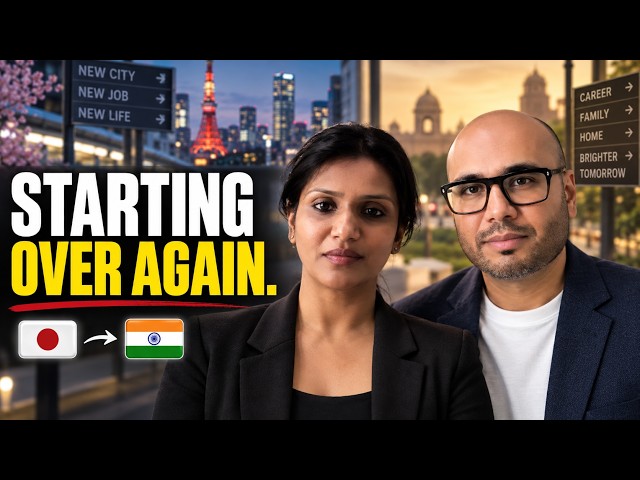
Watch: Do I Regret Moving Back to India? 10 Years in India and Back to US - Gayatri's Journey
10-year India-return regret case study: what went wrong, what could have been tested earlier, the staged-move plan that reduces risk, and the 6-month landing checklist.
The full write-up, with the numbers and the links.
Chapters
- 0:00 Introduction
- 1:20 Background
- 3:15 Why move to India in 2015?
- 6:40 Career planning for the move
- 10:07 Logistics planning
- 14:18 Making the decision?
- 15:40 Financial planning
- 17:34 Why homeschooling in US?
- 22:17 How was life in India?
- 29:04 Children transition
- 33:53 Language adjustment for kids
- 37:40 startup journey in India
- 42:10 Struggles in India
- 46:42 Why move to the US in 2025?
- 50:52 High schooler adjustment in US
- 53:27 Advice for future aspirants?
Transcript
Auto-generated captions, lightly cleaned
0:03 Why you're moving has to be strong and clear. So my elder one went to multiple schools in the US. So he was like you know labeled as naughty labeled as behavior and emphasize a lot more on that. It was beautiful. We were having our suddenly it felt like you know 24 hours is very very long. Whereas in the US that me and my husband consciously decided was not to say anything negative about it opens the doors for both Indian universities and abroad since I come from a non-corporate background my startup journey was a struggle because India and here is friendships are very strong in India the last 9th 10th 11th 12th that my son picked up were the best for him which we never thought would work. I totally empathize. Mo is not easy because I've just made one.
1:22 Hello everyone, welcome back to another episode of DIY return. Today I'm really excited to have Miss Guyri on our show. Miss Guyri spent almost a decade in US before the family has decided to move to India and after spending another decade in India, family has decided to move back to US. They're currently living in US right now. But this is an interesting story that I want to get into especially when they moved the kids are young how they went through the adjustment you know academics and now they are in college so trying to understand the journey which lot of people have questions about and also understand the reasons to move back and why back to us again and I'm really looking forward to this discussion and glad to have you with us today really appreciate you being with us today on on our show >> hey Thank you so much Avin for having me here. So I think this is the like I have spoken on many stages regarding
2:23 Work and I've done corporate sessions, keynote speaking and all that but this is my first talk where I'm show sharing about my return to India journey which is very very close to my heart. So I'm super excited and grateful to you. >> That's great. I'm really looking forward to our discussion now. So let's start a bit about your background. What made you to move to US initially? your professional background. let's start with that. >> Okay. So, initially it's the same story that all of us have. I got married. so after 3 months or I think 6 months into our marriage, my husband got a opportunity. He used to work for Deote and he moved to the US. So I also moved along with him. so nothing big story or anything there. We were very young. So we thought like you know that exposure and the savings and you know
3:15 Living in a different country we would learn we would evolve we would grow and we moved. >> Yeah. >> first was to UK. So in UK we were there for about one and a half two years and then moved to US. >> Got it. And how was the life in UK and US? >> So UK was good in certain terms like you know close to home. So I traveled very frequently to India. all that was fine but when we moved to the US it was more convenient because in UK we used to live in central London. So we used to take the subways all the time. so when we moved to the US it was like you know smaller home to a bigger home from you know taking the public transport to owning a car. So it had its own you know differences but we embraced both. We enjoyed both UK and other biggest advantage we had
Read the full transcript (66 more sections)
4:16 Was we traveled quite a lot across Europe. So every weekend we would visit one country and covered that up. So that was exciting but US had its own now beauty to it. >> That's fantastic. So sounds like I think you are having a good time. Things are going smoothly. So what brought you to India after a decade? >> Okay, I always had my one foot in India. So every year we would think we would go back for that somehow move to 10 years in the US and so much like my foot was always in India so much so that I delivered both my kids in India. So living in the US, I traveled to India for my deliveries. traveled in my end of my sixth month. so my elder one I brought him back when he was 3 months old and my younger one I brought him back when he was 5 months old. So that that calling of going back to India was always stronger. So we finally
5:18 Decided when my son was in grade four he was completing grade four we thought it is the good time to move back so he can start his grade five back in India and we moved back to India and there was no looking back at all. >> Got it. thoroughly enjoy it. >> Fantastic. So, sounds like I think you always have the idea or you know interest to move back. I kind of subtly intended like I think when your kid was elder kid was in grade four. Is there any trigger point like why exactly at that point and why not earlier or why not later? Anything that can help you in making that decision? See there was no trigger point as such but we thought the higher grades he moves on it will be difficult for us to transition to Indian education system but before that Abin I would like to mention that my sons were homeschooled in the US so they so he went to multiple schools we had our own challenges with the public school system
6:20 So we kind of pulled him and started homeschooling him so we tried preschool preschool experience was really good. But then when he started kindergarten in one of the schools, I had some issues which we were not able to solve. then we tried we moved from one community to the other. We
6:40 Tried another school the issues were repeating. so we then finally I didn't want to take that negativity anymore because see as a parent right so whatever you hear from and especially when you're very young you're naive you don't know a lot of things about parenting and all that so I strongly believe that when the child was born a mother in me was also born so I was start like you know I was matured as a wife I was matured as a daughter daughter-in-law and other roles that I played but as a mother I was also born right so I made my mistakes. We realized certain things were not working. So we started homeschooling my son. so that was the background to it. So when he was in grade poor age, we decided to go back. One reasons behind that was like you know the more delayed it might be difficult for him to adjust and my younger one was just stepping into the school. So we thought like you know that would be why expose him to the
7:42 American schooling system and then make a change. Everything put together we thought that was a good moment and we had bought a house in Bangalore. So we were getting the possession that year. So everything was falling in place and we thought like you know might as well move right now. >> Got it. Makes sense. So maybe you can talk a little bit on the move itself like the move to India from a planning perspective. So I think you kind of touched about the reasons to move. Maybe something on a career your profession your husband's profession like a career planning if you can touch on that that would be very helpful. >> Sure. so Amnesia I was here I was not working. I chose not to work because I wanted to take care of my kids but I volunteered a lot like I used to volunteer at the library was to volunteer with couple of organization. I taught Telugu to kids because that's my mother tongue. I volunteered at a Hindi school like Gurukul in Seattle. So that gave me a good idea of what my
8:43 Calling was. But I am a MBA grad. So I didn't pursue anything related to my MBA in the corporate side. But this experience of volunteering in Syaki gave me an idea or the clarity that early education space was my calling. education space was my calling. And since I homeschooled my kids, I also had to learn about different curriculums and different ways to teach the child. That gave me again few insights into education creating curriculum moving from one pedagogy to other pedagogy. What works for my kiddo. So that gave me a good understanding. So what I thought when we were moving was to do something in the education space when I moved to India. Got it. So and I lived in the US in the era where H4s were not allowed to work.
9:34 >> So that was another reason when my kids grew up I wanted to explore but I didn't have a chance to explore because of the visa issues. Got it. >> So when I was moving back to India that also gave me another excitement that I don't have anymore of immigration issues to take care. There is no restrictions as such what I would like to do. So when I so that was one and two we me and my kids moved to India my husband stayed back in the US till I found the job. So he moved only after an
10:07 Year. >> Got it. So there was a transition period to make sure that he finds the right job and >> so we didn't want to take that risk of like you know just moving back to India and then figuring out what he wants to do or anything. So he found a job and then we he made the move. So for me another advantage was I moved to Bangalore where my sister was living. So I had that family support when my husband was not around with us. >> Makes sense. So if you can talk a bit about like your husband's career, right? for example, was he able to find the job from US itself or did he take an internal company transfer or he has to you know come back and check the jobs in India.
10:56 >> so with him he was working for a boutique consulting company in Seattle where they didn't have presence in India. So he had to look out for a different company. So he started looking out for different companies. He in fact traveled once to attend an interview. They were aware that he was living in the US. So then once he got this offer then he resigned and he moved back. >> Got it. So he was able to secure the job while living in US only. Got it. >> So but we had to take some time. So we were away for a year or so. >> Got it. And any other things that you can talk about from a planning side from a financial planning or logistics planning? Anything that you can share from your journey? >> Yeah, I can definitely share. see certain things we planned was we took an entire entire container from the US to India. Okay. So the reason was one I'm familiar with this country because I lived here for 10 years. So I knew where I need I can buy certain things and when is the good time to buy I wanted to make
11:57 You so we had about like you know 6 to 9 months from the day we decided that we are moving and when actually the move happened. So I had a lot of time so I could plan and I already knew where I'm moving to right my our house was under construction so I kind of planned what I want to take so my husband traveled to India in between for work so he kind of did the financial analysis back in India for a similar kind of furniture or similar kind of setup how much would it cost and if we shipping from US to India how much would it cost so one is that And second the ease of buying the furniture or buying anything right. So in India I'm away from the country. So even when you are so I visited very frequently to home but when you're visiting your mindset is different. When you're moving and settling down your mindset is different. So I never bothered about what kind of kitchen items are available or what kind of
12:58 Furniture is available in India. So if I had to go do entire my shopping back in India, I had to do my homework. reach out to people etc. But whereas in the US I already knew where to buy, what to buy, when to buy. So we went ahead, we decided though we were moving personally, we were not doing any internal transfer. So we were aware that we would be going through that expenditure of shipping everything from US to India. So we kind of were okay with that. So we shipped pretty much everything from US. So that way what happened was I did not let go of any of my good things from here. So we carried everything. >> Okay. >> Okay. So one suggestion if you're shipping keep all your bills ready so that you will be able to show when you bought it and you know to the customs. So it's not brand new or anything. So we had 6 to9 months. So my
13:58 Furniture was always shown as 6 months old furniture. So we tried it, we used it at in Seattle and then we shipped it. So in case if we didn't like it, we can we could return it immediately and all that. So that was one thing. And two, always understand if you're moving with your family, if your kids have
14:18 Certain emotional attachment to certain things, I would always say take it with you. It's okay. Even if you're spending a little more on your shipment, even if you're not deciding to do an entire container or few boxes can be shipped, that gives them the familiarity into the new place. So my both kids by then they were like, you know, 8 and five. Yeah, eight and five. Yes, 8 years and five years. Close to nine and six. So they wereious readers. They loved the library. they loved the children book collection here. So what I started doing was collecting as many books as possible before we made the move for them to create a small library inside our co because I can't have a public library that is not in my control but whatever is in my control I wanted to create so I used the thrift stores I used the library sales wherever there were garage sale I would go around collect books and keep them and we shipped and we created
15:19 A small library for them. So this is just an example but if whatever they are attached to in the US if you can't take it say we can't take a public park but you can take a certain things and make their transition easier for children. >> Got it. Yeah. No thanks for sharing. >> So these are the things that I would say and but before that your why why you're
15:42 Moving has to be strong and clear. So decide, sit down with your family, talk to both of you have to be on the same page like both parents have to be on the same page. If the couple's moving, both husband and wife have to be on the same page. Make sure make sure you do your bucket list. So that's what we did like you know what are our like you know non-negotiables, what are our negotiables and everything. So for me my reasons the strong reasons why I wanted to move back was belongingness closer to family and my kids having a extended family. >> So my wise were very clear. So we decided to stay in Bangalore which is close to my parents' house and my in-laws house so that kids get to visit grandparents and grandparents get to visit often.
16:39 >> Yes. >> And two belongingness. I always felt I'm an Indian. I will be recognized always an Indian. Even if I'm here, get my US citizenship. People are going to recognize me as an Indian. I will never become an American. Even if I carry an American passport. >> So those two were very very strong for me. Family was the hook. >> Got it. Cool. anything on the financial planning side that you can talk about when you're moving like whether your house, your so like you know assets, anything? Yeah, it's better to have a house and move. because see comparatively I might be completely wrong also but my experience India is expensive. >> Yeah. Cool. >> schooling, your home, your eating out most of the expenditure that you go through in a month except for your rental India is expensive than living in
17:36 The US. but at the same time it again depends on your lifestyle that you pick up for yourself right so you can put your children in IB school which is quite expensive you can put your children in CBSC school and manage your finances etc but I would say have a rough idea about how much is going to be your monthly expenditure in India how much of a runway do you have and what kind of investments you want to keep in the US and move out like you know your 401ks or whatever it is right so those things and again always look at your visa status as well when you're making that decision if you're a citizen you have a GC then things change a little bit but if you're in visa it's a different plan altogether because you cannot come back once you make the moves right for citizens the option of coming back is always open >> yeah for sure >> so my in understanding of the entire
18:38 Journey and returning back now also the why is very strong. >> So anytime I feel down I look back at like you know why did I even make the move. So if that why is taken care all will fall in place. >> Yes. Makes sense for sure. The why has to be so strong. so maybe before going on to the next chapter of your life in India there is one thing that I wanted to understand a little bit if you're okay is the experience of homeschooling. I know you mentioned a little bit about the experience on the public school because you being a in the education sector. If you can explain your experiences if you're open to that you know from your public school and then the homeschooling in US I think that could be helpful for some parents who are thinking about that option.
19:23 >> Yeah sure. see my kids had u as like my younger one didn't try any schooling so I can't really talk about it. It was very small. but my elder one went to multiple schools in the US. So he was like you know labeled as naughty, labeled as behavioral issues because he wouldn't stand in the line. he wouldn't listen to the teacher, he would finish his work faster and you know he would look out for what else he was fidgety and all that. So he was neither could be categorized into autistic or ADHD. nor he was on the regular side. So there were certain challenges that he was facing. So they couldn't put him on an IEP because there was no diagnosis but he was in that phase of life. So later we figured out that he was not challenged enough.
20:21 >> Yes. Yeah. >> So he would just finish off his work and then obviously he's just a five six year old, right? He needs that physical movement. he needs that stimulation. So that was not provided. In fact he would be seated aside in the classroom. He would be alone so that he will not disturb other children. That didn't go well with him. >> So then we homeschooled then we figured out a lot of things for him. So increased his physical activity, increased his you know I because I was handling him I knew suppose I would give him a worksheet on math he was able to finish it faster. I would you know quickly change it to a challenging in the same concept I would give him even more challenging one etc. So meanwhile I was also part of homeschooling groups in the US which helped him to have that social interactions and company and there was one school in Seattle I exactly don't
21:21 Remember what term it was called as so they provided certain classes for homeschoolers so I enrolled him for pottery I enrolled him for certain classes there so where he had a formal classroom setup but not for academic subjects but for other extracurric particular things. So that gave him good social exposure. So one advantage that I see because he was homeschooled is he doesn't have this criteria of okay I will only mingle with my age group. >> Yeah >> that was the biggest advantage he gain. He can interact and play with younger kids. He can talk to older children. He can play with older children. So that was something that I observed as a good advantage. And when we talked to our kids about we were moving back to India, the first question, the first thought that came to my elder son's head was
22:17 I would like to go back to school. So we tried to understand why because whenever we visited India, the first question people would ask is which standard do you go to? Which school do you go to? Do you like your school? That was a common things. So he felt he would be more accepted if he went to school. So we thought we will give it a try because I was not against school or anything. >> We were not able to find the right fit for him. So we homeschooled him and second even I felt because during that time this was like you know 12 years ago so not even 12 years yeah 2015 10 years ago when we moved India may that homeschooling concept was not very strong though I had met few families who were homeschooling but we were not sure how things would be if he wants to take up boards or if he wants to take up competitive exams or We were also not clear on that front and he also came up
23:19 With he wants to go back to school. So we decided to send him to school. So since he went the younger one also automatically went to school. >> No thank you very much for sharing that and it's so subtle right how these kids are so observant and you know the questions that people are asking him that he was so particular that he wants to join the school. So so let's talk about your life in India. So how was the transition after a decade living abroad? you know the initial phase later and know maybe you can talk about the overall experience and the journey. >> see Vinach it was really really good. I can't emphasize a lot more on our family close by and you know I was so kids went back to school suddenly it felt like you know 24 hours is very very long whereas in the US it was the other way around like you know I would wake up in a fraction of a second I would feel like you know the day has
24:19 Come to an end because I was homeschooling them I was running my house I was volunteering I used to take my kids everywhere I volunteered so there were lot of things they were very small there was no house help right so suddenly it's the other extreme like you know where my house is taken care my health is taken care you know everything was taken care I felt suddenly like you know my days are very long I was very peaceful because as a mother when my kids so they were very small right especially my younger one when he was four he would spill water for example which is very common for children the first thought that would come in my mind is oh my god I have to clean this. So obviously that anxiety or whatever that stress or that emotion end of the day it was passing on to children whether I say it or don't say it they can absorb my emotions.
25:14 Yeah. >> So that was you know liberating for me. Okay now I'm telling my kids it's okay let's clean it or we can ask auntie to help us clean. Right. So that was a big shift in my parenting. So I became calmer. I I was spending a lot more time with my children than what I was doing in the US. so that was very helpful. My parents were visiting us. My grand you know both set of grandparents were visiting. We were visiting. My sister lives in Bangalore. So kids got to know the extended family. All that was really good. And eventually I started my ventures. I thrived my ventures. So one of my ventures incubated at Indian Institute of Management Bangalore. So I had the best mentors from the academia and as well as from the industry. We recognized by Startup India. All that happened because of the
26:15 Support system that I had. >> So even when I had to travel, I didn't really have to worry about my kids back of see for especially mothers, right? It is always there at the back of your head that you are ignoring your children. Guilt is very very embedded into our DNA. If we are sitting at home, we are guilty that we are not doing anything. If you're waiting, we are guilty that we are not taking care of our children. So that kind of managed because of the good >> Yeah. So thank I was very fortunate to have somebody who took care of my kids like you know extended family but at the same time I also took care of her very well. So it was always a give and take right so that is one I would say and second point that me and my husband consciously decided was not to say anything negative about India. Okay?
27:14 >> Because what we speak, what we think is what our children are going to absorb. So for me, I have the love towards my mother country. But for them, India was not home until then. For them, US was home. That is where they grew up. That is where they saw the world. That is where they developed certain perceptions. So if I tell, "Oh man, it is so filthy. It is so crowded. It is so dirty." then they will also pick it up. >> So we would crib among ourselves but never show it to children. >> So we were exa we were always excited about certain things and they also started being excited about those things. So we would say like you know come on let's run and go play outside.
28:03 So that was very interesting and very exciting for them because in Seattle gloomy weather dependent on me to go outside here it's like you know either if I'm busy the other lady who's taking care of my kids can take them outside. So if I am available they're super excited to come play with me. There are lots of kids again the place you choose matters the most for all these. So if you choose a good vibrant gator community then everything is taken care. You are not driving your children for classes. You're not worried about safety and security. Children can go out and play by themselves. So for them those things were very very exciting where it's like you know without you know a lot of organizing or play date. They're just walking out and playing.
28:50 >> So what else does a child want? Child doesn't know whether it is dirty, it is poverty country or a third world country or anything. Children have a very small world. If you can make that world happy. Play is something that comes very
29:04 Naturally for children. That is how they were born, right? So they are not born for a super good infrastructure or like you know great things available for them. That doesn't really matter to them when they're instinct of being a child is taken care. That is where I worked on. >> Yeah, it's a very good point. I mean I really appreciate you kind of highlighting that like you know how you and your husband have made it conscious decision not to talk I mean I think it's a subtle point but it's an important point you know thanks for highlighting that I really appreciate it so my journey in India was so we were happy but another thing it's the family that matters your family dynamics matter with your extended family I know a lot of women who moved after me I have talked to them but they couldn't sustain because of toxic in-laws or whatever reasons, right? They ended up moving back to the US.
29:59 >> I mean for me that was not the case. >> But again relationship takes time to build. It comes from both >> efforts from both set of children and the parents. So we had our own adjustments we had our own you know compromises to make but again the why was very strong. >> Yes that's a crucial one. So let's talk about I think the children's adjustment right someone who has been in the homeschooling like which curriculum you have selected and how did you select and then the journey especially now they would be in the college so you know trying to understand >> my elder one is in college younger was in younger one is in high school >> high school yeah so if you can talk through their journey like how they adjusted languages you know the curriculum and so on I think that would be very helpful >> okay so Avin as usual whoever is going from US or any country going to India.
30:58 The myth is that IB is the curriculum to go for. So I also followed that race. So we ended up with an IB school for my son when we moved to India. So within an year into IB school, I also understood that IB is more so this was back then right 2015. So things have changed right now but so 2015 when we moved I kind of understood IB is not for kids who want to settle down in India. Yes. So most of the kids were talking about going abroad for their undergrad itself. >> so slowly then I also figured out that IB school kids are a little affluent luxurious and all that. So because of various reasons I pulled my son out of IB and moved into CBSC. So with that see I would like to highlight this point for all the parents who are considering and
31:58 Feeling petrified about CBSC. I would like to bring one point here. So CBSC yes there is rope learning and languages are difficult but at the same time it opens the doors for both Indian universities and abroad. No abroad university will stop a child taking a SAT and coming to US. >> So when you have younger children like when my son was in grade five I was not sure whether he will come to the US for a higher education or he would prefer going to Indian colleges. So we were not aware right grade pine is very very young to even to think about what so I didn't want him to be like you know certain clo doors to be closed for him so we moved him to CBSC and what one reason second CBSC is way affordable than I so for me and my husband we only didn't think about affordability we could have afforded but we could have
32:59 Made certain compromises on other things and continued with IB school till 12th but what what cost and what was our priority so think why do you want to continue with IB school yeah >> so if that why is clear then it's okay to spend so much but don't fall into that trap everybody is going for IB school and get into that school and later realize see in Bangalore on an average an IB school cost 6 to 7 lakhs per year for a middle school and for high school it is on an average 12 lakhs if you have two kids So 25 lakhs per year you have to keep aside for their education. It is only school now. Then comes extracurricular activities. Then comes your t support tions etc. Right?
33:44 So I didn't want to fall in that trap and feel pressurized for the other things. So and another reason CBSC gives you that openness for both. And for me
33:55 Luckily my next door neighbor in Bangalore her son finished CBSC and he was in US. >> Got it. a data point. Yeah. >> And there was there were lot of stories that I started hearing then we made the shift. Okay. CBSC and IB the knowledge wise there are some gaps. I agree on that. I will not deny that. So what we did as a family was the extracurriculars that we picked up. We picked up some things that will bridge the gap that the CBSC was leaving for our kids. So they did sport, they did music outside, they did a lot of so there was a program called communication for an year. So they did that they were part of toast masters, they were part of some you know public speaking sessions etc. So that's how we kind of balanced it out and these days metros have a lot of options for kids and since I was also into education maybe that was easier for me to you know figure out what options
34:57 Were there for our children. So by grade seven my son was in CBSC. So he completed his till grade 12 in CBC and he wrote Indian competitive exams and he got into one of the top colleges in >> Fantastic. So maybe the transition from a language right for your elder son especially in grade six and grade seven when he switched you can talk about the second language, third language and how he cope cope up with those requirements. >> Yes. So for parents even if you have an iota of idea that you're moving to India get them started with Hindi. So which I did not do a lot because I was not very good with Hindi but I took him to Gurukul where Hindi was introduced to him when we were in Seattle. So when I moved back so he was in IB so he picked up Spanish. So later we moved him to CBSC Hindi was mandatory for him. So what we did was we hired a onetoone tutor. So she started off with a e. So
36:00 Within 3 months he finished off bar and all that. So what I'm trying to say is if you know that you are moving or even if you are not moving having another language in their head is always good for their brain development and knowing one language from India will give them some emotional attachment to the country. Right? So two if you are moving that will help them academically as well. So get a one-on-one tutor. Don't go for group sessions because they will know how to work with the child. So that's what worked for me. Group might work for somebody but it worked for me. So I also closely worked with the teacher. So right from LKG to grade six, we finished in two years. >> Got it. >> That's a transition that he has until grade seven.
36:47 >> Yes. Yes. And another thing for if you are picking up CBSC or stateboard or any of it, you will have to be smart enough to teach your child how to attempt the paper. So for my son, he was coming from a non-Hindi-peaking background. So writing was a challenge and already for him writing is a challenge whether English or anything writing is a challenge. So Hindi was even more challenging. So I sat with the teacher looked at the previous year board papers. So you kind of understand that 40 mark so 100 marks paper may 80 is your return 20 is your internals so work on that 20 so at least you'll get 16 17 >> right so in 80 40 marks is your grammar 40 marks is your theory so 40 marks grammar is easier >> so 40 by 40 you have one so you're 16 +
37:42 40 you're already passing >> passing yes >> so it's quite easy but you need to have a plan you need to have a strategy how to approach the exams. So my teacher was his teacher was very good. So even for the questions right she taught him like you know half of the question you copy and write your answer. So at least half a mark you will get instead of zero. >> So multiple halves will give you four five. for sure. >> So you need to have a plan. You need to have a strategy. That's all. The fear is something is not going to help. >> I keep reading online like you know oh my god my kid has to learn Canada if I have to go to Bangalore my kid has to learn Hindi if I have to go to Bangalore. But see it as you're adding two languages to their kitty.
38:32 >> Don't worry about marks when they get 60 also appreciate them. So the stress starts because the the children are so scared for languages because parents are expecting that kind of marks. If you can give that ease if you can help your child and don't talk about marks but keep doing it you will thrive. But at the same time I'm not saying you'll get 98s and 99s which is the standard norm in India. I'm not aiming at that. Got it. So let's I think switch gears a bit and understand about your professional journey like you know thriving that entrepreneur role I think you know giving that flexibility. So if you can talk a little bit about that I think that would be helpful. so Avin when this comes right I proudly say you might have met mothers who say that they don't have a career because they became a mother because they wanted to take care of their children and all that but I proudly say I am a entrepreneur today because I'm a mother because whatever I
39:33 Do is based on what experiences both my kids have given me. So because of the homeschooling experience and my son struggled a bit in reading. So I learned how to teach him to read. So that is my literacy be curriculum phonics spelling rules how to teach a child how to comprehend work how to write on their own. So my entire curriculum is something the foundation is something that I did with my elder son to teach him how to read on his own. okay. So I started off as a phonics teacher. So I used to teach phonics to children. then eventually fast forward four five years that company became a education consulting company where we worked with schools training their teachers, enhancing their curriculums, finding what are the gaps that the teachers have and filling in those gaps for workshops. then
40:34 We had multiple programs. So in the quest of you know searching to bring the balance what the CBSC was leaving the gap I so even if I couldn't find one for my kids I developed one. >> So so my both my kids were part of my classes and we would you know have other kids also join the classes. So that's how buzzing bees grew into an education consulting company. So I worked with about 3,500 families so far through different trainings, workshops and few corporate sessions. So and I kind of realized when my son was 56 is when I realized whatever I'm doing with my parenting is not the right way to approach. So I read a lot on parenting how to become a better parent. So then I got myself certified as a parent coach. So I extend those services through busing bees and later our phonics program English enrichment program became so strong and
41:35 So popular in Bangalore. I had to start literacy bees that I pitched it with IM Bangalore and I got incubated there. So that became a all a standalone company by itself where we have our own workbooks to teach you know English to children. because unfortunately fortunately English is treated as a language of is not treated as only a language. It is treated as sign of intelligence. >> So when you speak well people look at you as you're intelligent. When you don't I don't know why it is only for
42:10 Indians right. I have seen many Chinese who have translators who don't speak that great English but they're still valued respected but when it comes to Indians we kind of see the other person as the first impression that we have is on their language so how do your language get better when you read better when you read when you understand better when how do you understand the way you read makes the difference so that's where the whole literacy bees was born we have our own word books we train teachers we of our classes for English enrichment. Then we have board games that we will be launching soon in English. >> So that's a bit about my journey. So nothing was planned. Everything happened very very organically. And that's why I always say when you don't have constraints, when you don't have restrictions in your head, you move forward very freely with a free thought.
43:05 >> Yeah. So congrat no vision, nothing. like in fact when I started I didn't even know the name so eventually we named it so then we had registered then so all things took >> congratulations on the success and I'm sure I think you know it's the word of the month we will have the link so that I think people can check out and reach out you know if they have any questions and all that stuff >> so I know we have talked about lot of positives right a lot of you know thriving your professional kids enjoying the extended family the support system any struggle in the last 10 years you know living in India anything that you wanted to highlight >> definitely a commute is a struggle traffic jams are a struggle like you know and since I come from a non-corporate background my startup journey was a struggle because I didn't have the big names as I or you know I'm not an ex googler or I'm not I am
44:09 MBA grad or I didn't have like you know I'm not from a big corporate experience back in the US or anything I'm just a mother right so that was a struggle but we had to see there are many times I fell flat on my face but the only difference was I woke up I cried then wiped my tears and moved on so I will not say everything was easy but God gave me the courage to pick myself back And two with family. Yes. kids struggled a bit like you know when we were in Seattle if it was sunny that day. like you know even after dinner we would just walk or drive down for a ice cream. So I remember Cold Stone was their favorite. And when Cold Stone opened in Bangalore I was like let's go let's go there. Like it's okay for one ice cream.
44:59 We don't want to travel for half an hour. It's okay. We'll let go the ice cream. >> Right. So that was a emotional struggle that all of us went through and to I think the work culture was different for my husband. I don't know much into it. He would be a better person to talk about but yes it was a you know compromise on the work culture long hours of working etc. Right? So those were the struggles and then financially also right. So certain times it used to feel like what you're saving is what you're earning. >> So that adjustment had to be made. So it's all mindset changes that we needed to work on. So my kids were you know getting frustrated when we would get stuck in traffic. So then we created a small busy corner in the car. So where I had kept some art and craft and small books and some things for them to do.
45:58 So whenever we get stuck they would just pick up something and create something, drew something or played a game or I had to engage them like so like mindfully I had to engage them to keep them busy in the car so that they are not frustrated and sometimes they would get nauseated because of sitting in the closed environment for a long time. so we planned our days well that way. So we would not go to mall or anything during weekends because I had my flexible hours. So that is why I say like you know your experiences depend on on a lot of factors because I was not working full-time. So I could have the
46:42 Flexibility to take kids when they wanted and so initially we were renting a place and then we got our home ready and we moved. So till we moved we were in a much smaller place. So that was a big compromise for them from you know single family home in the US to an apartment in India. So that was a compromise and kids right. So my kids would stand near the park forever waiting for their turn. >> They would never get their turn. So eventually they learn >> how to manage. So we So during that phase what I did was only empathize with them. I never complained. I never said this is how India is, this is how children are or anything of those lines.
47:32 So we would be like huh it feels bad, right? I know you stood in the line for a long time. So what else can we do? So then they started taking their book. So they would read while they were waiting for their turn. So that their energies are you know diverted into some other than frustration. right. So that is when actually somebody in our community asked me how are they hooked on to their books and that's how my classes actually started. >> Yeah. Got it. So let's I think understand the strong why to move back to us right I think sounds like the life is going great you know thriving profession kids are doing fantastic the support system you got like you know systems in place to navigate some of the challenges that you know come along the way in any place so what changed and why back to us now >> so there are multiple reasons so we saw what my elder son went through
48:34 With J the IAT entrance it was rigorous very very competitive very very anxious journey okay so for him for us and for everyone but he finally made it to one of the good colleges though not IITs he made it to bits >> he was very happy then comes my younger one so till the last four years the focus was on the elder one because he was going through a tough journey which he picked up for himself. >> Okay. So then comes my younger one and says he doesn't want to take the traditional path. >> He wants to do something where he can build robotics and he can build. So he was not very clear as well. But one thing we understood was he is not keen on picking up you know the traditional path engineering or medical. So that was one reason and second my elder son mentioned that he would like to finish
49:36 His undergraduation and go to the US for masters. >> So that's when we kind of understood that you know maybe both kids will be going towards the US. >> So during all this discussion my husband got he is into AI innovation. So and last year is when the AI boom happened and during that time his company wanted him to move. So there were three big chunks that was kind of like you know showing of course I through my fit through my tantrum I didn't want to move because everything was going good and so my husband moved first so initially I moved then he joined so now this time he moved and later after 6 months I joined and so that was our why for kids education so because my younger one wanted to take a conventional route. We
50:36 Thought it's better for him to do high schooling here and figure out what he wants to do. Because see, India is really good with the traditional path. If you're taking engineering or medical, the colleges, the amount of academic rigor that children go through, the exposure that children get is really
50:53 Good. But if you're taking a non-conventional path, it's still evolving. So I wouldn't say it is not. It is definitely better than how it was when we were studying and now how it is. So all put together those three wise we thought we will make the move but I had to figure out my strongest why to move back because for me yes they are my world but there is a world for me as well right so otherwise I will not be happy as a person if I'm not happy then my family is not going to be happy. Then there is a lady called Dr. Chapali in the US. So she runs she is the OG of conscious parenting. So then I decided like you know I will do her one and a half year program when I'm here make use of my time here in the US. So I have enrolled for her level one of certification then I will complete the entire certification when I'm here. So that was my why when I like I figured out my why why I wanted
51:53 To move back. But it was like we never ever thought in our wildest dreams that I will move back. >> Yeah. Got it. So >> but life and God always have different plans, right? But I strongly believe that it is for our good. >> Yeah. So let's touch about I think couple of things. I think you are younger one who did you know most of the schooling in India. How was his adjustment in the high school in US? He was very happy because it's very easy. >> Because academic rigor in India is high. >> Right. But he also struggled culturally to an extent. but thanks to YouTube and other media exposure among children.
52:38 He kind of knew what he was getting into. He was aware of a lot of things that kids are speaking. So he knew something about you know American culture and you know shows and things like that because see now it is one world. It's no more like how it was when we see when I moved to the US for the first time I didn't know what yogurt was. >> For me it was always curd. Yeah. >> I didn't know what Mexican food was. >> Right. So for them it is not as challenging as it was for us when we moved to the US. But he had his own challenges making friends. See one thing I have observed with kids back in India and here is friendships are very strong in India.
53:27 >> Here it's more on the surface level or maybe that's our experience but it's more surface level. People are competing among each other. They don't share a lot of things. But in India we didn't come across that things. My kids had beautiful relationships built with their you know students in the school. they exchanged notes, they studied together. Though my son was writing his the one of the most toughest competitive exams in the world, not even in India, right? J is the top fourth or fifth toughest competitive exam. But both the kid his friend and he would exchange notes. He would they would study together. They would exchange. So they both went to different coaching centers. So they would exchange their question papers to each other so they get to solve more model papers etc. Right.
54:13 So that I haven't seen yet. >> Okay. And regarding your u ventures like you're still managing them while in US so yeah got it. >> No but I'm losing some clients so because out of sight is out of mind but let's see how it turns out here. I'm starting my classes soon in the US. So, so coming again back to where I started in Bangalore. So, we are starting our classes soon and then we'll take it forward from there. >> Okay. Cool. any advice or any topic that we haven't covered that you want to bring up that you want to share any future aspirants? Yeah. >> So, yeah. So, for families who are moving, right? So I would tell them don't go by popular opinions. Do your research whether it is school or whether it is home or whether it is going back to which city all that. See work first work on your why. If that is
55:16 Clear then all the other things will fall in place. So do your homework. Spend a lot of time on understanding the different boards available for schools. pick what works for your children. So I would suggest do your homework and it's okay even if you have to change schools every time you can't be holding on if your child is in third grade you can't see like you know yes this school offers till grade 12 but you never know if the priority changes if the personality of the child changes and then you might have to move to a different school. See both my kids never went to same school. >> Yeah. because of the different personalities, different priorities, one what worked for one may not work for the other. Right? So all schools are good.
56:01 Don't go for the best. All schools are good. You see what works for your child. >> The last 9th, 10th, 11th, 12th that my son picked up worked the best for him which we never thought would work. >> And I give complete credit to that school for where my son is today. >> Okay. Yeah. But people have hatred towards that school. But it worked for my son. >> Yes. I think it's finding the right right one for your kid like for here for his learning style and Yeah. >> Right. And two, if you're moving, I see a lot of families because of the visa constraints and like you know job issues, you're moving back to India. That may not be the choice that you made, right? But you're forced for that.
56:49 But embrace the change. Now I bring in this like you know what is in your control what is not in your control. >> right. So what is in your control you change what is not in your control don't try to change don't be try to beat yourself up when you are in that negative state or like you know not so happy about the move it quickly transfers to your children what mistake they did they grew up here they didn't ask you to bring them here we were the one who exposed them to the US and now we are the one who are the reason for them to go back to India so if you are in that state of mind it quickly transfers. So I totally empathize move is not easy because I've just made one right. So for me from US to India didn't take time at all. We were like you know day one we were happy like you know eating all the roadside food enjoying the health all friends and family being there but from Bangalore to US took a lot of time for me to even accept it.
57:52 But the change happened only when I accepted yes I moved. >> But what now? I stopped comparing like here I have to do my chores. Everybody does that. It's not only me, right? So everybody does that. So initially it took a while for me to even cook one full meal to do my dishes. So every time I felt, oh my god, where am I? Where am I? Where am I? Now I question why am I here? >> What is God trying to teach me? what is the lesson I can take forward. So first three months was all crying all downfall like you know I was there where am I now you know the women's day came when I moved so women's day was the busiest week for me like you know keynote speaking guest speakers attending all the networking sessions here I'm washing dishes >> it's not easy right especially for the women it's not easy but accept it embrace it if you are moving out of no choice then you will be clear. Your mind
58:55 Is clear. You're still the water in your brain is still then you will be able to think. When there are ripples in the water, you'll never find the clarity. You will never be able to think. right. >> Got it. Yes. So if you're open, I think one quick question from my side like on the move back what's the immigration status is on the H1 H4 again like moving >> we moved on Elvin. >> Elvin got it. Yeah. No, thanks for sharing that. Cool. So thank you very much miss guyatri for taking the time and sharing your story. I mean I enjoyed the conversation lot of you know some tidbits that you have shared which is very very helpful like you know I I really enjoyed and then there are so so many nuggets that people can take on. It's the mindset, you know, the strong why, how you act before the kids, the parenting, education, some popular opinions. There are a lot of nuggets that people can take on and make this transition smooth and successful. so really appreciate you taking the time and sharing your story and good luck with everything with your new certification and the new entrepreneur
59:57 Journey in US. I think God has different plans and I'm sure there is a reason you know why these things happen and good luck with everything. >> Thank you so much, Ain. You took back me to 20 years of my life and cherishing those memories and lot of mistakes that we have made but end of the day you are who because of the mistakes you made right so you change you adapt you evolve and thank you so much for having me over and if anybody needs any support or any guidance I'm always there to talk so we can always you know soundboard on the decisions you're making because I've been there done that and both I so I call this as US 2.0 journey that was my US 2 1.0 journey so I'm also excited to see what future lies in what God is going to give me in this 2.0 Oh, but thank you so much Avin for having me.
1:00:54 Always grateful. >> Yeah, it's my pleasure. And thanks again and have a great day. >> You too. Bye.