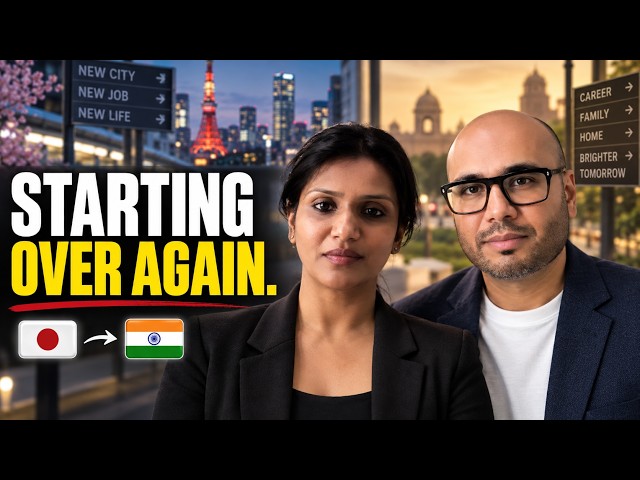
Watch: From Microsoft to ISB: Gopi and Ashwini's Return to India Journey
Discover how Gopi left Microsoft after 12 years, sold his $600K home, and returned to India via ISB. Real strategies for L1 visa holders planning their return.
The full write-up, with the numbers and the links.
Chapters
- 0:00 Intro
- 1:54 Background
- 5:49 Why move to India?
- 17:50 Planning the move
- 20:59 Life in India
- 21:38 Career progression to startups
- 25:28 What could be done differently
- 27:38 Advice
Transcript
Auto-generated captions, lightly cleaned
0:00 I had a conversation with Gopi and Ashwin who went to US in 2011 on L1 visa. While I was boarding the flight to US, I was like I'm going to return in 3 years for sure. >> They talk about their planning on the return to India journey. >> Like I think one of the most important aspect for any move to be successful, US has its own set of problems. India has its set of problems. That year we almost had an existential crisis. we were absolutely unprepared because our medical issues were not yet sorted. Our home was not yet sold nothing. A lot of money I left on the table especially the stock options and things like that considering you know I've been at Microsoft for close to 12 years by then. Buying the home we bought it in an area where home sales would take less than one or two days. Building a business is very different from working a job. It took I think 3 or 4 years before I even realized what it takes to build a business. [music] >> And finally, this is how they sum it up
1:01 About their life in India for the last [music] 8 years. >> Now, we felt like the life is complete after experiencing so much. If you're planning to move from US to India [music] and are overwhelmed with financial planning things like what is RNR, what to do with 401k contributions, compliance requirements, [music] investments, what to do with your house or social security retirement benefits. We have a detailed course that walks you through [music] everything step by step. Link for this is available in the description [music] below. Check it out.
1:54 So thank you very much Gopy for joining us today. So let's start a bit about your background and what made you to go abroad. >> Thank you Avinach for hosting me. First of all so glad to be on the returns podcast. I'm a 2006 graduate from CBIT in Hyderabad. So my schooling was in Hyderabad in HPS Ramanapur. Then I did my you know engineering in CBIT and I mean right after college I got placed at Microsoft which was like a dream come true. So I just worked at Microsoft Hyderabad for close to 3 and a half four years and in about 2010 end 2011 beginning then we started you know looking out for opportunities. the main reason why I sort of looked out for opportunities was at the time if you look at the kind of work that we did at Microsoft it was like pretty much outsourced kind of work the quality of the work didn't exist I mean and I was
2:56 Growing also pretty well and I kind of felt like I hit a ceiling with the kind of quality of the work that we are doing in in in the Hyderabad center then I said you know let me apply for other groups and and again being born into a Telo family obviously you know there's always this thing that you know why Don't you want to move to the US right like there is certain family pressure or societal pressure as well as in like let's explore US let's see what it has like there's always this itch right and about one year before what happened is I was on a business trip to the US so I went to the Microsoft headquarters on a B1 visa then I had to work just you know some couple of meetings and all that for close to 3 or 4 months then I realized how different the work culture was how different the quality of the work was And in that process you know I said like let me plan to move to the US because you know that will give me a different kind of exposure and I it'll help me grow professionally and at
Read the full transcript (35 more sections)
3:56 The time really the work quality here was very substandard right I mean compared to what it was in the US we just like sort of offshoring things so that was the primary motivating factor and when I was going you know basically when it's an internal move within Microsoft we get offered a L1 visa So the move was like an internal transfer. So there were no sort of H1B problems right and it was a L1B in the sense like my plan was okay in one or two years you'll get a green card you could do whatever you like maybe at that point already like 2 3 years in I was looking at a lot of these early stage startups at the time this you're talking about 2010 9 flipkart was there were like lot of budding startups that were happening at the time and I was looking at them and saying hey why I can't start something like this right it's a very simple web techn technology whatever it is and I I've been coding since I was like 12 13 years old. So looking at that I was like you know let me do something phenomenal with you know my life my career has to be this way I have to start my own startup but
4:58 Let me move to the US maybe get a little bit more exposure on technology and then start up. Yeah, >> that was the kind of mindset that existed back in 2010 when I moved to the US and it worked out well for me like I mean after I moved there I spent a good amount of time in multiple groups I was also working at office 365 that gave me a very good exposure because you know we basically at that point it was I mean even now maybe right it was like the richest group in the entire company and it was a cash flowing machine Right? And then you look at the the work hard party hard kind of thing you I basically gave my life to Microsoft by that time right where as we are going through that phase of like building my own career and things like that crux of how I moved and how I settled there.
5:49 >> Sounds like it's the career aspirations learning you know the new new technologies and new things. So how long you were there before deciding to move back to India and why the thought of moving back to India solidified? >> So there there are two aspects to it Ainach. So one is like fairly you know like like the heart and the second one is the brain I would say. So the heart aspect is like you know when I moved to the US I was like pretty clear that I wanted to come back to India because by the time already there was like a brain drain happening. I was also like I mean because I was maybe some part of it goes to my schooling as well. We used to wear khaki every day or the patriotism level was a little different and I was like while I was boarding the flight to US I was like I'm going to return in 3 years for sure and then you look at the family and family is like I mean everybody says that but who does right so it's always the same
6:50 Classic problem and then but then I was very adamant I was like you know we moved there and I was like you know by the time our L1 expires which is like 3 years let's not even apply for a H1 but you know just come back and I thought meanwhile you'll get a green card if need be we'll start the company there continue here this was like my dream plan so back in 2013 what happened is like we we had our first kid like my daughter was born and she was born pretty prematurely in the sense around 5 and a half months and she was at the NICU for close to close to 4 months actually from August to December and that was a little like medically it was very taxing for us because I had to run to hospitals for every little thing and there were follow-up appointments and all that. So practically it was very hard for us to return in 2014.
7:43 >> Yeah. >> like 3 three and a half years later. So then meanwhile what happened is we said okay know this is going to take a while before all these things get resolved. We even ended up buying a home there. because so the good thing about when you're you know hired at any of the mag seven companies like you know whether it's Microsoft Google whatever right at least you get like money issue is sorted kind of feel like [clears throat] of course there is always like a you can't put a hard number saying that this is the like there's always going to be people who will be earning more than you that's not the point the point is like you lead a comfortable life so in 2013 we kind of bought a home even before we welcomed our kid back home we bought a home and again I had the same mentality like know this is not going to stop me if need be I'm just going to sell it. >> And again the whole thing repeats right everybody's looking at it and saying hey you know he's going to say all this but will he really? But I never cared about the society in that sense. my aspirations were very important like you know me and my wife like ours is a love marriage. So
8:44 Like we were always on the same page like during our discussions as well. Hey when do we return? When do we stay here? How do we grow up our kids? Like I think one of the most important aspect for any move to be successful I kind of felt is like you know your spouse support right if that doesn't happen like it's very hard. So back in 20 so 2013 my daughter was born for about 1 and a half year 2 years we were like struggling with all the medical things 2015 is when you know I turned 30 actually so I'm 85 born so I turned 30 that year we almost had an existential crisis in the sense like you know that was our heart saying it's high time just move to the US sorry move return to the return to India move back from the US and we we sort of decided that year that you know let's let's start planning at least you know we already had a home that was we were one and a half year into it so there were installments going we were building things and I was also the peak of my
9:45 Career and you know back in India my wife was working at IBM then when she moved to the US again because of the H1B issues and all that she couldn't continue her career in middle in the middle somewhere she got a ED she could pick up couple of jobs but that was also another challenge right? In the sense like you know every time you move on a H1B the spouse always has to take a hit because only one of them can actually work the second one the other the other person either they if they get an ED it's good if they don't get an ED then you know things come completely to a kind of standstill for them. So that was the intent. So in 2015 I applied for ISB and I got admitted for the 2016 intake and when that happened we were absolutely unprepared because our medical issues were not yet sorted our home was not yet sold nothing. So kind of wrote to ISB admissions team saying that can I postpone the admission defer it by another year. They asked for a
10:46 Small deposit and then you know I joined in 2017. But this whole exercise has taught me a couple of things. One is you know obviously the spouse support that I talked about and having both of us being on the same page. The second thing is like when we were in the US right we were always thinking about you know obviously we have a we now have a kid we are supposed to be responsible parents and now next level when you think about how they are growing up are we giving them the right environment things like that and back in you know when when we went there right I mean this is one incident that like literally shook us is at least at the time we didn't even have kids but the Sandy Hook happened. Then we look at shootings all over the place. Then all all these like you know sort of ups and downs and we had a black lives matter movement in back in 20145 and there's like this you know subtle hint of things happening all around the place
11:47 That made us feel like you know US is not not too different. I mean US is has its own set of problems. India has its set of problems but US also has its set of problems. And then we were looking at US and India on the same page. We never put US on the pedestal and like you know India is here so being in US is better being in India is not act as good or whatever. Right? sort of got that equation right that anywhere the problems will exist and it is up to us to either solve those problems for ourselves or sort of avoid them altogether circumvent whatever you want to do and that sort of make made our decision easier >> in a sense then when once we put them both on the same level from a altitude perspective we're like okay you know if we have to move back to India so be it at least we have our freedom sorted and you know We could do things that we love. you know my wife Ashwini she she could talk more on that. She could you know restart her career. She's
12:48 Doing something again she's doing her own thing right now. So all of these were going on in our head and then we were also thinking of planning for a second kid and like again that was also a factor like okay at least let's have a second kid in India so that you know we'll have the family support and things will be much more easier for us to manage. >> Yeah. and money was one driving factor in the sense like you know like pushing us towards okay shall we stay in in in the US and not return to India because it's a lot of money I left on the table especially the stock options and things like that considering you know I've been at Microsoft for close to 12 years by then it was pretty hard but we were also looking at it from a expectation that you know if we can build something by ourselves it's just a matter of time we'll get back all the money that we are losing in this process.
13:42 >> Got it. So sounds like I think it it's the idea that you want to return back is always there and for different reasons or maybe join another startup you know just to get into the groove again and then do that versus completely shifting you know to an MBA program. is there certain thought process behind you know especially because now you have a family the kid and transitioning after like staying there for almost like you know six to seven years in US. Yeah. So well why ISB I'll tell you again this is more of a heart like you know what happened is like my entire life has been around Hyderabad okay my schooling is Hyderabad my inter obviously is Hyderabad then my education like my college has been in CBIT in Hyderabad then my first job was in Hyderabad I have like very very high attachment to Hyderabad for some reason and then Microsoft and ISB share a compound wall.
14:40 [laughter] So like literally when I when I when ISB started and when they started taking intake I was like I always had it in my head that you know one day I'm going to study here. >> Okay. >> For whatever reason and that stuck with me and you know back in 2015 when I looked at when I was just browsing you know how do I get back to India at at the time there were some couple of forums not too popular. I was also at that time I was a big user of Reddit as well just learning from other experiences. somewhere I saw an ISB ad that said bridge to India and I'm like okay this is awesome. So now that I've worked for so long in the US right and have a very good profile. See at the time when I applied I think 2 three years experience guy working at Microsoft but it was not such a big deal actually. So I didn't get an admit back in 2009 or 10 and again maybe if I have got maybe I didn't I would have not left to the US I don't know but I didn't get an admit then
15:40 And then I moved to the US but this again all all this always stays in your mind right like maybe with this profile I can get in >> yes >> and at the time already the the college was having very good rankings and I was also like you know for 10 12 years I was at Microsoft just as a software developer and I was very very deep into technology like I could handle massive u projects at office 65 almost like you know core services for them and when I looked at my own profile I said it's super deep technical I need to have like a t kind of profile where I'm very deep technically but I need to know a little bit of marketing a little bit of sales little bit of operations little bit of finance and you know again like the if you go with a common consensus right like people say hey if you want to start a startup like join a startup and I was always questioning everything like I I couldn't take anything by you know just the face value or like common knowledge right I was like okay because just
16:42 Because everybody says that doesn't mean that it is applicable in my situation maybe in my situation I need to do an MBA so that for one year I'll just be focused and learning other aspects than technology so that I know the building part other aspects I'm going to learn and maybe I'll find my co-founder I'll make good friends. I'll learn about the Indian market. it's been a while since I left and you know all this stuff and beyond everything I think another aspect is like we were too tired by the time we were really tired because I was at Microsoft for close to 12 years then I was tired just from the professional pressure then the family the health issues all this stuff it took a toll on us we were like you know it's okay we have we have made u some money that we could save just return to India chill for a year study I never bothered heard about my GPA. I till date I don't know what my GPA is in ISB. I never even sat for placements. It was like a dream come true. One year take a break, understand what you want to actually do with your life and actually do it.
17:43 Right. So that sort of like that that was the rational behind you know why ISB. >> Got it. Thanks for sharing that. So what
17:50 About the planning? I think in earlier discussion you mentioned about not able to sell the house and so you have to push it for an year you know health and all that stuff. Correct. So maybe you can talk a little bit on the planning side like you know the assets the stocks 401k lo anything that you can share from that perspective. >> Yeah. Okay. So because we had one and a half year from the time we got the deferral to let's say actually planning for a move and all that close to 1 year 3 months we had enough time for sorting out the health issues and sorting out you know selling a home. And you know if you remember when we were buying the home we bought it in an area where home sales would take less than one or two days once it's on market. >> So we planned for it like that. So we knew that you know if we were to move to India we have to sell it within a week and so there was this amazing neighborhood near Redmond which is Microsoft headquarters called Clani >> and Clani is a very top-notch locality
18:52 Whatever but it's known for you put it in the market it goes in a day that's it even when we were buying we bought it in probably one or two days we had to submit an offer and close it. So that sort of gave us that you know flexibility that when you know when we had to leave the home we could just put it in the market. In fact we use the same realtor that we used to buy the home to sell the home as well. We called him up his name is Rick and hey Rick we want to sell the home this is where we are you know just make it happen right so that sort of like trigger the process. >> So because lot of these things what happens is like there is no trigger moment. if you if you think about it like people keep thinking that they want to move to India but there is no trigger moment at what point do you make that call saying that you know okay we are packing the bags and we're moving to India right so this this sort of like selling the home correct me if I'm wrong was was the trigger moment because even like the ISB admit wasn't that much of a trigger moment right I could always go back to ISB and say hey sorry guys I I
19:53 Cannot join or something right like but selling the home was a big moment for us and that sort of stopped started the process. So, first we sold the home. Then that means we had to sell three-bedroom stuff, get it to one bedroom, then we had to move to an apartment. Then last I think for 4 days we were in a hotel. >> Hotel. >> so that brought us down to like 13 checkin bags. >> So basically like this like gradual thing that we were able to do. I mean thanks to Microsoft, thanks to all the you know career that I had. I was pretty lucky actually if you think about it like was super lucky in that sense. and also we were like very much inclined towards moving back. you know our our parents also supported at one point they were like you know okay now we believe you guys that you want to return so let us support you in that regard. So earlier that was not the case because in the initial days they never used to believe. The moment we sold the house that triggered sort of every discussion
20:54 Saying that okay these guys are very serious about going back and all that. >> Got it. So sounds like I think you know
21:00 The reasons to move back was clear and so how the life has transitioned like you know once you move back to India. Yeah, mostly we were afraid of our daughter Aara, how can she transition from America to India? Yeah, because she went to a like a preschool in America and we didn't know what schools were in India that were flexible for her or where she can transition easily. So we tried bunch of schools which didn't work but at last finally we found an IB school here that helped her transition mostly. Got
21:38 It. >> The other reason I think you moved is for you know both of your career aspirations, right? Someone who wants to build their own company and someone who wants to reignite their career. So let's talk about how the careers has evolved, how you know building their startups. let's you know dive into that and your experiences you know especially doing that in India after spending some time in US is going to be different challenges from your work life balance, work culture and so on. >> Correct. Correct. So I'll go first. I mean like see thing is building a business is very different from working a job. It took I think 3 or 4 years before I even realized what it takes to build a business and meanwhile I was going through like again we had even the covid thing happened in 2020. So right around the corner we were launching products. Finally I got a hang of how to run businesses, how to actually build a team, build product, make sales, marketing, everything happen and then COVID hits. So then two years
22:38 Gone down the drain. So practically what happened is like back in 2022 we sort of restarted the company all over again from scratch and now we are doing well. So now we are in the AI space and we have gotten some decent amount of funding as well from angels and like we are on a upward trajectory growth is good able to target certain verticals effectively but it's been a long journey and again you have to get lucky I mean some some part of it I kind of feel like you know especially with startups there's a lot of luck involved the time the timing is should be right the kind of skill set the kind of people you get on board co-founders, everything matters and people will drop off midway and you have to plan for that. we were in it for the long term. We kind of decided when we were returning itself that let's give it like 10 years. So usually people don't do that but we were like okay let's give it 10 years and see where we end up. not because we were like super comfortable
23:39 Financially but we were also like very like you know we're not going to give up on this right. We have to do it until we make it work. Because people say, you know, like, you know, whatever, right? There's an old saying that says failures are the stepping stones to success. It sounds too cliche, but cliche, but it's it's actually true. Every time you get a rejection, you kind of learn from it, and then you're hoping that the next one wouldn't be a rejection. So, that sort of like trains you to build your muzzle. How do you build your business and things like that? So, right now, we are in it together. I mean, Ash is building a consumer app. I'm more on the B2B side of things. overall we are having a great time. See the market the problem with like running a business in India is you're in a country that is very time rich and money poor unlike in US which is time poor and money rich. So it's easier sitting in India selling to the US market than
24:40 Sitting in India trying to sell it to the Indian market. >> It's very hard. Very very hard. And lot of these lessons people tell you but unless we practically learn we don't implement it. So that's sort of where we are at in our career. But no I think no specific thing that you know I like I know when I reach out to entrepreneurs where I when I reach out to successful founders a lot of them they give good advice but what happens is like the advice you usually get from founders isn't applicable to another founder because everybody's situation is different. So not a lot to learn from my journey when it comes to like no I think both of our journeys when it comes to startups and things like that because every situation is unique.
25:26 >> But yeah >> no thanks for sharing that. So looking
25:29 Back you know it's been about 7 years since you have been living in India. Have you ever felt you know you made a wrong decision or you know should you consider something else or you should have planned better anything any time occurred? >> Yeah. One thing I you want to talk? >> Yeah. One thing is about investments. >> Investments. Yeah. Like the passive investments. We should have had some passive investments >> which could get some recurring recurring kind of income. I have a big one actually. I thought you know we shouldn't have sold the home >> because I mean when we sold the home we sold it for like 600k the home is worth well over 1.2 1.3 million right now and I mean at the time see obviously we can't predict the future >> but like it's it's not too hard to keep a home actually in the US because things are way more organized. You probably will have a property management
26:29 Company take care of it. At least your monthly rent will cover sort of your investment. When we were there, it was that situation actually. So we bought it for like 450K, 450K and like you know our monthly installment was close to 3K 3 and a halfK. That's it. And so that I could have easily gotten from the rental itself. Sure. So when you have an asset that sort of like is paying back the rental, I mean the rental is kind of paying back the installment. There was no point actually selling that asset and coming back. It would that probably was like a decision that you know we just took it in like you know sort of like okay let's just do it. But if we like if there's an opportunity where you can hold on to some assets that can generate some cash flows or that could just pay back their own installments and things like that. I I wouldn't have done that. I mean I I think a lot of that also comes from you know maybe your parents or friends or somebody telling you hey this is not right this is right or whatever right it's not that you know
27:31 At that age you're just like very rash in some of these financial decisions. I wish I could have done that differently. you brought it. So, is there anything
27:39 That we haven't covered that you want to bring up or any advice for people who are considering about moving to India? >> So, one thing is like you there there is a slight cheat code. I think my daughter will kill me if I say this on a podcast because she's going to definitely listen to this. is that try and move before they turn four or five so that you know [laughter] there's not much big of a struggle there in the sense like the kids transition easily. I'm not I mean of course there's like you know I'm just sort of pulling her leg in the sense you know she doesn't have an option then right if she was like seven or eight years then it becomes a debate the sooner the better right because kids have like a period where they're making friends honestly like you know if their friend circle is like if if my kid has to move right now to us it's not that easy right because she's made good amount of friends here she enjoys in the community all that so that I can't I cannot
28:40 Take it away from her. She is building her career in karnatic music. She is doing her violin. She does attend cubing competitions. She is well settled into the Indian atmosphere, the Indian way of doing things, the culture, the food, everything. So, it's very very hard. Having said that, will they if they if they really have to move back, will it be that hard? I guess not because US is still a land of immigrants. Everything is pretty sorted there. The process is in place. So when people are you know transitioning back to us there is not much of a hassle and always again I don't know whether you know Ashwini agrees to this now but at the time when we were moving to India we were like you know let's try it for a couple of years. >> So that always kind of eases your decision. You will say okay you know let's try it for a couple of years. So that's one very important thing. But >> but we were we were actually already decided to move. So we were never going back to America again.
29:40 >> So >> there's no point in trying. >> Yes. >> Yeah. Now we now we are set here. But that mentality just eased us. So I was always like nothing works out okay let me just go back to join Microsoft and then again take the same Elma and just move back to US. Right. just having that mindset sort of helped. And again kids go through this like I I I want to talk a little bit about kids more in the sense see now we have a a second one a younger sibling now he is going for his cricket coaching here in one of the topmies in Hyderabad. So he is having a great time like morning 5:30 he wakes up goes for cricket and you know I I take him there spend couple of hours there then come back then we spend a lot of time with you know then he goes to school then he comes back spends a lot of time with us then sibling time then all of this family time that we have on the weekends I can't put a price to all that actually like you know when our parents both of
30:41 Our parents live on the other side of the city >> we are ourselves in like a gated community on the west side of Hyderabad. So anytime during festivals or if it gets you know a little lengthy or maybe more than three or four weeks we haven't seen our parents then we go back to their place. Yes. >> So they are getting their grandparents time lot of these smaller things I could never imagine that you know this is even possible in the US right because they will come there. I mean my my parents have come to us for visiting. Her parents have come to us for visiting. But every time they're there, they're always in a rush to go back. >> So it is just very unfortunate that it's very few parents who can like sort of make that transition and continue to be there.
31:26 >> So in that in our case also it was the same thing. They can't like actually stay there for a long time. Maybe 2 3 months stops they move back. So with all that we were like you know let's say we just you know when we moved here all the all these little things these little things really really matter because most of the podcast we have been talking about these grand ambitions big goals and you know ISB and all these big goals entrepreneurship Microsoft all this but the little things mattered so much like when we were having our second kid right like the very fact that we were back in India meant that we could actually have like a you know like a baby >> help from grandparents >> right and the baby shower baby shower all these little things really really matter we actually did not think about the little things when we were making the transition but when we experienced it was like a bonus >> and the very fact that you know if
32:27 Somebody gets sick you could just go there spend a day with them come back these are very priceless things so I mean I I cannot put a price on that >> for sure I mean I think >> these are very very important and these are subtle things and it's hard to you know yes you know explain >> yeah so >> now we felt like the life is complete after experiencing so much but in America I felt like something is missing I couldn't explain what is missing but after coming here I think we understood >> yeah True. So yeah, thank you very much for taking the time sharing your journey you know your experience in US and what made you to brought to India and the life in India and you know your career journey how kids adapted and so on. really thanks for taking the time and sharing your journey and insights with us today.
33:21 >> Thank you. Thank you Vin. Thick.