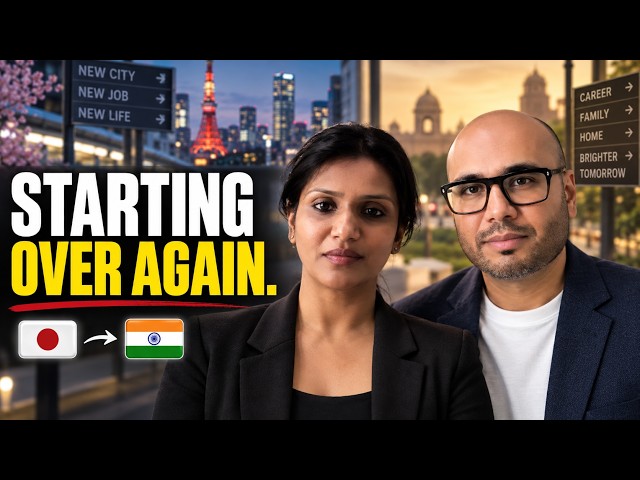
Watch: Back to India with Financial Independence After 17 Years Abroad
How Chintan achieved financial independence using the 30x rule after 17 years in US manufacturing. Non-IT career opportunities, green card decision & FIRE strategy.
The full write-up, with the numbers and the links.
Chapters
- 0:00 Introduction
- 2:03 Background
- 2:52 How was life in US
- 4:15 Why move out of US?
- 6:45 Pulling factors to move to India
- 7:46 Planning the move?
- 10:56 Your framework to determine corpus number?
- 13:00 Career opportunities for manufacturing/supply chain in India?
- 16:41 How is life in India?
- 19:17 Any surprises living in India?
- 20:47 Anything you would do differently?6
- 22:07 Anything that we didn’t cover?
- 23:22 Cost of living in India?
- 25:03 Immigration status
- 26:55 Advice for future aspirants?
Transcript
Auto-generated captions, lightly cleaned
0:02 Meet Chintan who spent close to 17 years in US working in supply chain and manufacturing. He talks about his reasons to move back to India. >> Once we got to a point where we hit a financial number wasn't really a whole lot of reasons to be in the US. I think there were probably not one but two or three trigger points. You know we started having some conversations with family on hey we considering coming back. and that was a bit mixed. He also talks about the opportunities for nonIT sector in India. >> Manufacturing supply chain in India continues to be a good place to be in so if you're automotive Pune and Chennai are super attractive. if you are in you know other industries so like castings >> and finally his thoughts on green card and advice for the future aspirants to make the transition smooth but >> I'm actually glad I didn't because then I would just get stuck for 6 months a year they're realistic u pragmatic willing to know that hey look I will
1:03 Enjoy some things I will be upset about some other things u I think that makes the whole transition so much easier >> before we jump in. Don't forget to subscribe so you will never miss these real non-fluff conversations that help you make an informed decision. Check the link below on how this return can help you make your transition smooth and successful. Hello everyone, welcome back to another episode of this return. Today I'm excited to have Mr. Chintan on our show.
1:50 Mr. Chintan went to US for his higher education and after spending close to 17 years, he and his family has decided to move back to India. It's been about an year since they moved back to India and
2:04 I'm really looking forward to this discussion about their journey, how they decided, how they planned and their life after moving back to India. Welcome Mr. Chintan to our show and glad to have you with us today. >> Thank you very much. >> Let's start a bit about your background and what made you to move to US. >> Yeah, so I'm originally from Mumbai. I studied production engineering in one of the suburban colleges in Mumbai. and I wasn't really ready to start working after college. my father had studied in the US as well. So I decided I would go and get a master's in industrial engineering. and I went to a school in Oklahoma called the University of Oklahoma and received my master's in industrial
Read the full transcript (35 more sections)
2:53 Engineering. and then post that I started working which was a good experience and then just kind of forgot to leave which is how I stayed there for almost 17 years. >> Got it. So how was the life in the 17 years in it's a long time and how was the experience and how was the life in US? >> Yeah. So the life in the US went through a good amount of transition over the 17 years I was there. initially I was a college student. I moved from Mumbai and I had you know I lived at home with my parents which you know led me to never having to cook, never having to take care of myself and having help and support around. from that atmosphere to going to the US where it was just me and my roommates.
3:43 Initially we slept on the floor had to do all the cooking, cleaning, taking care of life while studying and working part-time. So that was you know a good amount of challenge and good amount of learning who we are obviously along with a lot of freedom because we decided what we did, how we did it, when we did things. as we grew older and as I started working obviously amount of responsibility changed the amount of resources and
4:15 Support also changed and things obviously transition to eventually getting married and then having a a child so it changed every few years depending on where I was in the station of life. >> Got it. So I know you kind of mentioned that you forgot the thought that you're living in US right I mean it never occurred like so the life continued everything was going great so why this thought of moving to India occurred and what happened what changed or what was the triggering point and why the move back to India? Yeah, absolutely. So, the first few years was just, you know, it was enjoyable, it was fun. I was growing in my career. there wasn't really any significant responsibility.
5:03 But as time went on, got promoted a few times. eventually had a child. COVID came along which made me and my spouse both reconsider if we really wanted to live in the US. from my perspective the experience was really good. but it was really good on a few specific aspects. One it was good to learn who you are, what you can do which I had accomplished. it was also good to have a career that allowed me to grow, take on responsibility, learn aspects of business that I don't know if I would have gotten as many opportunities in India. So that was done as well. and then lastly, you know, the experiences of living by yourself in a different country, traveling, making money at a scale that's much higher, that I accomplished as well.
6:01 Post that there wasn't really a whole lot of reasons to be in the US. which is where the thought started coming in on maybe it's time to go back. >> Got it. And is there any trigger point or it just like a natural thing that happened? So is there like Yeah. Yeah. >> Yes. I've thought about this a little bit. I think there were probably not one but two or three trigger points. One my father passed away in COVID. two, my son was born about a year after he passed away. and three, I during COVID my company and I think most American companies, their approach to how they handled taking care of their employees made me feel
6:45 Like that wasn't how I wanted to live my life to where thousands of people were let go, didn't have jobs, didn't have health insurance. I just felt like that wasn't something I wanted to do from a long-term perspective. Those are the three trigger points. >> Yeah. And what are the pulling factors in India like in terms of the strong reasons to move to India? Yeah. >> Yeah. So I think first of all family obviously big pulling factor two culture you know being here during festivals being here during activities weddings just is fairly attractive and also from a just a economic perspective I don't think any other part of the world is going to grow as much as India will in the next 15 years so being you know part of that growth story that journey also [clears throat] is fairly attractive. and then third you know once we got to a point where we hit a
7:45 Financial number the thought of like
7:48 Hey maybe I should contribute back to society to country whichever way you think about it right those kinds of you know thoughts start you know coming in so those were the ones >> got it no thank you very much so if I understand I think it's like it's that time in co like I'm assuming 2021 2022 it's when the idea of moving back to India kind of solidified or started brewing into the mind. so you can talk about your planning right I think you know from 2021 2022 till 2024 it's about 2 to 3 years of planning maybe you can talk about how you plan your return from a logistics financial and other aspects the career we can go one by one if you can talk about that would be fantastic >> yeah absolutely so first is you know getting on the same page with my wife she's also from Mumbai from the same city as me like me she also studed married in the US although we met in Mumbai. so you know first getting on
8:48 The same page with her she was 100% cool with coming back as a matter of fact we sometimes joke that she wanted to always marry someone from Mumbai. She couldn't find anybody so she had to you know marry me and find a guy from outside. so she was cool with coming back. fairly important landmark. the second you know we family on hey we are considering coming back. and that was a bit mixed. They were like supportive but also like why which we explained. I'm not totally sure they understood our perspective but it was our decision. on the logistics front you know we both knew that while we want to come to India working and making money and finances aren't the same in India as you would have in the US so obviously we'd be making less money maybe working different hours so that's bit of a challenge so we wanted to give us a
9:50 Decent amount of question and I wanted to hit a number from net worth savings perspective where if I didn't work full-time for the foreseeable future or really ever I should still be able to you know not have significant degradation of lifestyle. so I worked to get to that number. it helped that I did a little bit of consulting which certainly helped push up my net worth number tremendously. and then from a logistics perspective, we had a date in mind for when we wanted to leave. That got pushed, a little bit to the right, which I think happens to a lot of folks. but we said that, look, once we got within like a 9 month window, we had a date circled on the calendar that we wanted to hit. and quite frankly, my wife didn't believe it until I booked the tickets to where we we needed to go. And then the last
10:52 I would say 2 to 3 months was a pretty I wouldn't say chaotic but there was a lot
10:57 To do because we had 16 17 years worth of stuff. bank accounts phone calls to make to friends and family all that stuff had to be done. so the last few months were a lot of work. >> Yeah. Got it. So thanks for that. Maybe if you're open want to understand about this corpus amount right like maybe you can put like know this x annual like you know how do you calculate maybe you can kind of walk through the framework that could help others in terms of how they can think through it that would be very helpful. >> Yeah. So I did a decent amount of like checking and research cuz I both me and my wife we believe in the fi part of fire. I don't know how much I believe in the re part of fire.
11:48 >> and I tried it to some extent to where when I came back for the next few [snorts] months I didn't really do a whole lot. did some consulting on the side but eventually got to a point where I was like I need something to do. so I'm back to working full-time for a old boss in a environment that's fairly easy to handle. so the approach we took was first we started with the 4% rule which I was able to handle. We estimate or at least I estimated what my spending would be in India once we move back cuz we have a child and we'll go to school and so on and so forth. So I estimated that and I wanted to be in the 30x plus range for getting a comfort level that hey look this should be fine. U now the way things have worked out that 30x range has been met and more than that has been met
12:48 And I'm actually working at a full-time job that has a decent paycheck. So I'm not really touching my nest egg too too much but that's by choice not by need. so for the most part worked out
13:03 Pretty decently well. >> Got it. So it's a 30x that the number that you have used for your you know the corpus amount but based on where you are I mean you still have the cushion because you're in in the corporate world and all that stuff. So I think you kind of touched about this on the career end career side. I think you kind of took not sabbatical like you know you you didn't plan to Yeah. >> Yeah. pretty much. Yeah. >> Yeah. for some time since you are someone who is in a nonIT I'm guessing because you said you are in industrial engineering and >> manufacturing and yeah manufacturing and supply chain. >> Manufacturing and supply chain. Maybe you can talk about some of the opportunities for someone who is in non in IT and who are thinking about moving to India like the opportunities that are in India right now and also compare and contrast about the the growth or you know the opportunities for this kind of sector.
13:59 >> Yeah. No absolutely. So just a little bit of background I I'm a industrial engineer from education and I spent most of my career in manufacturing and supply chain. good amount of time in oil and gas as a industry but you know when you're making stuff doesn't really matter if you're making soap or if you're making jet engines it's about the process it's about how you run the plant. and look overall I've had good experiences of having teams in India even when I had a role in Houston or other places cuz they are fairly global and in general manufacturing supply chain in India because especially since COVID and some of the trade issues that are being experienced lots of big companies want a second or third option to China and India is a fairly attractive place to do that. overall people with
15:01 The right attitude, willingness skill set, experience tend to do fairly well in this manufacturing and supply chain industry. I would say it's a bit regional. so I live in Mumbai but most of my facilities are not here because it's easier to have facilities away from a tier one expensive city. so if you're automotive, Pune and Chennai are super attractive. if you are in you know other industries so like castings, Rajcot are fairly attractive. So it's a bit more regional rather than just anything anywhere. [clears throat] but overall there's a decent amount of scope for folks like me that have global experience and are going to help companies go to the next level in India.
15:50 >> Got it. And what's the best way for these folks to identify these jobs or you know get these opportunities like you know networking or applying or reaching out? So any any tips or tricks that you can share? It's this part of the process is not as clean in India at least in my experience as it would be in the US. There's not like a readym made or ready to go network of recruiters. there's not a whole lot of like third party folks that you can reach out to. A lot of it is having the right connection or knowing people. there's some amount of like this applying to website type stuff that works but for the most part it doesn't work as cleanly or transparently here as it did in the US. I would just say you know it's a
16:43 Matter of figuring out what the sweet spot is for you and then committing to it. networking accordingly and then obviously a little bit of good fortune doesn't hurt you. >> Yeah. Great. So let's I think look at how the life is in India like it's been about an year and how has it been going so far? >> Yes. So I mean we are I think fairly pragmatic people. so we knew right look certain aspects of life will be better. family being here for events being here for when people need parents or aunts and uncles. having support for the child. he's not growing up just looking at my and my wife's face. He's you know hanging out with lots of people. so all that is great. we were prepared for that. obviously you know traffic some of the infrastructure issues some of the
17:44 Bureaucracy issues we expected those not to be fun or easy to deal with and that's pretty much worked out as expected as well. I think if you are realistic pragmatic willing to know that hey hello look I will enjoy some things I will be upset about some other things I think that makes the whole transition so much easier. >> Got it. But yeah go ahead. Yeah, one thing I'll add right like whenever I get asked the question on hey what do you enjoy what do you not enjoy some of this is like we know right hey we have a billion plus people we have a small place especially the city I live in so what are we going to do right we can't not have traffic and we can't have people on the streets and so on and so forth so that's expected what bugs me a little bit are the things that can be controlled right I'll give you a small example that is very telling. for a while the government had this message
18:48 Whenever you made a phone call to anybody Amitab Bachan or someone like him would come on the phone before you called someone and say hey be careful about online scams. This message take takes 15 seconds and every time I would call anybody I would get this message. I would call my wife 10 times a day. I would hear the message before I listen. The phone call may take 3 seconds. I would just say, "Hey, I'm here." So, I have to listen to that every single time. That bugs me cuz
19:17 That's not required, right? Tell me to be careful once a day, not 11 times a day. those types of things are, you know, more annoying than like, hey, traffic or not good roads, etc. >> Got it. were there any surprises that you didn't expect like living in India now? >> nothing major comes to mind to be honest. I think I think the maturity on some of the public activities road conditions traffic was probably a negative surprise.
20:03 >> and I think this is again is a bit regional because when I look at you know cities like Indoravad they've made some very good progress. the city I live in Mumbai frustratingly cannot still build a metro even after 7 8 years can build roads decently well so like the coastal road positive surprise u so that I would say is is one I think from a professional work perspective not a surprise but you know it's been encouraging at how competent some of the people in at least my universe are I very much feel like look this is you
20:48 Know India in 2025. we are really not subservient to anybody. maybe we get paid less due to economics and so on and so forth but competence, willingness, will to win all that's really great. >> Okay, that's good. is there anything that you would do differently from your planning when you look back? yeah, I would I mean if there's one thing I would do differently, I would probably give myself a little bit longer runway cuz like I mentioned earlier, the last two two and a half 3 months were fairly chaotic. And you know, in hindsight, did I get rid of a few things I should have probably brought with me? Absolutely. in hindsight you know had I planned the timing of when I came bit differently probably yes so that I would say as a little bit of a factor one kind of positive I'll
21:50 Mention I'm I would encourage most of the people to do this is before I came I did a bit of checking and found accounting firm to help answer my questions but also to help me with the transition on taxes and NRE status
22:07 And all that stuff. and that's been a smart move and even today they help me and answer questions that I would encourage for sure. can't think of too many other things I would have done differently honestly. >> Got it. No, understand. Cool. is there any topic that we haven't covered that you want to bring up? >> not really. I mean if anything right like I I know a lot of friends and not I mean some colleagues as well they have this thing to where like hey look let's go back but they are in that mode and won't likely come right what I would say is for that topic right there has to be the key decision is are we will are we ready to move and what's the timeline line. Once you have made a decision, then the mechanics of the move, the home, the stuff you own, the
23:10 Accounts, the transfer, all that stuff is not the difficult part. The decision for whether you want to come or not is the name of the game. You do that well and get good consensus and get good
23:23 Thinking behind it, that makes everything else easier. [snorts] >> Completely agree. Making that informed decision and acting on it is the key thing. So just getting the decision done and then then the next steps follows >> go with it. Yeah. Absolutely. >> Yeah. >> there are a couple of curious questions from my side. the first one is I know you have did enough research to you know do your annual expenses. now that you have been living in Mumbai for almost an year. was that something very close to what you expected? Because I hear from folks cost of living has been you know high like inflation is so huge in India. So want to understand from your perspective how has been your experience in terms of the expenses or the cost of living.
24:10 >> Yeah. So I am living where I lived before I moved to the US. So same home, same building. I live with my mom. There's a decent amount of space. So, I didn't really have to go buy a new house, >> which is certainly a, you know, a factor. overall, I don't think [snorts] things are more expensive than I expected. They're actually decently cheaper than I expected. some of that is just lifestyle. like I mentioned, I feel like I'm a middle-ass guy. I don't have a lot of expensive meats. so you know, I'd much rather go eat in a kind of a local restaurant than a fancy restaurant. So that's a variable, but I don't think, you know, things are expensive to a point, but they're unaffordable or I mean I work
25:04 In an office and if I go have lunch, I'm spending typically less than a couple of dollars for lunch in a pretty good setting, right? That's unheard of, right? so yeah. I know I I would say probably better than I expected. >> Got it. No, thank you. if you're open like what was your immigration status like when moving back to India? >> Yeah, sure. So, I moved in the US in 2007. I applied for a EB2 green card with a priority date of December 2012. during COVID we had a short amount of time where my priority date was active. So we got EAD and AP approved. when I was about to leave the priority date was like within 2 months of being active. today it's active. so my priority I mean if I can go get a green card
26:04 Today if I want to but I'm actually glad I didn't because then I would just get stuck for six months a year there and complicate my life on a tax and financial basis tremendously more. so we haven't really like sent in the paperwork to USCIS to say hey we don't want the green card I need to do that at some point of time but it wasn't I mean I had I didn't need to come back because of immigration. Yeah. >> Great. >> No, fantastic. Thank you very much. >> Yeah. One comment on that front. I think just this is my opinion to some extent. I think people like me that come willingly not forcibly tend to do better than the people that have to come back because hey, I didn't get H-1B or whatever.
26:54 >> Because it's a chosen decision, right?
26:56 There is a strong why you are moving back and you will be embracing some of the other cons because your why is so strong the case of fourth decision you know there is always reasons to you know not be happy about >> yeah any any advice for the future aspirants from your perspective like how they should plan or how should they think about you know when they're considering about moving to India >> yeah so I think you mentioned the word informed decision I think that's absolutely the the right place to start. two, I there's a quote by Ratant Tata that I tend to use and I'm paraphrasing a bit. Don't worry about if this is the right decision. Make the decision for the right reasons and make it right. and there's a lot of attractiveness of being in India for people that are grew up here. obviously some things aren't as good. but if you come for the right reasons
27:56 You will be in good shape. if you come for the wrong reasons then you know lots of people will go back and not enjoy it and complain and so on and so forth. if that's the case just stay right if you can. >> No thanks a lot Mr. Chintan I mean for a very candid honest conversation you know sharing your journey your insights your experience and perspectives. I think this is lot of good nuggets I think for people to take on and that would help in their decision process and planning their journey back to India if they have decided to do that. Yeah, thanks again for being with us today and sharing your insights. >> Thank you very much. I enjoyed the conversation. >> That's great.
28:49 >> [music]