
NRI Retirement Advisory in India 2026: 401(k), Roth IRA, FCNR & Pension Planning
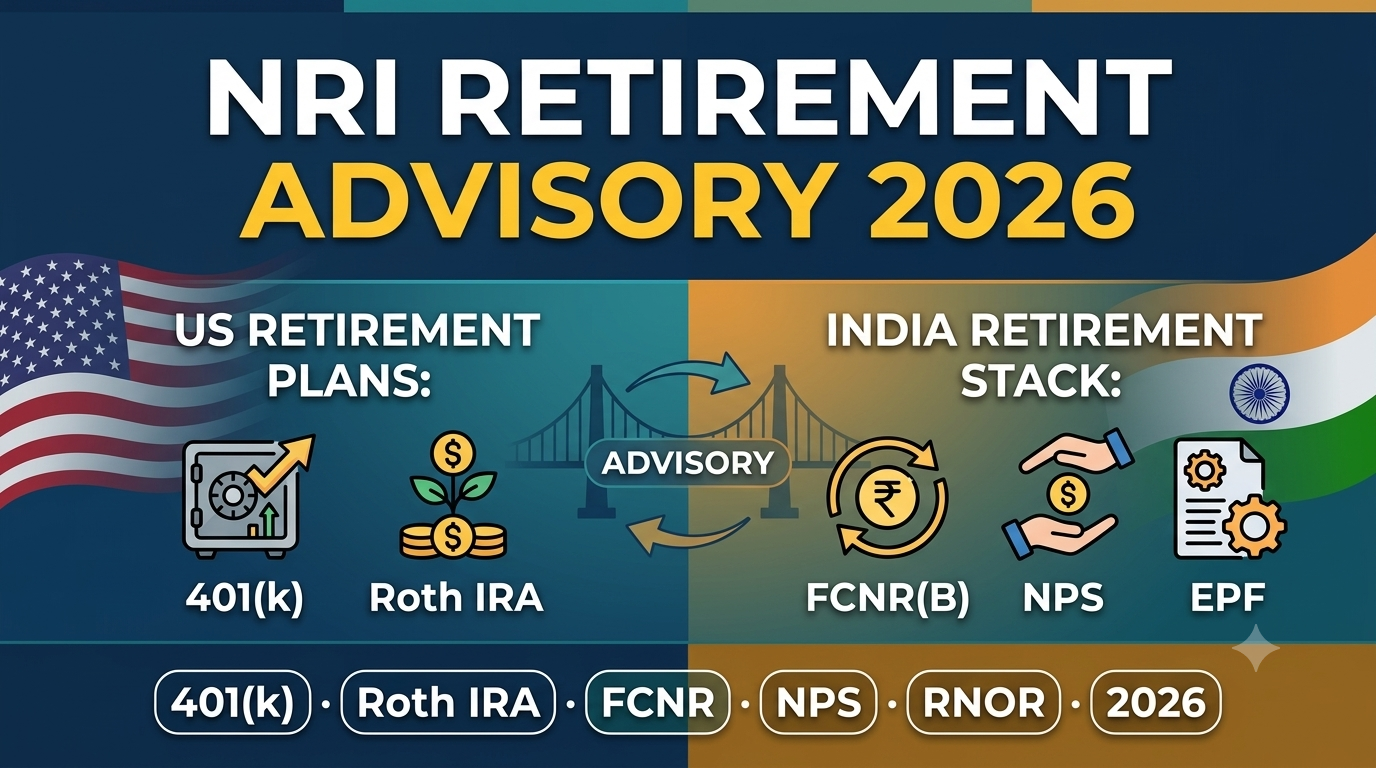
Most NRI retirement advice is either US-centric (401k / Roth IRA) or India-centric (NPS / EPF) and misses the bridge. This 2026 guide combines both sides plus foreign pension porting, RNOR tax planning, and a 5-step decision framework for returning NRIs.

Most NRI retirement advice is either US-centric (401(k) / Roth IRA) or India-centric (NPS / EPF) and misses the bridge. This 2026 guide combines both sides plus foreign pension porting, RNOR tax planning, and a 5-step decision framework for returning NRIs aged 50 to 70.
What this guide covers
NRI retirement planning usually breaks into seven decision areas. This guide maps each one and links to deeper articles where you need more detail.
| Intent cluster | What the NRI is asking | Sample queries | Deep-dive |
|---|---|---|---|
| 1. Retirement advisory | "Help me plan retirement, I have US + India assets" | best retirement advisory for nris returning to india, nri retirement financial advisor, personalized retirement plan nri | This article |
| 2. Senior living | "Where do I live? Community vs independent home?" | senior living india, ashiana antara cost, retirement homes india, assisted living india | Senior living cost 2026 |
| 3. City selection | "Which Indian city is best for my retirement?" | best city india retirement nri, goa retirement, kerala retirement, coimbatore pune bengaluru retirement | Best cities 2026 (sibling article) |
| 4. 401(k) to India | "Should I keep, rollover, or withdraw my 401(k)?" | 401k options moving to india, 401k withdrawal rules india, 401k rollover to india | 401(k) options |
| 5. Roth IRA NRI | "What about my Roth? Can I still contribute?" | roth ira 5 year rule nri, roth ira withdrawal india tax, roth conversion nri | Roth IRA 5-year rule |
| 6. Foreign pension porting | "Will my US SSA / UK State Pension / Canada CPP / Australia Super follow me?" | us social security living india, uk state pension nri india, canada oas cpp nri, australia super nri | US SSA in India · Canada CPP / OAS · How to apply |
| 7. Estate / Will / Reverse mortgage | "What if I die or run out of money?" | nri will india property, reverse mortgage india nri, estate planning nri india | US estate-tax planning · Reverse mortgage (sibling article) |
The 5-step NRI retirement framework (2026)
A structured path that any returning NRI should walk through, regardless of asset size. Each step is independent but builds on the previous.
- Step 1: Map residency and tax window.{" "} Confirm your India tax residency timing using the RNOR status calculator. If you return before 31 March, the move falls in the current financial year; if after 1 April, the next year. This single decision drives the next 4. Also confirm OCI status if you hold a non-Indian passport.
- Step 2: Inventory your retirement assets.{" "} List US 401(k), Roth IRA, brokerage, US Social Security (if eligible), Canada CPP / OAS, UK State Pension, Australia Super, Indian NPS, Indian EPF, FCNR(B), property in India, and any business interests. Use the financial checklist as a template. Categorize each as "retire-in-India" vs "stay-foreign".
- Step 3: Decide 401(k) and Roth IRA strategy.{" "} Most NRIs should keep US 401(k) in the US. Decide leave-in-plan vs rollover-to-IRA vs partial withdrawal. Review the 5-year rule for Roth conversions. Plan RMD timing around your RNOR window to minimize US tax. Use 401(k) options + Roth IRA NRI as deep-dives.
- Step 4: Build the India retirement stack.{" "} Convert NRE / NRO to resident accounts. Decide FCNR(B) maturity (hold to maturity vs redesignate to RFC). Open NPS Tier 1 (if under 65) for the additional 80CCD(1B) deduction. Consider SCSS for any post-move idle cash. Map property title and inheritance. Use NRE / NRO guide + city guide.
- Step 5: Port foreign pensions and update tax filings.{" "} Apply for US Social Security direct deposit in India (Form W-8BEN + SSA-1199). Set up UK State Pension claim, Canada CPP / OAS, Australia Super drawdown. Plan annual India ITR filing with foreign-income disclosure (Schedule FSI / TR). Use US SSA how-to + repatriation guide.
Where each retirement asset lives (and how it's taxed in 2026)
The decision matrix below covers the 11 most common NRI retirement assets. Numbers are illustrative 2026 ranges; consult a cross-border advisor for your specific case.
| Asset | Where it lives | US tax (if NRI) | India tax (RNOR) | India tax (ROR) | Repatriation |
|---|---|---|---|---|---|
| US 401(k) | US plan | 10-37% on withdrawal + RMD after 73 | Foreign-source, not taxed in India if RNOR | Foreign-source, taxable in India with DTAA FTC | Not needed; stays in US |
| Roth IRA | US account | Tax-free after 5-year rule + 59½ | Foreign-source, not taxed in India if RNOR | Foreign-source, taxable on earnings in India (rare for tax-free US) | Not needed; stays in US |
| US Social Security | US SSA direct deposit to India bank | 0-30% withholding; W-8BEN for treaty | Foreign-source, not taxed in India if RNOR | Foreign-source, taxable; DTAA applies | Not needed; SSA direct-deposits |
| Canada CPP / OAS | Canada Pension Plan + Old Age Security | n/a (you're a non-resident of Canada) | Foreign-source, not taxed in India if RNOR | Foreign-source, taxable in India | Direct deposit to Indian bank via SWIFT |
| UK State Pension | UK DWP | n/a (non-resident of UK) | Foreign-source, not taxed in India if RNOR | Foreign-source, taxable in India | Direct deposit to Indian bank |
| Australia Super | Australian complying super fund | n/a (non-resident of Australia) | Foreign-source, not taxed in India if RNOR | Foreign-source, taxable; DTAA caps at 15% | Direct deposit to Indian bank |
| NRE / NRO / FCNR(B) | India bank | n/a | N/A (already in India) | FCNR(B) interest tax-free; NRE tax-free; NRO interest taxable | FCNR(B) + NRE freely; NRO USD 1M / FY |
| Indian NPS Tier 1 | NPS Trust | n/a | N/A (already in India) | 40% lump-sum tax-free; 60% annuity taxable; 80CCD(1B) deduction | Not repatriable |
| Indian EPF | EPFO | n/a | N/A (already in India) | Taxable on withdrawal if < 5 years; tax-free after 5 years continuous service | Not repatriable (NRE account credit only on retirement) |
| Senior Citizen Savings Scheme (SCSS) | Post office / bank | n/a | N/A (already in India) | 8.2% p.a. (2026); 5-year tenure; Section 80TTB tax-free up to INR 50K interest | Not repatriable (NRI cannot open new SCSS) |
| India property | India RERA / sub-registrar | n/a | N/A (already in India) | Rental income taxable; sale capital gains taxable; 80C for principal repayment | Sale: USD 1M / FY for up to 2 properties; inheritance unrestricted |
The "RNOR" column is where the value is. Use the RNOR window (usually 2-3 years) to draw foreign-source retirement income into India without local tax. That alone can save 15-30% of your foreign pension / social security income. Read the RNOR status tax benefits guide for the 729-day and 9-out-of-10-year tests.
Senior living community vs independent home (the live-where decision)
This is where most NRI retirement decisions are emotional rather than financial. The 2026 cost matrix is below; the qualitative factors are family-specific.
| Living model | 2026 monthly cost (India, average) | Upfront | Best for | Watch out for |
|---|---|---|---|---|
| Active senior living (community, independent) | INR 40,000 – INR 1,50,000 | INR 30L – INR 1.5Cr (deposit or buy) | Independent 60-75 year olds wanting community + zero maintenance | Lock-in, exit penalties, "resort" framing can hide service gaps |
| Assisted living (daily care) | INR 60,000 – INR 2,50,000 | INR 50,000 – INR 5,00,000 (admission) | 75+ year olds needing daily help, post-hospital recovery | Nursing quality varies hugely; visit at meal time, talk to families |
| Memory care (dementia) | INR 1,00,000 – INR 3,50,000 | INR 1,00,000 – INR 10,00,000 | Alzheimer's / Parkinson's / dementia diagnosis | Few India operators have proper dementia-trained staff; consider Thailand / Singapore for advanced care |
| Independent home (own / rent) | INR 25,000 – INR 1,50,000 (rent) + INR 1.5Cr+ (buy) | 100% property cost | Family present, want privacy, can self-manage | Loneliness, lack of emergency response, no built-in community |
| Live with adult child | INR 0 – INR 30,000 contribution | None | Strong family ties, multi-generational living preferred | Loss of autonomy, dependence on family goodwill, relationship strain |
For full cost breakdowns by operator (Ashiana, Antara, Columbia Pacific, VataVriksha, Primus, Serene, Parijmaani), see the 2026 senior living cost guide. For city-by-city fit (climate, healthcare, cost, NRI community), see the best cities for NRI retirement 2026.
Healthcare and insurance for 60+ NRIs (the highest-impact decision)
NRIs consistently underestimate the cost of healthcare in retirement. A single cardiac event in a private Indian hospital costs INR 4-8 lakh; oncology treatment runs INR 15-50 lakh. The 4-5 years before Medicare eligibility at 65 (for US NRIs returning) is the most expensive window. Plan for:
- Senior citizen health insurance from a recognised Indian insurer (Star Health, HDFC ERGO, ICICI Lombard, Care, Niva Bupa) — INR 50,000-1,50,000 / yr premium at age 60-70. Read the NRI / OCI health insurance guide for the full comparison and 80D deduction up to INR 1,00,000.
- Top-up / super top-up cover for the INR 10-30L range. A super top-up of INR 25L on top of a INR 5L base costs INR 8,000-15,000 / yr at age 60.
- Critical illness rider for cancer / cardiac / stroke — INR 5-10L lump sum payout, INR 2,000-5,000 / yr premium add-on.
- US Medicare Parts B and D if you have 10 years of US work credits — keep paying even when abroad, get Part B back when you return at 65.
- Hospital network selection — pick your retirement city near one of: Apollo, Fortis, Max, Medanta, Manipal, Narayana, MIOT, or regional multi-specialty hospitals. Cardiac and oncology outcomes in tier-1 India private hospitals are now comparable to US averages at 1/10 the cost.
- Power of attorney for healthcare — execute before you travel. Without it, your adult child cannot authorise treatment if you are incapacitated. See the US estate-tax planning guide.
Foreign pension porting: US SSA, UK State Pension, Canada CPP/OAS, Australia Super
This is the most under-discussed part of NRI retirement. Most NRIs assume their foreign pension "stops" when they leave — it does not. All four major countries pay into India.
| Country | Pension type | Eligibility | Direct deposit to India? | Tax in India (RNOR) | Tax in India (ROR) | How to start |
|---|---|---|---|---|---|---|
| US | Social Security (retirement, disability, survivors) | 40 work credits (10 years) | Yes — direct deposit to Indian bank via international ACH | Foreign-source, generally not taxed | Foreign-source, taxable with DTAA FTC; Form W-8BEN with SSA | Step-by-step apply |
| UK | New State Pension + Old State Pension + private / workplace pensions | 10 qualifying years of NI contributions | Yes — direct deposit to Indian bank in GBP | Foreign-source, generally not taxed | Foreign-source, taxable; UK-India DTAA caps UK tax at 0% for most state pension | UK DWP international claims; or International Pension Centre (IPC) |
| Canada | CPP (contributory) + OAS (universal) + GIS (top-up low-income) | CPP: 1+ contribution; OAS: 10 years residency | Yes — direct deposit to Indian bank via SWIFT | Foreign-source, generally not taxed | Foreign-source, taxable; Canada-India DTAA caps Canada tax at 15% (or 25% OAS) | Canada pension details |
| Australia | Age Pension + Superannuation | Age Pension: 10 years residency; Super: depends on fund | Yes — direct deposit to Indian bank via SWIFT | Foreign-source, generally not taxed | Foreign-source, taxable; Australia-India DTAA caps at 15% | Services Australia + your super fund |
The combined effect: a US-NRI couple at 65, both with full SS credits, can collect USD 4,000-5,000 / month direct-deposited in India, pay 0% India tax during RNOR, and roughly 15-25% combined US + India tax in steady state. That is the single biggest NRI retirement lever, and most DIY NRI returns miss it.
7 common NRI retirement mistakes (and how to avoid them)
- Withdrawing 401(k) entirely at move-in. Triggers 30%+ US tax, gives up 5-15 more years of tax-deferred growth, complicates the DTAA. Better: leave the 401(k) in the US plan or roll over to a US IRA, then plan withdrawals against your RNOR window.
- Missing the RNOR window for foreign-source income. The 2-3 year RNOR window lets you receive US SSA, UK State Pension, Canada OAS, and Australian Age Pension into India with effectively 0% India tax. Once you become ROR, these are all taxable. Time your move-in and your RNOR tests carefully.
- Converting US property to India property without exit-tax planning. FIRPTA, US depreciation recapture, and India capital gains need to be sequenced. Don't sell US property in the same year you become ROR.
- Renouncing US citizenship prematurely. Expatriation tax (Form 8854) kicks in at USD 2M+ net worth, but for most middle-class NRIs the bigger issue is losing US Social Security access. Most NRIs do not need to renounce.
- Choosing senior living before healthcare network. The #1 thing that makes a senior living decision go wrong is discovering the nearest tertiary hospital is 2 hours away. Pick the city first, then the community.
- No will, no power of attorney, no nomination update. Without a will covering India + foreign assets, your heirs face 2-7 year Indian probate. Without a healthcare POA, your family cannot authorise treatment. Update nominees on all accounts at move-in.
- Choosing the cheapest health insurance at 60+. Premium difference between a top-tier plan and the cheapest is INR 15,000-30,000 / yr. Claim settlement ratio is the real metric — pick a plan with 95%+ claim settlement ratio, not the cheapest premium.
When to hire a cross-border retirement advisor (and when not)
A cross-border retirement advisor is worth the cost when:
- Your combined US-side retirement assets exceed USD 200,000 (401(k) + Roth + brokerage + pension).
- You have foreign-source income that will continue post-return (US SSA, UK pension, Canada OAS, Australia Super).
- You hold property in 2+ countries.
- You have a business interest that needs an India-side restructure.
- Your move-in is in the next 2 years and you have unvested RSUs, unexercised stock options, or a deferred-compensation plan.
A 2-hour cross-border session typically costs USD 250-500 and saves 5-15% of lifetime retirement tax. A full engagement (one-time plan + annual review) costs 0.3-0.5% of AUM / yr. Avoid advisors who promise "no tax" — that's not what RNOR or DTAA does. The honest version is "0% during RNOR, 15-25% combined in ROR steady state, instead of 30%+ if you do it wrong."
Your next 3 actions
- This week: Run the RNOR status calculator with your move date and India visit history. Confirm whether you qualify for 2-3 years of RNOR.
- This month: Book a 2-hour cross-border advisor session (Desi Return partners with two US-India cross-border firms) to map your 401(k) and Roth strategy. Use the financial blueprint service or the quick-calls entry point.
- Next 3 months: Shortlist 2-3 cities and 2-3 senior living communities or independent-home options. Visit each. Then shortlist healthcare plans and get a SCSS / NPS Tier 1 application in motion if you qualify.
Get a personalized NRI retirement plan
Cross-border planning from someone who has done the move themselves. 2-hour deep dive, then optional full engagement. Indian CA + US-India cross-border tax advisor available.
General information only — not personal tax or retirement advice. Complex cross-border cases need a qualified advisor.