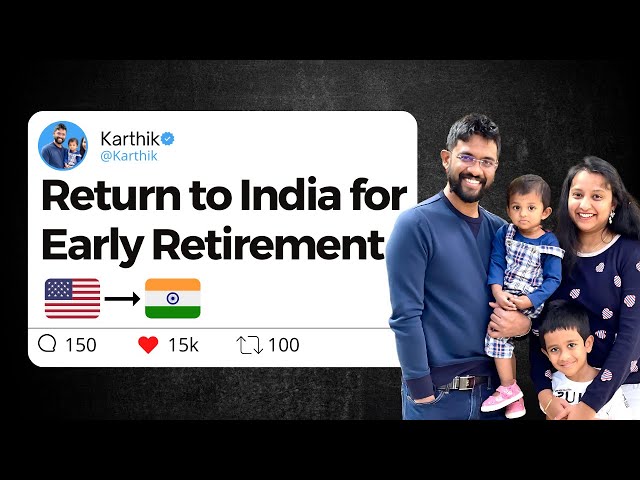
Watch: He Saved 40% of His Salary... Then Left the US for a Small Town in India
Ashish explains his 10-year US savings plan, 40-50% savings rate, FIRE number, tier-3 India cost model, family reasons, and remote-work return path.
The full write-up, with the numbers and the links.
Chapters
- 0:00 Introduction
- 1:40 Background
- 6:32 Why the thought of moving to India?
- 10:48 Decision process
- 16:28 H1B sentiment
- 20:22 FIRE Planning
- 32:00 Planning the move
- 39:24 Life in India
- 42:35 Life in Tier3 city
- 47:53 Any surprises?
- 49:18 How Desi Return helped with the journey?
- 51:10 Any advice
Transcript
Auto-generated captions, lightly cleaned
0:00 Like like causing discomfort for me with with respect to okay I'm I'm being far away and and all of that and and it's they are managing by themselves. That was the second one and and the third aspect was the financial independence calculations. I would say at least 40 to 50% of our take home was was entirely savings. And and that that part was intentional. If if my yearly expenses so much, I'll have the bare minimum covered. If if my yearly expenses like plus 20% that would be comfortable. If it is like plus 40% on on top of the base that that that would be the the best case that would be the ideal. If those are all the assumptions.
0:49 To is very comfortable. per month. Basically I think they they scrapped all the appointments, especially the appointments for the next one year. And and I would I would really I mean that that sort of stuff would really make me really sad.
1:39 Thanks a lot Ashish for joining us
1:41 Today. So let's start a bit about your background and what made you to go abroad. sure Anashua. Thanks for having me. It's it's a pleasure to meet you and talk to you directly. yeah, so I graduated my bachelor's in 2012. and and I I got placed in a decent company on campus placements. and I started working. and and 2 years after working, I mean, just just like a lot of people can relate, the bug started. Like everyone else is going to the US or Australia or Germany or Canada. maybe I should try it out, too. And and I know a couple of I knew a couple of people at that time who directly went from right out of B.Tech.
Read the full transcript (63 more sections)
2:30 But I wanted to work. I wanted to experience that. And so, yeah. I I looked into universities. I wrote the GRE. the the whole process, I think a lot of people are familiar with with with with that process itself, right? So, everything worked out after after a couple of years of work, I I joined master's in a master's program in one of the decent university. I mean, it's not like like tier one or but I would I would say it's a tier two university in the US. and it was a 1 and 1/2 year course, like three semesters. and things were much better at that time. I I was able to secure an internship during during the summer after like first two semesters.
3:20 And then luckily that got converted into a full-time offer. like 1 and 1/2 year after I I joined my master's. so, in 2016 January, I I joined my employer. But and I stayed with that employer for 10 years until 2025 December, exactly 10 years to the to the dot until I moved out of the US. Got it. So, it's only one employer pretty much Yeah. Yeah. One employer in 20 And and actually that was the same employer I've been with in India from 2012 to 2014. So that that also definitely helped with with like securing an interview or or something like that. That it made things a lot easier because I knew people inside and and they were able to make sure that my resume goes to the top of the pile of like hundreds of resumes that come in for any of these positions, right?
4:16 Yeah. So so yeah, that that was professionally the the situation and then after I got a job, I mean I got married and we we had a child like right now we have a two close to three-year-old kid and yeah, that that that is how I ended up my my US journey has been. Yes. And it it has it has been really great. I mean the the the 10 years have been really great like learning experience and work experience. And and speaking of the employer, my wife ended up getting a job at the same employer. >> [laughter] >> So so we we we have a lot of history with with my employer basically as as a family and and as an individual person. I think I we got married after one year after I moved.
5:10 So we we knew each other from from our bachelors. So after I after we got married, she came over here and and she had her own share of issues with like H-4 EAD and there was no immediate work authorization. But here she already worked for like four years for a central government company. So it was a tough transition for her initially. So she was like, "Okay, I'm not going to sit idle. I'm I'm going to do my own masters." and then she she did secured an admission in one of the one of the decent universities. and then after that she was able to find a job within our same company. So yeah, we have a lot of history with our employer.
5:55 Got it. So was that with H-4 EAD or her own H-1? >> So she as soon as she got an admission with with at her university she moved to F-1 because that opens up a lot of possibilities, right? With H-4 EAD you can't even work on campus. And obviously the OPT and and all those STEM OPT and all of those benefits they they won't happen with H-4 EAD. So she immediately as soon as she got an admission she she traveled to India, went to her visa interview, got her thing done. And once she got a job she she got her own H-1B. Got it. Cool. So sounds like I think it
6:34 Was good times in US for 10 years. Had a good career and so on. So why the thought of moving to India and when did it even start occurring to you? Yeah. So when I moved in when I moved to the US I was not thinking about okay how long will I stay here or or what is what is the exit plan or anything like that. But my wife she she has always had one foot in in India. I mean actually even when I first thought of it to go just by myself and as I said we were together at that time. Her first thought was why do you have to go? Why do you have to do do a long distance? Things are fine now and all of [laughter] that. So so there was that and and then so so it used to say that she she always had had a foot in India and then she was she still is very attached to both of her siblings and her mom and all of that. So she has very strong family attachment all of that too. So
7:35 As time went by she she got got used to the idea and I was like okay okay I'll come and we'll let's see how it goes." but but I definitely want to come back sooner or later. So, as it is the case with with a lot of people, since from the from the beginning it was in the in the back of the mind. but once she got a job and and once once things stabilized for us after after our marriage, until then we were doing long distance. when when she was on H-4, it was I mean, the the financial situation was was not I mean, we were definitely comfortable, but it was not a lot of savings on one salary and all of that, right? So, but but once all of the those were figured out, I think it was in 2019 she started working. At that time, we we we started seriously thinking about, "Okay, we if if we have to do we need to think about timelines and everything." And at that time, we were also looking at buying a house because both of us are working at the same place. It it only makes sense now. so, what we were
8:37 Planning was, "Okay, if if we do buy a house, we need to look for a shorter horizon. It's it's not going to be like 5 or 6 year thing." so so, we need to put a down payment accordingly, my manager monthly payment accordingly, and all of that. And very honestly, 2025 sounded like a nice round number at [clears throat] that time. So, it was like, whatever we targeted was like, "Okay, 6 years. let's take like 3-4% appraisal of the house per year. then it is going to be so much we we we are going to make so much upon sale and all." Fine. So, so since that time we we we were fairly certain that that on at that around 2025 we would be going back. the I mean, in hindsight, I can say that things went according to plan.
9:30 A lot of things could have gone wrong and and not according to plan, and we probably would have pushed it forward or maybe even backward depending on like family situation here and all of that. so once once we figured that out, once we had that the date in mind, we were consistently basic basically planning everything around that. And then COVID happened. so so two years everything was shut down and we couldn't move and and that that that only added to the frustration of not being able to travel, stay close to family and and and not knowing what what the situation on the other side of the world and all of that is there, right? so yeah, and and the timeline with the kid also worked out because we we knew that we were going to start a family in the next couple of years at that time and and the timing would be right. The kid wouldn't be too old where it is a whole other thing for him to get adjusted and all of him or her. We didn't know it but it was him
10:31 At that time. [laughter] to get adjusted and all of that, right? So, a lot of things really fell in place. We tried to plan as much as possible and try to look like two or three steps ahead but but but things also worked out for us. Okay, great. So, before we jump onto the
10:49 Planning because it's a long planning like you know, 2019 to be filed. So, I wanted to confirm on the decision process, right? See, I think your wife was always keen on, you know, spending time. Sounds like you are open but not like certain and as you mentioned I think the reasons that you went to US were also like career, financial, you know, other aspects. So, how did you think through that process, right? I mean, you know, both of you have to be on board and you know, you both are in a growing careers, you know, you can do much more in US. Why the thought about India is like more strong where you have to like okay, you decided in 2019 itself that you'll be moving in five six years because by that time careers can go in a different trajectory and all. So, what is the big pulling factor for you and then for the family to decide? Right. Right. So, I mean, honestly, the the career aspect of it, whether you want to call the fire or motivation of of like climbing the ladder and growing
11:50 In career and all of that, that has fizzled out by that time. For me, it was like, okay, yeah, I I don't mind what whatever I was doing. And and you can also see it in my career trajectory, right? I I could probably have could have taken a couple of risks, made a couple of jumps, and and like financial and even even designation wise, I probably could have made a better progress than than what I did. But but I I I didn't have as much passion towards it, I guess. I I just wanted to take it slow at that point. So, so, I have a better career here if I want to become the next Sundar Pichai. I need to stay here. I didn't have that sort of motivation at that time. That was one thing. The other thing was family situation. My my parents my my mom's health started deteriorating.
12:44 So, right now, she she suffers from Alzheimer's. She she is like at mid-stage Alzheimer's. So, I think I think at that point, I don't think it was full-on Alzheimer's, but but she she had had she was having dementia and she was forgetting stuff and all of that stuff was happening. And basically, my dad was taking care of her by by himself. One of my siblings, he also stays in the US. So, both of us were not close by. So, there was that factor. And and my my dad had his own health issues. So, that also started like like like causing discomfort for me, with respect okay, I'm I'm being far away and and all of that and and it's they are managing by themselves. that was the second one and and the third aspect was the financial independence calculations.
13:43 At that time actually I didn't even know about about FIRE and and like financial independence and retirement planning and all of that. but but I mean just just by doing some back of the math back of the napkin math, I was able to comfortably figure out that okay, if I if I move to a smaller city, I mean to to provide context to to to the viewers, right? Right now I'm staying in I moved back to a tier three town in Andhra Pradesh. So, I'm not in Bangalore or Hyderabad or any other one of the metros. So, I wanted to come to this town firstly to stay closer to parents and secondly did it it was easy to manage the expenses here even if I don't get any opportunities here because that that that needs to be a basic assumption, right? If if I'm staying outside of the tech hubs or whatever. So, so yeah, there there there these were the three main factors or or kind of two main I guess. I mean, my
14:43 Motivation towards work and and growing the corporate ladder and career and all of that started fizzling down. At the same time, I was also starting to figure out that okay, maybe maybe I don't need to need to to grow up the corporate ladder to to have a decent life and and definitely it makes things a lot easier in India. And obviously the rest of the stuff are the I I figured out the H-1B issues at that time. I think Trump was already president at that time. and he was like in his first term. And he was in his first term. So, >> so there there there there was there was all of all of that sentiment change towards immigration and all of that overall. So, I it also happened organically. It was not like my my wife sat me down and had an intervention or something like that.
15:32 Nobody saying that, "Hey, I'm going to leave. Are you going to come with me or not?" There was no such ultimatum. Organically, it it happened and and I'm I'm really glad it did happen because neither of us felt like we we were compromising on a lot. Even she even though she was not happy initially, but she she understood the advantages of of the US, right? Whether it's like career-wise or or she she was in a government job, so it was very strict like bossism and no no appreciation for for like work and all of that. She was kind of coming from that background and looking at US work culture and all, she definitely had a lot of learning and a lot of great experiences there. Yeah. So, between both of that we we naturally came towards a conclusion that yeah, moving back really works well for Makes sense. So, I think it's a lifestyle, parents, and all these aspects I think, you know, definitely. Yeah, thanks a lot.
16:28 I know this is something that you mentioned. Just wanted to understand a little better. I think the sentiment has changed in the US, right? I think, you know, that's also like a a minor factor. So, anything that you can share on that visa, the sentiment, or the challenges, or some of those, yeah. Right. Right. So, tell an anecdote. I mean, one of my uncles, he he has been He moved to the US like, I don't know, maybe 30 or 35 years ago or something. And he's settled there. He's a citizen and his his kids are citizens and all of that. So, when I was moving back, I I gave him a call and said that, "Hey, I'm moving back." And and that that was that was such a shock to him. It it was such an alien I mean, you've been here so long, why don't you still have a green card?
17:20 >> Right? I mean, so I he he he he was probably one one generation behind and and at that time things were so so good and so easy in in multiple fronts, right? I mean, you come in within 5 to 6 years you can get a green card where 5 years after that you get a you become a citizen. and the H-1B the lottery never filled up, right? I mean, lottery was not even a question. this was like long time ago, things have changed even in the last 10 years things have changed a lot. the the overall sentiment I think it depends on how much news you watch, I guess. in my workplace or in my community I never felt anything negative with hey, you you're taking away our job or or or any anything negative in in that sense, right? I mean, people were always always really really nice.
18:16 But but I mean, with with government changes and everything there have there have been like structurally very huge opposition to immigration, legal or otherwise, right? and especially very recently I think they they scrapped all the appointments H-1B appointments for the next 1 year. And and I I I would I would really I mean, that that sort of stuff would really make me really sad because there there there there there is no if there is an emergency, whether it's a health emergency or family emergency, being away indefinitely essentially and not knowing when when I can go back and plan. That that sort of stuff definitely I mean, I personally missed my sister-in-law's wedding because I didn't have a stamp. I just had to stay back and and my my my wife had to come to India. So, that sort of stuff, right? like 10 years ago or 15 years ago that was not not a problem in that sense. Yeah, even though the green green card backlogs were still a
19:17 Little bit longer, nowhere as long as they are right now here. But the all of those things have have changed, right? and and on the other hand how however however many opportunities you have whether you have high or low in India, I just I know I just said that the the job opportunities have been reducing, but still whatever job opportunities there are, the the salary is very comparable to the US when you adjust for like cost of living and all of that. Yeah. earlier those those opportunities were not there. You either get a government job or a bank job or or you figure something out, right? But but now things have changed significantly and then there are opportunities. the landscape is changing, but there are opportunities. We just need to keep adapting either way, I guess. Got it.
20:08 >> So yeah, the the the depending on how how how you how you pursue the the ongoing situation, micro and macro situations within the US, you'll probably need to take a call.
20:22 >> Let's talk about the planning, right? I think in 2019 itself like you had maybe some calculations. I think the fire is one important thing. Maybe you can walk through that or you know how did you like is there certain milestones that you have planned like you know once we reach that we will make a move. Is there anything like that went in the planning or yeah, so as I said, right? I mean I we did our calculations a little backwards because we decided on a date and then tried to figure out if if we can fit it or not. Yeah. and and eventually we we were able to fit it, right? Whether it's like career progression or promotions or increase in salary or or whatever, all all of those factors they they they definitely helped us and and we were intentional our our spending too. As I said right, the the home we had was a fairly small two two bedroom town home. And our monthly payment including
21:22 What you call the the Peter, right? Our property tax interest taxes and insurance all of that it amounted to like $1,400 a month. So we we we were able to save a good amount of money. I mean I would say at least 40 to 50% of our take home was was entirely savings. that that part was intentional because we knew that okay yeah we need to figure out a way to exit by 2025, right? Milestones yeah we we did have milestones in the sense that if if my yearly expense is so much, I'll have the bare minimum covered.
22:09 If my yearly expense is like plus 20% plus 40% on on top of the base, that that that would be the the best case. That would be the ideal case, right? So so we we we were planning one step at a time. So we as soon as we we were able to reach the first one before before the stipulated timeline 2025. We were comfortable at that point. Okay yeah now now we we don't have to figure out our planning around Bangalore or Hyderabad or Mumbai or Pune or whatever. We can go ahead with with a tier three or two or whatever. I mean we we the plan to move to tier three city was idealistic, right? I mean it it would it wouldn't have happened if we we didn't reach our FI my the way we we thought of them, right?
23:02 So, but but the thought process was that if we don't if we can't get to 100% if you only get to 70% or something, okay, then then we'll go to Hyderabad or Bangalore and work a few years and then figure out figure out what what to do. Got it. and another kind of thing that sort of worked out in our favor was was COVID and remote work and all of that, right? Remote work suddenly exploded after COVID. So, the possibility of okay, maybe I can I can go not stay in Bangalore or Kurnool even in India and and continue my job even if it is at a reduced pay. that that suddenly opened up. at the time we planned in 2019 or whatever, we probably couldn't have envisioned that because at that time that was not even not even a thing, right? so, that that was another thing. It was on the back of our heads at least I mean, she knew that she she she wanted to quit and and completely
24:02 Pivot to a different career once she moves, but I I was like, "Okay, I'll see if if I I knew because our company had presence in in India and I had such a long history with them. I was hopeful that that the the company might be accommodative of to to some extent and that is what ended up happening." Got it. if it's okay, if you can talk a little bit about some numbers, right? I think you know, maybe on the back of the envelope like, you know, for a tier three city in India like is there some range that you had for an annual expense and all that stuff? I know you kind of mentioned from in from that perspective like X like 20% 40% which is more comfortable. If you can share, I think that would definitely just help the viewers to see through that along those lines, yeah. Sure, yeah. So, so the the very I wouldn't I wouldn't even say very minimum. I would say a a decent lifestyle, right? I mean, you you eat out once a week, You you go to a movie once every couple of weeks.
25:01 You shop in Amazon for like let's say 5,000 rupees a month or something like that. And and another assumption was you have your house figured out. You don't need to pay rent or EMI or whatever. If those are all the assumptions, 80,000 rupees 80,000 to 1 lakh is is very comfortable. per month. And you probably need to account for like yearly expenses. Let's say >> [singing] >> you need to buy a new phone. Once every 3 years or something. So so that that that might come up here and there. Your yearly if you have a car yearly car maintenance, car insurance, health insurance, life insurance. All of these yearly expenses, I mean, they might amount to like 3 lakhs or something like that. But but 80,000 per month for 12 months and and like like 3
26:02 3 lakhs for what we call yearly expenses. You can get a very very very decent upper middle class lifestyle, right? Let me put it that I don't think you can do like international vacations once every 6 months or something like that in in this budget. But but and I mean this is also including cost of domestic help in in in the house and and obviously groceries and fuel and all of that. So that is that is the that has been our same middle level target. Yes. If you could go beyond that and and both of us like to travel. We used to travel a lot in the US and and and try to account for like some travel to like Thailand or Vietnam or or somewhere close by. Maybe Europe once every 3 4 years or something like that.
26:55 If if you can account for that, those will obviously increase and and with travel you can spend however you want. There there is no upper limit to that. Got it. I mean I know you mentioned about the house. The other big one is also the education, the school, right? Like what did you factor in like with the school for the kids especially you have a young kid and yeah. Yeah. Yeah, so that's a good point. Actually >> [snorts] >> I think housing and schooling. These are the two things that significantly differentiate tier one cities from like two or three tier two or three, right? Rest of the stuff, I mean if you order in Swiggy whether you order it in in my town or in Hyderabad, the difference is not going to be too much. So schooling what I'm from what I saw and what I'm accounting and I'm not still one totally 100% figured haven't figured out what his next 12 years of schooling is going to be whether I want to do like an international school
27:56 And and in my town there there is no true international school yet. I mean they call themselves international but they don't have like IB or IGCSE or any of these syllabi. So right now what I'm factoring in is like 70,000 per annum. That comes to roughly over 5,000 rupees per month, I guess. Yeah. And that that happens at like middle school primary and and above. If if for the first three or four years it is going to be between like 40 or 60,000. Got it. And again for for the first three or four years I'm not thinking of anything exotic like with respect to international schools or anything. Maybe my my opinion will change once he I'm sorry. Once he starts actually learning and and once the syllabus and all of that starts becoming important.
28:47 That's when I plan to take a closer look at the how much I want to spend and and what sort of syllabus and what sort of school is is important and that sort of thing. But in in in the budget what I just just said like of 80,000 or whatever, you you can account for 5,000 rupees for fees every month and I think that that that will that will cover for a decent school. Got it. Yeah. Thanks a lot for sharing that. And then like any mention without even before knowing the FIRE like you already thought about like you know how to have a life without like you know being on a on a job or something. So when did you hear about FIRE and then is there some FIRE multiplier that you have in mind like you know that you want I know you mentioned like the actual like what is that number or like the multiplier that you you were talking Right. Right. Yeah. So I mean I started looking into like the literature and like Mr. Money Mustache and and and all of I started following all of these financial advisors if if you may call them, right?
29:47 That's when I figured out like okay there there is an entire instructor around this they call it safe withdrawal rule and multipliers and and all of that. And and for US the safe multiplier is 25x. if your annual expense is 10 lakhs say, if you have 2.5 crores you you are at least within the within the US ecosystem for 30 years you are set. so so that that that was easy first target to work with and and I've been going off of that for the first few years. and then you you you can start refining it. For India folks say that because of higher inflation and everything it has to be 30x and I sort of agree with that.
30:37 And with the the once once we started getting comfortable and and things started getting comfortable for us financially, we started increasing the our budget basically. Initially it was like yeah, let's just target for the bare minimum. Then okay, what if we add some padding and all of that. So it went through multiple fine-tunings like that. By the time I moved out, I think we were at somewhere between 30x to 40x. Got it. So yeah, and and I would like to make a note that we were not planning to fire at that point. I mean my wife was planning to quit anyway, but but by the time I moved out, I had I had an internal offer and and my company was willing to support remote work. So we we we technically had FI corpus, but but we weren't planning
31:40 At least I wasn't planning to retire early anyway. Yes. And and I was planning to work for a couple of years and then figure out stuff once once we moved to we moved to India. Got it. Now thanks a lot Ashish for sharing some of those you know numbers and multipliers because that would help the audience to think through that. I know like you started planning in 2019
32:01 To 20 like you know before making the final move. I know financial planning is something that we talked about. What about others like career, you know, when did you have those discussions with your employer or maybe from a logistic side or you know something like wrapping up the stuff in US? So maybe you can talk a little bit about that like in general from a planning perspective. Yeah. Yeah, so actual planning planning started say 1 year before move. Like 2015 January and and I think that's when I stumbled upon like like the the Desi Riton channel and then some of the interviews that you have been doing and all of that. So at that time we we started looking into the major thing was house for us. Yes. Because we had to select thankfully we didn't have any issues with school or anything.
32:49 One one thing we did slightly differently with my child is that he he didn't go to daycare in in the US. When he was 10 months old or so we tried for for a couple of weeks but he immediately fell sick for like 6 months or so and it was not a good experience for us at all. So, we are like okay we are in the next one one and a half year we are we are anyway going to move. There there is no point trying to get him accustomed to the the environment here especially in the place where I used to live we used to the wait times was on year. For for for any daycare I mean forget good daycare or bad daycare. For any daycare the wait times are like 6 to 6 months to 1 year and and it just didn't seem worth it for us. So, so we had a nanny who came in part-time like about 20 hours a week or so.
33:41 And again even the remote work stuff was also helpful at that time because we we were only expected to go to office 2 days a week. So, 2 days I used to go 2 days my wife used to go. One one person was at home all time and and the nanny would just come in and and help out with the with the child when one of us were working. So, yeah. All this that is to say that we we didn't have any anything to worry about my my son his him getting changed schools or anything like that was not there. House we started talking to the realtor in like May or something like that and I I gave my timeline okay I want to move out by December. She said that this might be a little bit too early to to decide because real estate market is seasonal and all of that. So, end of June she she actually started working on the house with like these staging and and paintings and and making any of the changes and all of that.
34:43 It it did take take time for us. And I think last fall and even now the market is maybe barring the area, I guess, or or any of the other hot spots, rest US the market has is still a buyer's market, I would say. If there hasn't been like significant appreciation. I mean I mean if I look at like junior students or whatever, or even if you look at similarly priced sized homes around my community, they were sold at higher price 2 years ago than what we sold. Yeah. So, some some of the folks who bought in like 2022-3 had to sell it for a loss basically because the market has tapered down. 2022 was like like it was so hot, right? Yeah. so, we we the house was on the market for like good 2 months or something like that. I mean [clears throat] we got an offer
35:44 Within the first 3 weeks, but but but it was on the By the time the process and all has happened, we we we were supposed to travel on December 8th was our flight. Our closing date was on December 4th. Okay. So, I mean we we didn't have to physically stay in the place that we I think we signed like 10 days before or something like that. So, my my wife was really getting anxious with that. I was kind of okay. I just didn't want to deal with FIRPTA and all of this. Yes. As soon as I become non-resident for this year, I'll the what you call capital gains tax the I need to start looking into that. There were all those complications, but I was like, "Okay, I mean if you have to sell it from India, we have to do that.
36:29 But yeah, luckily we we only had one offer and we just accepted that one. that was okay. I mean, I think we we cleared 20K less than what we expected basically. And in the in the long in the big picture, I think it's okay. And it was definitely worth the peace of mind. We we didn't want to like wait two more weeks, host two more open houses or something and then try to negotiate and all of that. So yeah, the house house was a big big aspect. All the rest of the stuff actually was very fairly easy. I mean, almost all another thing that that we tried to make it easy for ourselves is we came back with like eight suitcases. That's all. We didn't carry any of our stuff with us. Firstly, because most of the stuff we bought again, we knew that it was it was not a long-term thing. All this furniture was fairly cheap and moving all that furniture would have cost us as much as the furniture itself.
37:29 So so it didn't make sense for us. And also even if we move here right now, we are staying at our parents' place and and our own place is not yet ready and it takes time. So we don't even know where we would have kept this stuff if we bought it. So that that was again, we we didn't want to deal with all that logistics. And we were able to sell almost everything on Facebook. Yeah, including like big big furniture, we just gave it away for free because it had to be dismantled and taken away and you have to have a truck and all of that, right? So that was really easy. Car, I highly recommend Carvana for for anyone trying to sell. Maybe you you'll get like $500 to $1,000 less or something, but but in my case that didn't even happen, But heard that for some folks that happened. But but the process is so smooth. I mean you don't have to worry about anything.
38:26 You just give your keys and they'll pick it away. So that was something. Okay, the employer wise I spoke to my employer in August or something. And said that hey I'm planning to move. I don't think I'll be able to move to Bangalore. I'm planning to move to a tier three city. If you can provide me a internal relocation international relocation with a remote position I can take that. That was my proposal. And yeah, my my employer initially was they were very accommodating of that. They they tried to get like high level approvals and all of that. And by the time we moved out I I had an offer in hand and Once I moved I took like a couple of months off break and then I started working. Got it. No, thanks a lot for sharing that. So
39:24 How is life in India now? >> Yeah, so things have been as expected. Right? I mean we had certain expectations. We had expectations about family. They were met. We had expectations about traffic. They were met. my my kid is having a lot of fun. I mean especially moving during winter time was such a huge relief especially this year with so winter being so bad in the US, right? We were really dreading even the December month, right? Because my kid he always wants to go out. He doesn't want to stay home. He wants to walk around and and go go around to playgrounds and parks and all of that.
40:14 It becomes really hard in the US with that, right? But but here he's having fun. He started his school like about 3-4 weeks ago. I think he he's slowly getting adjusted with it. the crying has stopped. >> so and and parents are really happy to to both sides of parents really happy and family are really happy to spend time with us and the kid and all of and as I said, I I started my work, but but the only surprise that that I sort of accounted for but but not immediately was that like 10 days after I started my work in India there there has been a company level policy to scrap remote work in India with my employer.
41:03 So I I I started my work on February 9th here. I worked for 10 days or something. On 19th I I got a call from my boss saying that, "Hey, this is the policy. We need to We need to make some difficult decisions." so the the I I still have time until like June 1st to either move or or figure out my options. Right. I most likely I'm not going to move. I I I have a couple of things in mind that that that I I wanted to pursue anyway in in the long run, right? I mean, my my original plan was, "Okay, I'll I'll do do this job for a couple of years or something and then I'll I'll move on to something else." that that timeline might might might get pushed back a little bit, I guess.
41:50 But yeah, I mean, I think I I want to let folks know that these sort of surprises so sooner or later something or the other is going to happen in in in such a such a huge move, right? It's it's not probable that everything goes according to plan. with a corporate job and a tech job, there was always a possibility of a layoff or like policy changes or all of that. it's just that it's happening so quickly after I started. It It It is It caused a little bit of discomfort, I guess, but I mean, it's fine. We have We We We have some options, and we'll probably figure those out. No, thanks a lot for sharing that.
42:35 I'm curious about, you know, someone making a decision and living in tier three city, right? Especially someone who lived in abroad for some time. you know, one thing is I I think because of the flexibility with the careers and all this stuff that makes sense, but also like having these interactions with the like-minded people, right? Like those intellectual discussions, you know, the city shutdowns like, you know, at 8:00 p.m. or 9:00 p.m. it's not like much activity going on. So, how are you coping up, or maybe it's your lifestyle that you prefer? Because this is something people always, you know, they might want to go to a tier three tier three city, but hey, their options are limited. Maybe kids might not adjust, or maybe, you know, those kind of social interactions. So, just curious in terms of how it's going for you, yeah, you know, from that angle. Yeah, yeah, I mean, you you you definitely bring up a couple of important issues, right?
43:25 So, so, first thing with kids, again, it became really easy for us because this is all he knows, right? Yes, yes. so, so, that that makes things easy from kids' perspective. city shuts down at 8:00 or 9:00. We can live with that because with a child, it's not like we are going to pubs every other weekend or something like that. So, so, that that that is not an issue, too. schooling again, right? I mean, I'm I'm yet to see what what needs to happen. I mean, I'm fairly certain over the next few years, like like a proper international school will will come to my place, but I I have my my concerns about whether whether that level of price is needed for for high school or schooling education. I mean, schooling education is is a is a big issue in itself, right? Especially in India with the cost raising cost.
44:16 Schooling inflation is like 15% or something ridiculous like that. so yeah, that that one I'm I I it is a little waste on and I'm probably also okay with him completing until his like 10th or 12th here in a in a decent mid-tier school and then moving on to like like Hyderabad or Bangalore or wherever you you have like better plus two schools or or engineering colleges or or maybe even US, right? If you're talking about under learning and all of that, right? So so that that that is another problem that that is not very urgent for me. some things that that I one of the major things that that definitely makes a difference for us is the social circle and like-minded people. luckily one of our friends a a couple they stayed in some other foreign country and they moved back at the same time as we did. Actually, they moved a year before we we did to the same town. so they they they are the direct ones
45:19 Where we can shamelessly complain about all our first world problems, right? so that that that that provides one one sort of way went out for us. It would be nice if there were like more more families like that or or more folks who who who are like-minded to us. right now all of all majority of my interaction is is online through via various communities the the the the city return community and other folks. I know some of my friends who moved back to different towns and and maybe to Hyderabad and Bangalore and all of but they they they share some of the same return to India concerns or whatever and and that is something.
46:07 One thing I definitely miss which which maybe it takes a few years for for a tier three city to have all those facilities is like decent libraries. I mean even even in Hyderabad or Bangalore we don't have a lot of libraries but I've been hearing that there are some like private players who provide really nice libraries for children for their books or for them to spend time and all of that sort of stuff. And I think you mentioned a couple of times about a running club or something like like for for outdoor activities and and stuff like that. You you have a lot more options in cities, right? So that sort of stuff is is a little adjustment and our plan for that is we we have some family in Bangalore.
46:52 So we we we will be traveling anyway. It's not going to be an every weekend thing but every once or two times a month we we could make a trip to Bangalore and try to plan something there as a family or something like that. That's our plan. I mean one of the the natural spaces and like interaction with nature that is one of the major compromises you need to be prepared when moving back to India, right? I mean whether it's tier one, two or three that sort of like hiking culture and all of that it's it's still a little bit lower. I mean my my town had their own their first pickleball court like six months ago or something >> So things are things are showing up and we have like an indoor cricket thingy. If you want to do stuff like that there are opportunities and options and maybe we will will will plan travels strategically to Bangalore or Hyderabad depending on the need I guess. Makes sense.
47:52 I know you said most of your
47:54 Expectations were met. Like were there any surprises? anything that you guys have encountered so far? Surprises. In a good way or in a bad way, I mean. I mean, for me I don't I don't I haven't had any any surprises. I mean, right now this room is fairly hot what I didn't used in years, but but yeah, that is what it is. We had an AC set up like a couple of days ago. So, that that sort of stuff with respect to weather and all of it, right? And and I will take a hot Indian day over a cold winter day >> Yeah. any day of the year. So, yeah, honestly I didn't I didn't have any any surprises with respect to with respect to adjustment and everything.
48:48 I would I would have like to be surprised in a positive way with respect to like, I don't know, cleanliness or civic sense. And those those are the known issues with with with India, right? I mean, some places it has improved, but some places it it's it's just where it has been since since the last time I have left. But yeah, my short answer is I haven't had any surprises. Makes sense. And then one last question,
49:18 So how did Desi Return help in your return to India journey? Oh, it did it helped a lot. I mean the amount of knowledge within very firstly, I mean, even before the WhatsApp group became very large, right? Just hearing stories of of so many people from different backgrounds and countries going to different parts of India. That has been very really reassuring. It's like I'm not the only one taking the road that was less traveled or something like that, right? So, even I was telling my dad like I mean he was always worried, "Okay, why why you are giving up so much and coming back and all?" I think that's a story in everyone's home.
50:07 But but when I told him that, "Hey, there is this community where 1,000 people are doing this." He was like, "Oh, are there 1,000 people doing >> And and that is definitely reassuring, right? I mean and and as as you were just mentioning about I don't have a lot of people in real life to talk about all the all the potential issues and and tax implications and investment stuff and and all of that. And and this is a great community to to share knowledge and all of that. And and just lately we have been realizing that as a collective group we have a lot more knowledge than than professionals I guess because apparently professionals don't agree with each other and So, yeah, it it it is a really valuable community and and really kudos to you Nationals for bringing this up and and tying all of us together. No, no, it's a small thing that I can do and I'm glad to be a part of these big decisions for people like when they're thinking
51:07 About or considering about moving to India. Cool. Is there anything that we
51:11 Haven't covered that you want to bring up or any advice for the future aspirants who are thinking about moving to India especially from a FIRE from moving to a tier three city anything that you can share? Yeah, yeah. So, I think that things are rapidly changing especially the the job and the market ecosystem and and all of that, right? I wish I could say that if if you made up your mind just pack your bags and move, right? If you want to move to India just do that but but I don't think that is that is practical advice anymore. I mean if I are not whether whether you want to continue working or not even if you want to come back come to India and work the opportunities are not as good as they they were like let's say even three or four years ago, Let's call it like the the AI disruption or
52:11 How the leverage has shifted more towards employers than employees, right? My own employer they were never as aggressive with with like scrapping the entire remote program for for an entire site that that itself was a was a huge surprise because my employer has been fairly we take feedback from employees and we we only make policies based on that kind of a kind of a company but but even that is changing because the ecosystem is changing. So I would say that if you can secure a job and move then that's great. If you can if you can get an internal transfer then then that that that is the best best way to do that at least one of these policies, right?
52:57 But if if neither of them are an option I would say at least five years worth of living expenses need need to be need to be set aside and and be prepared to spend through that. Given the situation, right? I mean I'm not going to say that like things things are great in US or or any any other Western country, right? I mean the the same impacts the same stuff that is impacting India are also is also impacting all the other countries but if you have something stable there which which is working. Make sure that you you have enough cushion while while while moving and and take ample time to plan one year or something at least and and I would say that >> [music] >> try to stay away from all the tax retirement plans like whether it's Roth IRA or 529 plans.
53:52 We keep having discussions in the WhatsApp group, right? I mean it it is such a huge mess to untangle and the the traditional 401K is so easy to handle because India recognizes that and and that's easy to manage once we are in India. But otherwise just try try to stay away from that. And yeah, the tier three tier three city and all of that it really depends on one's personal situation, family situation and and as you said there are downsides to these sort of cities, right? I mean I can I can go from anywhere to anywhere within 20 to 30 minutes. That's a huge advantage. But but there are also downsides. So and I definitely had I mean my family being here, my parents being here. I was born and brought up here. My parents stayed in this town for like 30 years or something. So I have a lot of contacts through through them for for anything. So that's sort of
54:55 Support is definitely priceless, right? I mean we thought that building all all that network and referrals and all of that from scratch will be will be hard. So even if if a tier two or tier one city becomes slightly expensive. Don't let the expenses control the destination. Yeah, so thanks a lot Ashish for sharing your journey and talking through some of the numbers and you know the life in a tier three city. So really appreciate because these are the things that I think people need to understand the reality and what went through your thought process and this can help others to make their informed decision, you know, whether that's a right choice for them or not. So, thanks a lot again for taking the time and sharing your story with us today. Yeah, thanks very much. It was great talking to you. Yeah, great.