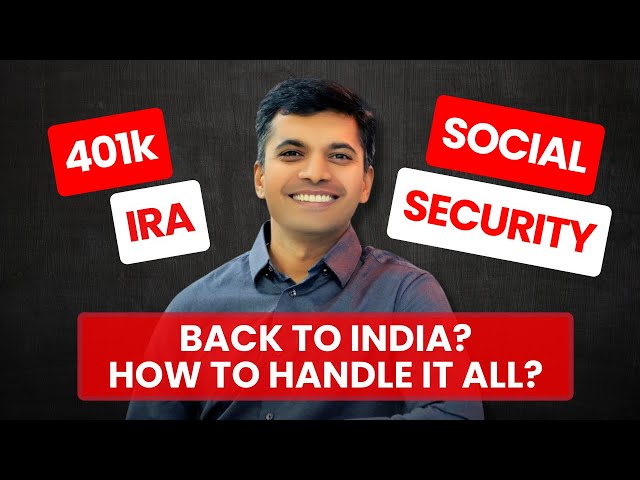
Watch: Planning Your Move to India? 5 Things You Can't Afford to Miss | NRI | Back to India
US bank and brokerage accounts, keeping your US phone number, 401(k) and RNOR planning, moving back with children, transferring money, and choosing the right move date.
The full write-up, with the numbers and the links.
Chapters
- 0:00 Introduction
- 0:53 What Happens to Your US Accounts?
- 3:36 What Should You Do With Your 401(k)?
- 5:38 Moving Back to India With Kids
- 7:10 Should You Move Your Money to India?
- 8:32 When Is the Best Time to Move?
- 10:28 Freeze Your US Credit Before Leaving
- 11:11 Plan Your Return to India Early
Transcript
Auto-generated captions, lightly cleaned
0:00 Over the last few years, I have spoken to a lot of families. What I have noticed is that even though every family situation is different, the same five issues come up again and again. US bank accounts, 401(k)s, kids, moving the money, and finally when to actually make the move. And what's interesting is that these are not five independent decisions. They're all connected because the best time to move may depend on your kids' school, and the financial planning might depend on your tax situation. And your tax planning may actually influence when you move. So, today I want to walk you through the five things I would want every family to think about before leaving the US. Not a checklist, but a way of thinking about the transition.
0:50 One of the first things people start thinking about is what happens to all my
0:55 US account numbers or financial accounts when I move to India. And this is where I see people sometimes think, "Hey, I'm moving to India permanently, and so the US bank might close my account." Not necessarily. There are US banks and financial institutions that may allow customers to maintain relationship even after moving abroad, depending on the institution and your circumstances. We have several members in our community who have been managing their checking account with Chase, Bank of America, DCU, Wells Fargo, even after moving to India and also after updating their address as an Indian address. Note, if you go to the local branch, they might say it's not allowed. So, it's better to call the customer service who understands these edge cases and be able to update your address.
1:50 Coming to brokerage accounts, Charles Schwab, Fidelity, and E*TRADE are good options when you wanted to update your Indian address and something that you can maintain after moving back to India. I wouldn't definitely use Robinhood or WeBull for [music] a pure equity portfolio. These institutions specifically doesn't allow accounts [music] once you move out of US. So, please be aware of it and roll over your equities into one of these custodians, whether it could be Charles Schwab or E-Trade. So, don't wait until the last minute to figure this out. Do this while you are still in the US. First, review every important you have. Bank accounts, retirement accounts, brokerage accounts, HSAs, 529, anything that has money or important financial information attached to it. And ask, "Can I continue using this after I become an Indian resident? Do I want to consolidate these accounts? Do I want to
Read the full transcript (13 more sections)
2:52 Maintain these accounts? Do I want to roll it over to another institution?" And [music] complete this while you are in US. This is underestimated. And this is [music] your US phone number. Think about it. How many accounts use your phone number [clears throat] as a second factor authorization? Your bank accounts, credit cards, brokerage, and all the services that you have accumulated in the last 10 to 20 years. You don't want to discover after moving to India that you can't receive one-time password required to log in to your own account. That is why maintaining the US phone number can be extremely useful during this transition. And one option that's very popular among our community members and either I personally use is [music] Tello.
3:36 If you're interested, we have a link here as well as in the description below. And once you sign up, Tello dollar credit after a successful order when you use the referral link. The bigger lesson here isn't which bank or which phone company you to use. [music] It is don't disconnect your US financial institutions until you know you don't need it anymore. The second thing that comes up in almost every serious conversation is retirement money. Especially, what to do with my 401k money? There is no universal answer. I have seen people make this decision based on what their friend did. My friend cashed out everything out. Someone on the YouTube said never touch your 401k. None of these answers automatically apply to you.
4:25 There are several things you need to look at. One possibility is leaving the money where it is if the plan permits. But, this is the least preferred. [clears throat] The second option is rolling it over to an IRA. That's the minimum that you can do. And there are situations you might want to consider withdrawing as a part of broader tax strategy. And this is where R N O R resident but not ordinary resident planning can be important for all the eligible families who are moving to India. The point isn't R N O R means that you have to take all your money out. Absolutely not. The point is, based on your tax situation, based on your needs, the plan on what to do with your 401k can be different for different families during the R N O R period. And therefore, the timing of the financial decisions deserves to be planned [music] rather than improvised. We have actually done a much deeper video talking about all these options and what are the things to consider when deciding on what
5:27 To do with your 401k. And we have a description of this video on the screen as well as in the notes below. So, there is one thing I want you all to take away.
5:38 Don't make a six-figure retirement decision because you are three weeks away from your flight. Start looking into this months, ideally much earlier before you leave. Then, we get to the topic that is often more emotional than financial. The kids. This is where I have seen parents carry a tremendous amount of anxiety. My children was born here. They never lived in India. My kid doesn't know how to speak Telugu. They have friends here and this is what I have seen families who have made the move. This is the most anxious part of the families when moving to India and this is the least of the concern after the move because kids are very, very resilient. And generally, the younger they are, the easier it can be for them to adapt. But that doesn't mean the transition is effortless. They're leaving friends, they are changing schools, they're changing their daily environment. So, I wouldn't approach this as, will my kid adjust? Instead, I
6:41 Would approach it as, how do we help our kids adjust? So, involve the process. Tell them and understand why you are making a move. Involve them in the school selection process. Give them the time to build friendships and most importantly, don't expect them to experience the move the same way you do. For you, it might feel like coming home, but then it may feel like leaving home. That's an important distinction parents to understand.
7:10 The fourth issue is money and this one comes up all the time. Should I transfer everything to India before I move? And my answer is usually, don't transfer the money simply because you are moving. Transfer the money because you need the money in India. >> [music] >> For a lot of families, they're very familiar with the financial systems or the ecosystem in US and it's better to leave the money in US unless you need that money in India. So, just move the money that you need in India for the initial setup, for the first 6 months, and so on. So, instead of asking, "Should I move all my money to India?" I would ask, "What money do I need in India, and when do I need it?" That's much better way to approach it.
7:56 Also, for large transfers, work with your local relationship manager with your bank, so that you can get the best exchange rate. The important thing is you don't have to move your entire financial life from one country to another country on one particular day. Your move is a transition, and your money can also transit accordingly. So, no rush in transferring the money when you move. And this brings me to what I think probably the most important decision of all, when should you actually move? And this is where I see family optimizes for one thing and completely ignore
8:33 Everything else. Someone says, "October is the best time to move from a tax perspective." And some people will say, "Move in June because that's when the school starts." But there is no one magic date because you're actually trying to optimize three things at the same time. Your kids' needs, your career, your tax and financial planning. And sometimes these three things don't agree at all because your kid might have to move in June because that's when the school year starts. Your employer might want you to transfer in January, but from a tax perspective, another period might be more attractive. So, the question isn't what is the best month to move to India. The better question is, "What combination of timing gives my family the best overall outcome?" And this is where I literally would consider these three things. Kids' schooling, their school admission, academic year, exams, and so on.
9:25 The second is tax and financial planning, your US tax residency status, Indian tax residency status, O&R eligibility, and finally, your career. Notice period, new joining date, job transfer, and so on. Because sometimes moving 2 months earlier or 2 months later can change the financial picture. But, saving a little tax isn't worth it during disrupting your child's education or your career. That's the part that gets missed. The tax optimization should be one input into the decision, not the entire decision. Your goal isn't to minimize the tax bill. Your goal is to build the best overall transition for the entire family. And here is one last thing. It's boring.
10:10 It's not exciting at all. And nobody is going to make a full video about it. But, do it before you leave the US. Review your credit and consider freezing your credit with the three major credit bureaus, Equifax, Experian, and TransUnion. Because once you are living outside of US, dealing with identity
10:29 Theft, fraudulent credit activity can be much more complicated. It is one of those little pieces of housekeeping that's easy to forget. So, put it in your the pre-departure list. And that's really the big message I want to leave you with today. Moving back to India isn't like I'm leaving America and I'm going back to India. It's a series of decisions. And that's why at Desi Return, we don't want to simply tell you move to India or don't move to India. We want to help you answer a much more useful question. If I am planning to move back, how do I do it thoughtfully and prepare it properly? If you're thinking about moving back to India, even if you are 2 to 3 years away, consider subscribing to Desi Return.
11:12 Because the best time to move >> or start planning is not when you book your flights. It's much, much earlier. Also, if you have made your decision to move to India, check out our planner where we talk through the steps or the things that you have to do 6 months ahead, 12 months before, 3 months after before the move, and so on. So, check it out, which is a customized guided list of things that you have to consider when moving back to India. Until next time, take care.