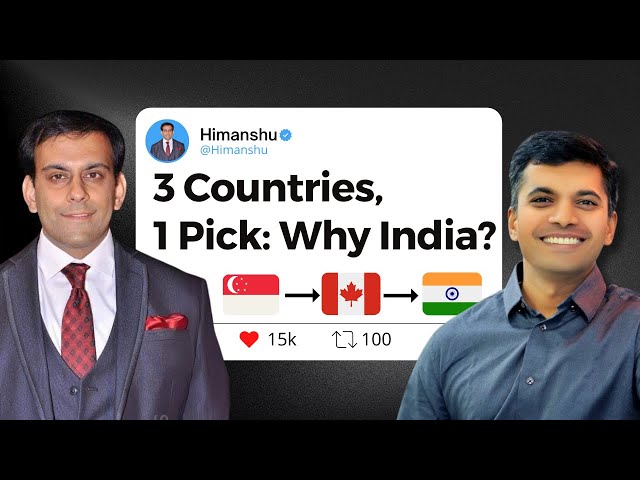
Real Return Stories | Episode #196

After 16 Years in Singapore, Why a Single-Income Family Returned to India

This transcript-backed story is useful because Siva is not rejecting Singapore. He describes it as secure, comfortable, efficient, and close enough to India to make family visits easier than in many Western countries. Even so, the combination of emotional distance, aging parents, children, and single-income cost pressure eventually pushed the family toward a very different landing plan in India.

Related planning guides: If this question is part of your broader return plan, also review moving back to India from Canada guide and moving back to India from Germany guide.

Key Takeaways

  • Siva finished graduation in 2005, had shorter Belgium and UK chapters, and then spent the long stretch of his overseas life in Singapore from around 2009 until returning last year.
  • He describes Singapore as safe, comfortable, well-structured, and especially convenient because India is only about a four-hour flight away.
  • The return decision was gradual, not sudden. Missing family moments, wanting children to bond with grandparents, and his mother's age all mattered.
  • Single-income pressure made the move harder to postpone. Rising rent, school fees, and healthcare costs changed the math.
  • He sent his family to India about a year earlier so the children could settle before his own final move.
  • His India landing plan was explicitly risk-mitigated: start near the native place in a tier-2 city so the family could sustain for a year even if the right job did not appear immediately.
  • The children's harder adjustment was health and environment, not just school. Even after keeping the IGCSE curriculum, he says standards in smaller Indian cities may not match what families expect abroad.
  • He is happy after returning, but he does not romanticize India. The tradeoffs are real, and he repeatedly says every family must decide based on its own conditions.

What to know first: Why would a single-income family leave a comfortable life in Singapore after 16 years? Because comfort stopped solving the deeper family problem, and the numbers also became harder to ignore. The transcript shows a family that still respected Singapore, but chose India for proximity, grandparents, children's roots, and a lower-risk landing plan near home.

How the Singapore chapter began

The transcript does not start in Singapore. Siva says he graduated in 2005, went to Belgium for about six months on a contractor-style opportunity, returned to India briefly, then moved to the UK around 2006 before coming back again for personal reasons. Singapore came later, around 2009, and became the long chapter.

That matters because this was not one clean relocation from India to Singapore. It was a broader international career that eventually stabilized there for roughly 16 years. By the time he returned to India, Singapore was not just another posting. It was where adult family life had actually formed.

The other useful background detail is that moving abroad was never presented as a grand childhood dream. In his telling, the process began by trying opportunities as they came, then slowly building a life around them.

What life in Singapore actually gave the family

Siva is consistently fair to Singapore. He calls it beautiful, secure, comfortable, and well-structured. Work processes were clearer. Life felt more organized. He also talks about discovering physical activity and a healthier lifestyle there, partly because organizations and the government encourage it more actively.

Another major advantage is proximity. He says Singapore to India is about a four-hour journey, which made it far easier to keep visiting home than if he had been based in the US, Canada, or Europe. That helped, but it did not fully solve the distance problem.

"Life in Singapore is very good."

That line matters because this is not a case of someone being pushed out by a bad host country. The story becomes stronger precisely because the family left a system that worked well in many day-to-day ways.

Why the India return became serious

The return decision was gradual. He says years abroad created a constant feeling of being disconnected from important moments back home. Marriage, children, and the passage of time made that disconnection harder to ignore.

The children were a central reason. At the time of the conversation, he says they were around 8 and 9 years old. He wanted them to have a real bond with grandparents, not just phone familiarity. The transcript adds one practical detail many families will recognize immediately: language. The children spoke English, while his parents could not really meet them there. That made family closeness thinner than it looked from the outside.

His mother's age added urgency. Later in the interview he also mentions a child health episode before the move, which made the family think harder about where they wanted support and recovery to happen.

What pushed the decision forward

  • Missing important family moments back in India
  • Wanting children to bond properly with grandparents
  • His mother's age
  • A child health issue before the move
  • Rising cost pressure on a single-income household

Why single-income pressure changed the math

The transcript is unusually concrete here. Siva says life in Singapore feels far easier when both spouses are earning. In his case, his wife was a homemaker focused on the children, so the entire household ran on one income. That made rising post-COVID costs much harder to absorb.

His examples are not presented as universal price tables. They are his way of showing how quickly the numbers tighten. He says a two-bedroom place that once rented closer to SGD 2,000 could later move toward SGD 2,800 or SGD 3,000, depending on area. In his own case, an HDB rental of about SGD 2,500 could now be more like SGD 3,500 in his estimate.

Schooling is where the story gets sharp. He says even on the lower side, a child's tuition could be around SGD 2,500 per month, making it roughly SGD 5,000 per month for two children once bus and related costs were included. Add healthcare for a foreign family and the single-income pressure becomes much easier to understand.

Transcript-specific example

The guest gives a hypothetical person earning about SGD 10,000 per month. Against rent, school fees for two children, and family healthcare risk, the story is not "Singapore pays well so it must work." The story is that one income can start feeling narrow much faster than outsiders expect.

How he reduced risk before moving

One of the most practical parts of the transcript is the sequencing. Siva says he sent his wife and children to India about a year before his own final move so they could settle into school and environment first. He explicitly describes that as risk mitigation.

The second piece of the strategy was location. Instead of forcing an immediate landing in a big metro, he built the first stage around his native place near Visakhapatnam. The thinking was simple: if the right job did not come within a year, the family could still sustain there more easily than in a tier-1 city.

1

Send the family earlier

That gave the children time to settle and made the final transition smoother when he himself moved back.

2

Keep enough financial runway

The guest says he planned so the family could manage for some time even if the job market did not cooperate quickly.

3

Use the native place as a fallback base

The tier-2-city landing was not accidental. It was a deliberate way to buy time and reduce pressure.

4

Search wider only after stabilizing

The idea was that if needed, he could later move himself or the family toward larger cities after the first stage became more stable.

If you are still at the stage of designing the move rather than executing it, our guide on how to think through the India return decision is the right companion to this story.

What happened on the career side after return

Siva did not plan a long career break. He says he expected to take around three to four months off, then start moving again. In practice, the search was harder than that.

He says Visakhapatnam was not the right market for his IT profile, so he explored opportunities in Hyderabad and Bangalore. Even then, the call rate was low and salary expectations often did not line up cleanly. That is an important correction to the common assumption that a long Singapore career automatically converts into a clean India re-entry.

At the same time, he does not claim India is uniformly lower paying. In fact, he says some people in India at similar seniority can earn in roughly comparable bands, and that savings may even look better in India if housing is already taken care of. The transcript is careful here: he says this as an observation, not as a guaranteed market rule.

If the career side is your biggest concern, our article on career insights for NRIs returning to India helps widen the lens beyond this one case.

How the children handled school and environment

The transcript says the initial adjustment was not easy, but the difficulty was not just academic. He talks more about health and environment. After moving near his hometown, the children had repeated hospital visits over roughly six months to a year before things stabilized.

On the school side, he tried to preserve continuity. The children had been studying under IGCSE in Singapore, and he kept them in the same curriculum in India because he still wanted the option of returning to Singapore if the move did not work. That is a practical detail many parents miss: curriculum choice can also be a reversibility decision.

His strongest school warning

He says families should not assume that a school in India offering IGCSE will match the standard they were used to abroad. In his personal experience around Visakhapatnam, the label alone did not guarantee the same level of delivery.

That is why this story pairs well with our broader guides on school boards for NRI children and what actually matters when choosing schools after return.

What life in India feels like now

Siva says he is happy after coming back, and that his mother is also happy. That part of the goal clearly worked. But he does not romanticize the rest. After the early settling phase, he says standards are not always what he would want them to be, and there are obvious quality-of-life differences from Singapore.

That balance makes the story credible. India is not presented as cleaner, easier, or more efficient. It is presented as more aligned with the kind of family life he wanted to build at this stage.

He also leaves one final door open. Depending on the situation, he says he could still act on an overseas opportunity later. But his present preference is India. That is another important lesson: return does not have to mean pretending uncertainty is gone forever. It can simply mean that India is the current winning choice.

The strongest lessons from this story

  • Good life abroad does not end the return question. A place can be comfortable and still stop fitting your next life stage.
  • Single-income pressure changes the Singapore story. The transcript is much more positive about Singapore when both spouses are earning.
  • Risk mitigation matters. Sending family earlier and landing first in a lower-cost base gave the move more breathing room.
  • Tier-2-city return can be strategic, not accidental. In this case it was part of the family's runway design.
  • School continuity does not guarantee standard continuity. The transcript's IGCSE warning is one of its most useful details.
  • Your decision should be yours. He repeatedly says other people's stories are inputs, not instructions.

Related articles

Frequently asked questions

The FAQ answers below focus on the exact questions this transcript genuinely answers: why a family leaves Singapore, what single-income pressure looks like, how to reduce risk, and what happens to children and schooling after the move.

Final thought

The strongest part of this episode is its discipline. The family did not confuse desire with execution. They respected Singapore, accepted the cost and distance reality, moved in phases, and used a tier-2 landing as protection rather than as surrender.

If your household is also weighing comfort abroad against roots, grandparents, and children's long-term fit, this story is a reminder that the answer may not be a bigger city or a better salary. It may be a better sequence.

Planning a family return that involves kids, career, and city choice?

Use community support for the emotional side, and a structured planning call for the parts that cannot stay vague any longer.

Join Inner Circle

Book a 60-Min Call

This is especially useful if your move depends on school timing, family alignment, and whether you should land first in a metro or in a lower-pressure home base.