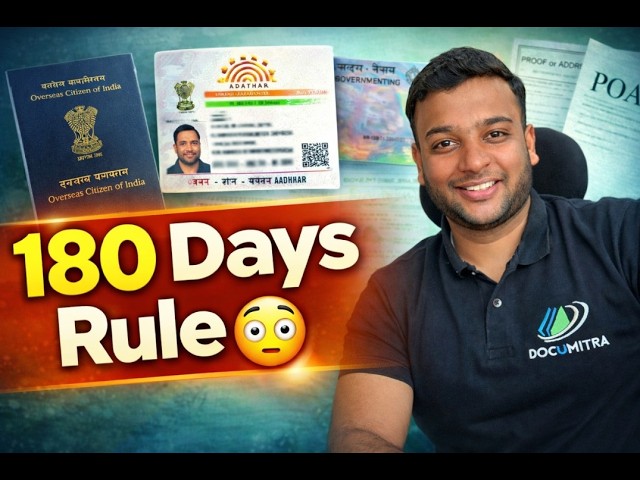

Why this becomes an airport problem
The episode opens with a very practical scenario. A viewer had booked flights to India after almost three years. The passport was valid. The OCI card was valid. Everything looked fine until the airline agent asked a question that changed the mood of the entire trip: is your OCI linked with the new passport?
That is the exact moment this article is built for. Many OCI holders do not revisit the rules after they first receive the card. Then a passport gets renewed, and the person assumes that "valid passport plus valid OCI" is the whole story. Sometimes that assumption causes no immediate problem. Sometimes it creates needless stress right at check-in.
The transcript says that when someone renews a passport, they often assume everything is fine and in most cases they are absolutely right, but depending on the age there is a small thing that needs to be done online. That is the safest way to think about travel after passport renewal.
The key value of this conversation is that it narrows the issue. This is not a broad overview of every OCI topic. If you need the full legal sequence around citizenship renunciation, visa choice during transition, and apostille paperwork, read our guide on OCI mistakes NRIs make around renunciation, visa, and apostille. This page is only about passport-renewal travel readiness.
What OCI is and what it is not
Before discussing passport renewal, the transcript resets a common misunderstanding: OCI is not dual citizenship. India does not allow dual citizenship, and OCI should be understood as a long-term immigration privilege for eligible people of Indian origin, not a second citizenship document.
In practical life, OCI is powerful. It functions like a lifelong multiple-entry facility, lets you live in India without repeatedly applying for visas, and generally allows work in the private sector or business activity. But it does not give you an Indian passport, voting rights, or open-ended access to every right reserved for citizens.
Why this distinction matters for passport renewal
If OCI were citizenship, many people would expect the status to sit independently of passport changes. But because OCI is tied to the identity documentation of a foreign national, passport changes still matter. That is why the update and reissue rules exist at all.
An OCI card is not a dual citizenship. India does not allow dual citizenship. OCI is a lifetime visa that allows people of Indian origin to travel and live in India without a need for visa each time.
It provides benefits like multiple entry, lifelong visa, live in India indefinitely, work in private sector, start your own business. But it does not allow you to vote or work in government jobs, hold an Indian passport or own an agriculture land.
For official background, review the Government of India's OCI services portal, which clearly describes OCI cardholders as foreign nationals holding foreign passports.
Do you need a new OCI card after every passport renewal?
No. That old belief is the first major mistake the episode tries to correct. The transcript says many people still think every passport renewal means a fresh OCI card application. That used to be closer to reality years ago, but the official rule set has been simplified.
The safest modern interpretation is narrower: for many cases, the card itself does not need replacement, but the government still expects certain passport-linked updates or a one-time reissue depending on age. This is why blanket advice fails.
Many people believe that every time their passport gets renewed, they need to apply for a new OCI card. That was actually true years ago, but rules were simplified. Today, for most people, the OCI card itself does not need change. What they need to do is updating their passport information online.
The adult-rule nuance you should not miss
The transcript describes ages 21 to 49 as a category where most adults do not need to update anything until 50. That is directionally useful, but it needs an official-source correction: if a new passport is issued after completing 20 years of age, there is a one-time OCI reissue requirement. Do not read "21 to 49" as a blanket exemption if that adult reissue milestone has never been handled.
The one official correction you should not miss is this: if a new passport is issued after completing 20 years of age, there is a one-time OCI reissue requirement. So the safe answer is not "every time" and it is also not "never." It depends on which age-based rule applies to you.
The official source for that distinction is the OCI Miscellaneous FAQs on the government portal and the Consulate General of India, San Francisco OCI reissuance clarification. Both make the same structure clear: there are online-upload situations and there is a one-time adult reissue situation.
Which age-based OCI rule applies to you?
This is the part most travelers should slow down and read carefully. The rules become manageable once you separate them by age instead of treating "passport renewed" as one single event.
| Age / situation | What usually applies | Travel takeaway |
|---|---|---|
| Below 20 | Upload the new passport copy containing the holder's photo and a latest photo on the OCI portal each time a new passport is issued. | No repeated full OCI reissue just because the passport changed. Finish the online update within the official timeline. |
| New passport issued after completing 20 years of age | One-time OCI reissue is required to capture adult facial features. | This is the adult milestone many people miss. If it applies to you, do not rely on outdated "no action needed" advice. |
| Adults after that one-time reissue | For many cases, no recurring OCI reissue is required unless personal particulars change. | This is the simpler stage most adults want to be in before travel. |
| Passport renewed after turning 50 | One-time upload of the new passport copy and latest photo under OCI Miscellaneous Services. | Usually an online update stage, not repeated card reissue every time. |
Under 20: the transcript is straightforward here
Children and teenagers renew passports more often because facial appearance changes more rapidly. The live official FAQ says an OCI cardholder up to age 20 should upload a copy of the new passport containing the holder's photo and a latest photo through OCI Miscellaneous Services each time a new passport is issued. It gives a three-month window from receipt of the new passport.
Use the official portal checklist rather than a transcript summary for the upload itself. The current FAQ names the new passport copy containing the holder's photo and a latest photo as the core documents for this age-based update.
Complete the upload each time a new passport is issued up to age 20, within the official three-month window. This is normally a free online update, not repeated full OCI-card reissue.
After completing 20: this is the one-time adult trigger
The official rule says OCI must be reissued once when a new passport is issued after completing 20 years of age. This point matters more than any other nuance in this article, because many adults assume their OCI is simply "lifetime" and therefore operationally untouched forever.
The Ministry of Home Affairs OCI brochure and the government OCI FAQs both describe this as a one-time reissue so the adult facial record is captured.
The trigger is precise: OCI must be reissued once when a new passport is issued after completing 20 years of age. It is not merely a recommendation, and the twentieth birthday by itself is not the trigger.
After that one-time adult reissue, routine later passport renewals generally do not require another OCI reissue unless another listed change applies.
After 50: easier again, but still not ignore-it-forever easy
The transcript says the next passport renewal after crossing 50 usually triggers one final passport-details upload. That matches the official OCI guidance. So yes, the rule becomes simpler again, but "simpler" still means you should consciously complete the one-time post-50 upload rather than assume nothing applies.
After completing 50 years of age, upload the new passport copy and latest photo once when the next passport is issued. The live official FAQ gives the same three-month window.
This is an online update, not repeated OCI-card reissue after every later passport renewal.
Important edge case
If your OCI was granted on spouse basis, the government FAQ applies a different rule set and expects passport-and-photo uploads each time a new passport is issued, along with the required marriage-related declaration and supporting documents. This article is written for the more common person-of-Indian-origin travel scenario from the transcript, so verify spouse-basis cases separately on the official OCI portal before travel.
If you are working through the larger paperwork timeline for a future move, pair this narrow travel article with our NRI moving back to India checklist and planner guide and our separate guide on OCI to Aadhaar to PAN legal requirements after returning to India. Those guides cover different steps in the move and belong in a separate planning pass.
What should you carry before traveling to India after passport renewal?
Current Indian consulate guidance is direct: travel with your existing OCI card and current valid passport. The Consulate General of India in Seattle also states that there is no longer a requirement to carry the old passport with the OCI card.
This travel-document answer is separate from OCI record maintenance. Confirm whether you are in the up-to-20 upload category, the one-time adult reissue category, the post-50 upload category, or the spouse-basis category before you travel.
For current travel guidance, see the Consulate General of India, Seattle OCI Miscellaneous Services page. For update and reissue requirements, use the live Government of India OCI Miscellaneous FAQ.
Confirm which OCI rule applies to you
Do not start with social media summaries. Start with your age, OCI basis, and whether your first new passport after completing 20 years of age has already triggered the one-time reissue.
Complete the OCI Miscellaneous step before travel if required
For uploads, use the official OCI portal. For reissue, follow the official reissuance process applicable to your location.
Travel with your document chain
Carry your current valid passport and existing OCI card. Old passport is not required for travel under current consulate guidance.
Keep the scope narrow
Do not confuse this with renunciation, e-visa, apostille, Aadhaar, or PAN tasks unless those separately apply to you.
For the pre-departure paperwork that often gets ignored until too late, also review our hidden essentials before returning to India. It complements this article without competing with it.
Can OCI status ever be cancelled?
Yes, although the transcript is careful not to turn this into fear-based content. The point is not that ordinary travelers are one mistake away from losing OCI. The point is that OCI is still an immigration status granted by the Government of India, not an untouchable object that exists outside legal conditions.
The episode mentions the usual categories people should understand at a high level: serious false information problems, certain serious criminal issues, or activity treated as against national interest. Most readers will never come close to these categories. But the mindset lesson is still useful.
The better habit
Do not treat OCI like a card you obtained years ago and therefore never need to think about again. Treat it like a status that stays smooth only when your identity details and travel records stay accurate.
Many people think OCI is a permanent document that never needs attention again. But technically OCI is a immigration status granted by government of India. So certain rules apply. Providing wrong information or incorrect information during the application, involving in some serious criminal convictions or activities considered against national interest could lead to OCI cancellation.
But these situations are very very rare. It is important to understand that OCI is not an automatic citizenship but a special travel privilege.
Detailed video summary and chapter guide
The episode is structured around one very common real-world mistake: travelers assume that if both the passport and OCI card look valid individually, then no further question exists. Avinash starts by explaining how that assumption breaks down at the airport, where airline staff often focus on whether the OCI record is aligned with the passport currently being used for travel.
From there, the discussion becomes educational rather than dramatic. First, the video refreshes the basics of OCI itself: not dual citizenship, but a long-term travel-and-residence facility for eligible people of Indian origin. Second, it removes the old myth that every passport renewal requires a brand-new OCI card. Third, it separates the rules by age so viewers can stop mixing children, adults, and older travelers into one confusing bucket.
The most valuable part of the video is the practical simplification. Once you understand the age-based logic, OCI after passport renewal is not mysterious. One transcript recommendation now needs a current-source correction: official consulate guidance says travel with your current valid passport and existing OCI card; carrying the old passport is no longer required.
Chapter guide
- The airport check-in story that exposes the problem
- OCI basics: lifetime visa-style privilege, not dual citizenship
- The first myth: passport renewal does not always mean new OCI card
- The age split: under 20, after completing 20, and after 50
- The often-missed rule: one-time reissue when a new passport is issued after 20
- The current travel-document rule: existing OCI card plus current valid passport
Quick travel-readiness checklist for OCI holders after passport renewal
Use this before you book or before you fly
- Check whether you are below 20, dealing with your first new passport after completing 20, or renewing after 50.
- Confirm whether your OCI is based on person-of-Indian-origin eligibility or spouse basis, because the spouse-basis rule differs.
- Use OCI Miscellaneous Services if your case is an online upload case.
- Do not postpone the one-time adult reissue if a passport was issued after you completed 20 years of age.
- Carry your existing OCI card and current valid passport; old passport is not required for travel.
- Verify sensitive rules against the official OCI portal or your consulate before travel if your case is unusual.
The main lesson from the transcript is not "OCI is hard." It is the opposite. OCI is manageable when you stop using stale advice and start using the exact rule that matches your age and documentation history.
Need help cleaning up a passport, OCI, or visa situation before travel?
If your India travel plan is being delayed by uncertainty around OCI, passport renewal, or documentation sequencing, use the DesiReturn visa and OCI support flow before the airport becomes your first fact-checker.
Frequently asked questions
Do I need a new OCI card every time I renew my passport?
No. The live Government of India OCI Miscellaneous FAQ says the card must be reissued once when a new passport is issued after completing 20 years of age. Up to age 20, and once after completing 50, the usual requirement is an online upload of the new passport copy and latest photo within three months.
Spouse-basis OCI cases have a separate rule and require an online passport-and-photo update each time a new passport is issued, with the listed marriage documents.
Can I travel to India with my new passport and existing OCI card?
Yes. Current Indian consulate guidance says an OCI cardholder can travel with the existing OCI card and current valid passport. It also says the old passport is no longer required for travel with the OCI card.
Complete any age-based online update or mandatory one-time reissue that applies to you. The travel-document answer does not cancel an outstanding OCI update requirement.
What is the OCI rule for children and teenagers after passport renewal?
For an OCI cardholder up to age 20, upload a copy of the new passport containing the holder's photo and a latest photo through OCI Miscellaneous Services each time a new passport is issued. The live official FAQ gives a three-month window from receipt of the new passport.
This is normally an online update, not repeated full OCI-card reissue. Follow the portal checklist for any additional fields requested during submission.
What is the one-time OCI reissue rule after age 20?
The trigger is not the twentieth birthday by itself. The live official FAQ says OCI must be reissued once when a new passport is issued after completing 20 years of age, so adult facial features can be captured.
After that one-time reissue, routine passport renewals generally do not require another OCI reissue unless another listed change applies.
What changes again after age 50 for OCI passport updates?
After completing 50 years of age, the live official FAQ requires one online upload of the new passport copy and latest photo when the next passport is issued. The documents should be uploaded within three months.
This is an online update, not a recurring OCI-card reissue after every later passport renewal.
Do I need to carry my old passport with an OCI card after renewal?
No. Current Consulate General of India guidance says there is no longer a requirement to carry the old passport with the OCI card. Travel with your existing OCI card and current valid passport.
An old-passport copy may still appear in an OCI Miscellaneous Services application checklist. That application-document requirement is separate from what you must carry for travel.
Is OCI the same as dual citizenship?
An OCI card is not a dual citizenship. India does not allow dual citizenship. OCI is a lifetime visa that allows people of Indian origin to travel and live in India without a need for visa each time.
It provides benefits like multiple entry, lifelong visa, live in India indefinitely, work in private sector, start your own business. But it does not allow you to vote or work in government jobs, hold an Indian passport or own an agriculture land.
Can OCI status ever be cancelled?
Many people think OCI is a permanent document that never needs attention again. But technically OCI is a immigration status granted by government of India. So certain rules apply. Providing wrong information or incorrect information during the application, involving in some serious criminal convictions or activities considered against national interest could lead to OCI cancellation.
But these situations are very very rare. It is important to understand that OCI is not an automatic citizenship but a special travel privilege.
Need a cleaner India travel documentation plan?
OCI confusion usually shows up late, when flights are booked and the margin for error is gone. Get practical guidance for OCI, passport, and travel-document questions before your next India trip.