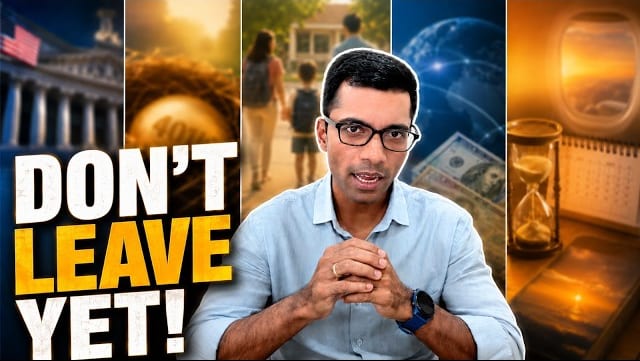
Avinash looks beyond the salary gap at green card waits, H-1B rule changes, India's GCC boom, startups and family life. He argues the better question is which set of trade-offs fits the life you want to build now.
Is the American Dream Still Worth It for Indians in 2026?
Avinash looks beyond the salary gap at green card waits, H-1B rule changes, India's GCC boom, startups and family life. He argues the better question is which set of trade-offs fits the life you want to build now.
In this story
- Is the American dream still worth it for an Indian professional in 2026?
- How big is the salary gap between the US and India?
- Why is salary alone the wrong way to compare the US and India?
- How are India's GCCs changing careers for experienced professionals?
- How long is the green card backlog for Indians?
- What has changed for H-1B holders, and why does policy volatility matter?
- Is America becoming anti-immigrant?
- How much has India changed, and what does its startup scene offer?
- How do family, age and lifestyle change the answer?
- Is the American dream dead, and what should you ask instead?
- TL;DR: the short version
Is the American dream still worth it for an Indian professional in 2026?
For decades, many Indians saw the same sequence in America: get a good degree, get an H-1B, get a good job, buy a house, raise children, get a green card and build wealth. Avinash works through that idea in the video and asks whether the American dream is still worth it, or still worth the price, for an Indian professional starting from scratch in 2026.
He is clear that this is not a question about whether America is a good country. He says it absolutely is, and that Indians should go there when the opportunity makes sense. His argument is that the economic and immigration equations have changed dramatically, and that India has changed at the same time.
The framework he sets out covers salary, green card backlogs, career, startups, lifestyle, family and what a person wants to do next, so that viewers can answer the question for their own life.
How big is the salary gap between the US and India?
Avinash starts with money, because for a long time the salary gap was enormous. He gives an example: an engineer in India might make 10 to 20 lakhs per year, while the same professional in the US could make roughly 100,000 to 150,000 dollars per year. He says that even after taxes and living expenses, the difference is still substantial.
He says that difference justified a lot of things, including immigration uncertainty, living far from parents, loneliness, cultural adjustment, child care and being thousands of miles from home. He then says the Indian side of the equation has changed, which is why he asks the question again. He also cites the US Bureau of Labor Statistics, which put the median annual wage for a software professional at around $133,000, and he adds that top US companies can pay dramatically more.
| Figure | As stated in the video |
|---|---|
| Engineer in India, per year | 10 to 20 lakhs |
| Same professional in the US, per year | roughly 100,000 to 150,000 dollars |
| Median annual wage for a software professional in the US (Bureau of Labor Statistics) | around $133,000 |
These are the figures discussed in the video, and pay levels change over time. This is general information, not personal tax, legal or investment advice.
Why is salary alone the wrong way to compare the US and India?
Avinash's main point is that headline salary is only one part of the decision. He says the useful comparison goes beyond salary and includes:
- After-tax income
- Cost of living
- Savings
- Lifestyle
- Career growth
- Immigration security
He says that when you look at the whole equation, the gap becomes much less obvious for certain roles. He offers a simple test. Imagine you were offered a lower headline salary in India, but your savings, career responsibilities and family lifestyle worked for you. Would you seriously consider it? He says this is a much more usable comparison than salary alone.
He is not saying Indian and American salaries are equal. He says they are not, and that the US still has a massive compensation advantage. His argument is that this advantage has to be weighed against the other parts of the equation rather than read on its own. For a related reading on the money and lifestyle side, see Rs 60 lakh in India or $200k in the USA: which life feels richer?
How are India's GCCs changing careers for experienced professionals?
Avinash points to the size of India's technology industry, which he describes as a roughly $300 billion industry, according to NASSCOM's 2025 outlook. He says the global capability centre (GCC) ecosystem has moved beyond the old, cheap outsourcing model. As of 2024, he says India has 1,700 GCCs employing 1.9 million professionals.
These centres now include roles in:
- Product development
- Engineering
- AI
- Cybersecurity
- Finance
- Global leadership
He quotes the economic survey as saying GCCs are evolving from support functions into product development, engineering and AI-enabled functions. His example is Charles Schwab, which he says is hiring around 2,000 employees by the end of 2027 for engineering and technology roles in Hyderabad. For many professionals, he says, the question is no longer whether they can get a job in India, but how good a job they can get there.
NASSCOM and Zinnov project that GCCs could reach 99 to 105 billion dollars by 2030, employing 2.5 to 2.8 million people. He says this means you no longer have to leave India to work for a global company. For someone with 10 to 15 years of US experience, he says the international experience, management experience, global network, customer understanding and technical expertise can be particularly powerful in India. For more on the job routes open to returning NRIs, see jobs for returning NRIs across GCC, startup, MNC and US-remote options.
How long is the green card backlog for Indians?
Avinash says that for many Indians, the American dream was never simply about working in America. It was about building a permanent life there. He then looks at the August 2026 US Visa Bulletin. For Indian employment-based applicants, he states that EB2 has a date of 15 January 2015, EB3 has a date of 1 January 2014 and EB1 has a date of 15 October 2022.
His reaction is that someone who started the green card process more than a decade ago may still be waiting. He asks viewers to think about the person behind that date: someone who arrived in the US in their 20s, built a career, bought a home and raised children, and who may now be in their 40s, still waiting for a green card or permanent residency.
He says this creates a different kind of life. A person can have a strong salary, a house, children in school and a successful career, while their immigration status is still hanging over their head. He lists decisions that this uncertainty touches:
- Can I change jobs?
- Can I start a company?
- Can my spouse work?
- Can I move?
- Can my child age out?
He calls these life decisions, not small questions. He also says the latest visa bulletin is a reminder that the backlog is not simply disappearing. In his view, the dream used to be about the opportunity, and for many people it is now more about immigration risk management.
What has changed for H-1B holders, and why does policy volatility matter?
For people without a green card, Avinash says the H-1B remains a critical part of the equation. He asks viewers to look at how much the rules have changed. He describes a White House proclamation that requires a $100,000 payment for certain new H-1B petitions, with the restriction focused on workers outside the US. For the official rules on this category, check the USCIS guidance on H-1B specialty occupations.
He also describes proposed changes. The administration has proposed changing the H-1B selection process so that higher-wage positions receive a higher weighting rather than every registration being treated the same. He also mentions a proposal to charge $100,000 when a student visa is converted to H-1B.
These are the figures and rules discussed in the video, and they may change. This is general information, not personal tax, legal or investment advice.
The bigger issue, in Avinash's view, is that the rules are moving. He says a difficult rule is one thing, but not knowing what rule will apply in the next two months or the next year is much harder to handle, especially when you are planning a 10, 15 or 20 year life. He adds that this is the part people rarely put into a salary comparison. For the wider picture, read the H-1B visa trap, including layoff rules, H-4 EAD and the green card backlog.
Is America becoming anti-immigrant?
Avinash says he wants to be careful with this question. He hears many people say America does not want immigrants any more, and he calls that too simplistic. He says the data does not support the statement.
He cites Gallup's June 2026 survey, which found that 73% of Americans still say immigration is good for the country's economy. He notes that this figure came down from 79% in 2025.
In his view, the more accurate story is that America is becoming more selective and more politically contentious about immigration. He says some policies are clearly becoming more restrictive. Even so, he says he would not tell an Indian professional that America does not want them.
He says America still wants highly skilled talent. The pathway to becoming a permanent resident, however, is becoming much more complicated and politically uncertain.
How much has India changed, and what does its startup scene offer?
Avinash argues that people should compare today's America with today's India. He says many people compare America today with the India they remember leaving, and that is not always the India they would be returning to now. He lists what has changed: global technology companies, GCCs, fintechs, venture capital, startups, private equity and deep tech.
India has also become one of the world's largest startup ecosystems, he says. In 2025, 11 new unicorns were added, and the estimate he quotes puts India at about 125 unicorns, third after the US and China. He says the breadth of the ecosystem is more interesting than the count alone, covering fintech, consumer internet, SaaS, AI, healthcare, climate tech, EVs, space and deep tech. He adds that startups are increasingly being built for the global market from India.
For someone who is 25 and ambitious, he says the decision is not simply that America has opportunities and India does not, because that is an outdated comparison. The better test is which ecosystem gives them better opportunity for the life and career they want. For a story about leaving the US to start a company in India, read Why I Left the U.S. to Launch a Startup in India.
How do family, age and lifestyle change the answer?
Avinash says the case for India grows as people get older. Being close to parents, family, domestic help, community, social life and cultural familiarity become more valuable. He gives two examples: being able to attend a function without planning six months ahead, and having children grow up around grandparents.
On lifestyle, he says many Indian cities now offer great schools, international airports, international companies and malls. That lifestyle is very different from the India that many people left 15 to 20 years ago. He is also clear that you cannot romanticise India, and he names traffic, pollution, bureaucracy, education pressure and infrastructure gaps as serious problems.
He sums up the shift simply: sometimes the country has changed, sometimes your priorities have changed, and usually it is a little bit of both. He gives four examples of how the answer shifts:
- At 22, the answer could be completely different from the answer for someone who is 35 with two kids and waiting for a green card.
- At 45, financially independent, with parents getting older, the answer could be completely different again.
- In a highly specialised field where the US has dramatically better opportunities, America still wins.
- India may be attractive if you are very entrepreneurial.
He says there is no universal answer, and that is exactly the point.
Is the American dream dead, and what should you ask instead?
No, Avinash says. He is clear that if you are a doctor, engineer, researcher or technology professional with an exceptional opportunity in the United States, America can be an extraordinary place to build a career and wealth. He points to its enormous capital markets, world-class universities, deep innovation ecosystems, high compensation and some of the world's strongest opportunities for ambitious professionals.
He says the question has changed. Twenty years ago, many Indians asked how to get to America. Today, he suggests asking what you are giving up to stay in America, and what you are gaining. He adds that returning to India has an opportunity cost too, which is why he does not think the decision can be reduced to which country is better.
He concludes that the American dream is not dead, but that it is diminishing as the automatic default choice for ambitious Indians. He adds:
The goal was never to live the American dream. The goal was to build your dream life.
His closing question is where you would choose to build your life today. He frames the better question as which set of trade-offs makes sense for your life right now, at this stage. He says Desi Return covers the career, financial, family and practical side of returning to India. For a structured way to work through it, read Desi Return's decision framework for moving back to India.
TL;DR: the short version
- Avinash says the American dream is not dead, but it is diminishing as the automatic default choice for ambitious Indians.
- Salary is only one part of the decision. He names after-tax income, cost of living, savings, lifestyle, career growth and immigration security.
- India's GCCs now include product development, engineering and AI roles, and NASSCOM and Zinnov project that they could employ 2.5 to 2.8 million people by 2030.
- The visa bulletin dates he cites for Indian employment-based applicants are 15 January 2015 for EB2 and 1 January 2014 for EB3, and he says the backlog is not simply disappearing.
- H-1B rules are changing, including a $100,000 payment for certain new petitions and a proposed change to the selection process.
- Avinash says America is becoming more selective and politically contentious about immigration, and that the better question is which trade-offs fit your life now.
Watch the full video on the Desi Return YouTube channel.
Test the decision against your own trade-offs
Work through your own trade-offs with the should I move back decision tool, or book a 1:1 quick call with Avinash to talk through your situation.
Chapters
- 0:00 Is the American Dream Still Worth It?
- 1:24 The Salary Gap: US vs India
- 2:54 India’s GCC Boom Is Changing Careers
- 4:21 Salary Alone Is the Wrong Comparison
- 5:43 The Green Card Backlog Reality
- 8:00 H-1B Rules and Immigration Uncertainty
- 9:29 Is America Becoming Anti-Immigrant?
- 10:44 India Is Not the India You Left
- 12:07 India’s Startup Opportunity
- 13:32 Family, Lifestyle and What Changes With Age
- 15:40 Is the American Dream Dead?
- 17:02 The Better Question to Ask in 2026
Transcript
Auto-generated captions, lightly cleaned
0:00 For decades, millions of Indians looked at America and saw the same equation. Get a good degree, get H-1B, get a good job, buy a house, raise kids, get green card, and build a wealth. And eventually, you had made it. That was the American dream. But here is the question I want to ask you today. If you were an Indian professional starting from scratch in 2026, would you still choose United States? Or if you were someone who moved to America 5, 10, 15 years ago, and what would you recommend someone who is thinking about moving to US today, knowing what you know today?
0:47 I'm not asking whether America is a good country. It's absolutely is. I'm not saying Indians shouldn't go to America. They should, especially if the opportunity makes sense. But the economic and immigration equations have changed dramatically. And also, India has changed at the same time. So today, let's look at the numbers. Immigration, salaries, green card backlogs, career opportunities, startup lifestyle, and ask much more important question. Is the American dream still worth the
1:27 Price? By the end of this video, I want you to have a clear framework for answering this question for your own life. Not just through salary, but through career, immigration, family, lifestyle, and >> [music] >> what you want to do next. Let's start with the obvious one, money. For a long time, the salary difference between US and India was enormous. An engineer in India might make 10 to 20 lakhs per year, while the same professional in US could make 100 to 150,000 dollars per year. Even after taxes, living expenses, the difference still is substantial. And that difference justified a lot of things.
2:21 Immigration uncertainty, living far away from the parents, loneliness, cultural adjustment, child care, and being thousands and thousands of miles away from the home. But here is what's interesting. The Indian side of the equation has changed. India's technology industry is now roughly 300 billion dollars industry, according to NASSCOM's 2025 outlook. And the India's GCC, the global
Read the full transcript (23 more sections)
2:56 Competency center ecosystem, has moved forward beyond [music] the old, cheap, outsourcing model. As of 2024, we have 1,700 GCCs employing 1.9 million professionals. And these are not just call centers anymore. They increasingly include product development, engineering, AI, cybersecurity, finance, and even global leadership roles. The economic survey specifically notes that GCCs are evolving from a support functions into a product development, engineering, and AI-enabled functions. And here is what's happening. For example, Charles Schwab is hiring around 2,000 employees by the end of 2027 in engineering and technology roles here in Hyderabad. So, the question isn't would you get a job in India?
3:56 For many professionals today, the question is how good a job can I get in India? And that's a very different question from 15 years ago. Now, let's be clear. The compensation still are not is not equal. The US has still has a massive a competition. Now, let's be clear. I'm not saying salaries are equal. They are not. The US
4:23 Still has a massive compensation advantage. For example, the US Bureau of Labor Statistics put the median annual wage for a software professional at around $133,000. And top US companies can be dramatically higher. The relevant comparison is in salary. It is after-tax income, cost of living, savings, lifestyle, career growth, and immigration security. And when you look at the entire equation, the gap becomes much la- less obvious for certain roles. Here is one way to test your own thinking. If you were offered a lower headline salary in India, but your savings, career responsibilities, family lifestyle work for you, would you seriously consider it? This is much more of a usable comparison than salary alone.
5:22 Now, we get to something that's particularly important for Indians, the green card. Because for many Indians, the American dream was never simply I am going to work in America. It was I'm going to build a permanent life in America. And that's where the systems
5:43 Becomes incredibly difficult. Let's look at August 2026 visa bulletin. For Indian employment-based applicants, EB2 India has a date of January 15, 2015. For EB3, it was even back January 1, 2014. For EB1, it was October 15, 2022. Think about what that means. Someone who have started the green card process more than a decade ago and still be waiting. And don't look at that only as a date on the visa bulletin. Think about the person behind it. Someone may have arrived into United States in their 20s, built a career, bought a home, raised children, and now be in their 40s, still waiting for their green card or permanent residency.
6:44 And this creates a different kind [music] of life. You might have a great salary, a house, kids in school, a successful career, but your immigration status is still hanging over your head. And that uncertainty affects decisions. Can I change jobs? Can I start a company? Can my spouse work? Can I move? Can my child age out? These are not small questions. These are life decisions. And the latest visa bulletin is a reminder that backlog is not simply disappearing. In fact, the September 2026 showed no employment-based cleaning for Indian applicants.
7:31 The dream used to be about the opportunity. [snorts] For now, for many people, it's about immigration [snorts] risk management. If you are currently in the green card queue. I would genuinely like to know how long have you been waiting and has the wait changed the way you think about long-term future in America? Let us know in the comments. If you don't have a green card, the H-1B remains a critical part of the
8:02 Equation. But look at how much the rules have changed. In September 2020, the White House has a proclamation requiring $100,000 payment for certain new H-1B petitions with restriction focused on workers outside the US. The administration has also proposed changing the H-1B selection process with the higher wage positions receiving a higher weightage rather than a rather than every registration. And also, they have proposed charging $100,000 if a student visa is getting converted to H1 even for OPT and so on.
8:47 The bigger issue is this. The rules are moving. >> [music] >> And when you're planning a 10, 15, 20-year life, the policy volatility has a cost. You can have a difficult rule. What is much harder is to handle not knowing what rule will be there in next 2 months, next year, and so on. And this is the part people rarely put into a salary comparison. Has the visa uncertainty ever changed a job, a business, or a family decision for you? Is America really becoming anti-immigrant? I really want to be careful. You hear a
9:31 Lot of people say America doesn't want immigrants anymore. That's too simplistic. The data doesn't support that statement. Gallup's June 2026 survey found that 73% of the Americans still says immigration is a good for the country's economy, even though it came down from 79% in 2025. [music] The more accurate story is America is becoming more selective and more politically contentious about immigration. And some of the policies are clearly becoming more restrictive. So, I wouldn't tell an Indian professional that America doesn't want you. And that's not true. I would say America still wants highly skilled talent, but the pathway to becoming a permanent resident is becoming much more complicated and politically uncertain.
10:31 This is probably the biggest part of the story because we shouldn't compare today's America with India of 2005. You should compare today's America with today's India. One thing I have noticed
10:44 Through the conversations we have at Desi Return is that people often compare America today with India they remember leaving. But that's not always the India they would be returning to now. India has changed dramatically. You have global technology companies, GCCs, fintechs, venture capital, startups, private equity, deep tech, and much more. GCC story itself is a significant one. NASSCOM and Zinnov project that GCC could reach 99 to 105 billion dollars by 2030 with employing 2.5 to 2.8 million people. It means something important. You no longer have to leave India to work for a global company. You can work for a global company while sitting in India.
11:40 And also, for someone who has 10 to 15 years of US experience, this can be particularly powerful. You are bringing international experience, management experience, global network, customer understanding, technical expertise, and sometimes a much stronger compensation profile than a traditional Indian career path. And for an experienced NRI, the question
12:07 May not be, "Will India give me a job?" It may be, "Where does my international experience become valuable in India?" So, if you're entrepreneurial, the equation gets even more interesting. India has now become one of the world's largest startup ecosystems. In 2025, 11 new unicorns have been added, and the estimate put India to have about 125 unicorns, ranking third after US and China. >> [music] >> But, what's interesting isn't just simply the number of unicorns. It's the breadth of the ecosystem. Fintech, consumer internet, SaaS, AI, healthcare, climate tech, EVs, space, and deep tech. And increasingly, the startups are being built for global market from India.
13:03 And if you are 25 and ambitious, the decision today is not simply >> [music] >> America has opportunities and India doesn't. That's an outdated comparison. The comparison is, "Which ecosystems gives me better opportunity for the life and career I want?" If you are a young and building your career today, this is worth asking seriously. Are you choosing a country
13:32 >> [music] >> because of an old idea where the opportunity exists, or because that is genuinely the best ecosystem for what you want to build now? And this is where conversation becomes personal because money isn't the only reason why people move to America. Better infrastructure, safety, predictability, career opportunities, individual freedom, and certain quality of life. These advantages remain real, and India offers something that becomes increasingly valuable as you get older, being close to parents, family, domestic help, community, social life, cultural familiarity.
14:19 Being able to attend a function without planning 6 months ahead, having your children growing up around grandparents. And for those who have lived in both places, I'm curious, what matters to you today that did not matter nearly as much when you first moved abroad? Parents, time, career, children, or something else? And in many Indian cities, you can have great schools, international airports, international companies, malls, and increasingly the lifestyle which is very different from the India that many of us left 15 to 20 years ago. And yes, India has some serious problems, traffic, pollution, bureaucracy, education pressure, infrastructure gaps, and you can't romanticize India, either.
15:15 The point isn't India is better or US is better. The point is India is now much more credible alternate. Sometimes the country has changed. Sometimes your priority has changed. Usually, it's a little bit of both. So, is the American dream dead? No. This is where I want to be very clear. If you are a doctor, engineer,
15:43 Researcher, technology professional, and you have an exceptional opportunity in the United States, America can be extraordinary place to build career and wealth. US still has enormous capital markets, world-class universities, deep innovation ecosystems, high compensation, and some of the world's strongest opportunities for ambitious professionals. But the question has changed. 20 years ago, many Indians asked, "How do I get to America?" Today, I think the better question is, "What am I giving up to stay in America, and what am I gaining?" And the returning to India has a opportunity cost, too. That is why I don't think this decision can be reduced to which country is better. The better question is, "Which set of trade-offs makes sense for my life right now at
16:43 This stage?" Maybe the American dream is not disappearing. Maybe it's just simply becoming one of the options among several. Let's say, if you are 22, the answer could be completely different you versus
17:02 Someone who is 35 with two kids and waiting for a green card. If you're 45, financially independent, and your parents are getting older, the answer could be completely different. If you are in highly specialized field, where US has dramatic better opportunities, America still wins. Maybe India could be attractive if you are someone who is very entrepreneurial. There is no universal answer, and that's exactly the point. Don't make 2026 decision based on 2006 playbook. The salary cap isn't the only thing that matters anymore. Immigration risk matters, career growth matters, taxes matters, education, finances, lifestyle matters.
17:51 And the opportunity you have in India also matters. So, is the American [music] dream still worth it? For some people, absolutely yes. For some, it may not be not. And for a growing number of Indians, the decision is no longer America or failure. There is now a legitimate third option. Build your career, wealth, and life in India. The American dream is not dead, but I do think American dream is diminishing as the automatic default choice for ambitious Indians. And perhaps that's not a bad thing, because the goal was never to live the American dream. The goal was to build your dream life.
18:38 And in 2026, you have more choices than ever before. So, don't ask, "Should I stay in America?" Ask, "If I was staying my life today, where would I choose to build it?" That is the question worth answering. And if you're seriously working through this decision for yourself or your family, that is exactly what we talk about Desi Return, the career, financial, family, and practical side of returning to India, so you can and the decision with clarity. >> [music]