Most NRIs lose money through timing, paperwork and wrong assumptions, not bad investments. Avinash works through five mistakes from Desi Return community stories and what to do instead.
Five Financial Mistakes NRIs Make When Returning to India
Most NRIs lose money through timing, paperwork and wrong assumptions, not bad investments. Avinash works through five mistakes from Desi Return community stories and what to do instead.
In this story
- Why do NRIs lose money when they move back to India?
- What is RNOR, and why is wasting it the first mistake?
- Why does FEMA compliance matter after you return to India?
- Is life in India really cheaper for returning NRIs?
- How can NRIs avoid overpaying tax with DTAA benefits and treaty forms?
- What happens to assets in India and abroad without a cross-border will?
- What are the five financial mistakes NRIs make when returning to India?
- Where can returning NRIs get guided help with these steps?
- TL;DR: the short version
Why do NRIs lose money when they move back to India?
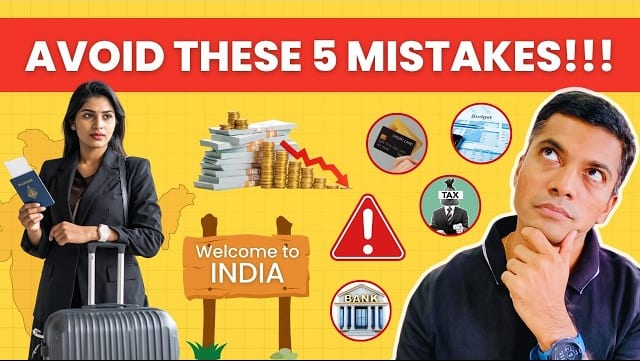
Avinash opens with an uncomfortable point. Most NRIs do not lose money through bad investments. They lose it through timing, paperwork and wrong assumptions. He is clear that this is not fraud or black money, just missing small details that nobody explains. This article covers the financial mistakes NRIs make returning to India, based on five points he raises from stories shared in the Desi Return community. He says he has seen families lose lakhs of hard-earned money after moving back, and that the families were not careless. Nobody had told them what happens behind the scenes.
He also points to a changed setting. He mentions much higher scrutiny from the tax department, automatic information sharing between countries, much higher living costs and tighter FEMA enforcement from the RBI. In his view, the old NRI playbook no longer works. That is why the Desi Return financial planning roadmap was built, so that you do not miss any critical step during the transition.
The five mistakes are taken in order below: RNOR timing, FEMA compliance and banking, the cost of living in India, DTAA and tax filing, and estate planning. Each section sets out what goes wrong, as Avinash tells it, and what to do instead.
What is RNOR, and why is wasting it the first mistake?
Avinash says most NRIs do not understand RNOR or even know what it is. RNOR stands for resident but not ordinarily resident. He describes it as a temporary window, usually one to three years after returning to India, and calls it a golden window. During RNOR, most of your foreign income is not taxed in India. He also says foreign investments receive special treatment and that you have flexibility to restructure those assets.
The mistake, in his telling, is carrying on as before. People keep the same investments, the same accounts and the same structure after they move. The cost, he says, is that you permanently lose a once-in-a-lifetime tax planning opportunity. After RNOR ends, global income is taxable in India, reporting becomes mandatory, and restructuring your assets becomes expensive.
In Avinash's example, a family sold stocks in the US after their RNOR period had ended and paid tax in India. He says that could have been avoided with simple planning. He puts the cost of that mistake at over 12 lakhs. He has also seen people miss this window and later pay lakhs for a decision that could have been completely tax-free. These figures are as of March 2026, and this is general information, not personal tax, legal or investment advice.
His fix is to treat RNOR as a financial grace period, and he gives three steps:
- Map your RNOR years before you touch any large asset.
- Plan RSUs, stock sales, rental and retirement withdrawals within that window.
- Delay restructuring unless it is necessary.
He says the financial planning course maps RNOR timelines with real examples, so you do not leave money on the table. For RNOR status itself, read what RNOR status is in India, with its benefits, duration and rules.
RNOR is not just a status, it's a strategy window.
Why does FEMA compliance matter after you return to India?
The second mistake is assuming that only your address has changed. Avinash says that once you become a resident, your NRE and FCNR bank accounts must change, your investment permissions need updating and your foreign holdings have to be reported. He describes what many people do instead. They keep NRE accounts running, do not tell the bank about the change in residency, ignore asset declarations and keep foreign accounts open. He notes that people do all of this unintentionally.
He explains the cost. Non-compliance comes under FEMA, which can mean penalties and interest. Accounts can be frozen, and repatriating money can become difficult. Notices can arrive. He adds that banks do not stop you and systems do not alert you, so you only discover the problem when notices show up. He names the Reserve Bank of India as the source of tighter FEMA enforcement.
His advice is to act within six months of returning:
- Update your residential status with the bank.
- Convert NRE and FCNR accounts to resident or RFC accounts, as applicable.
- Review your foreign asset permissions.
- Document everything.
Avinash puts it plainly: do not treat FEMA as paperwork. For more on foreign assets, read returning NRIs and foreign assets, with RBI rules and FEMA clarity, and for the account decision, see when to convert, keep or close an NRI account after returning to India.
Is life in India really cheaper for returning NRIs?
The third mistake is assuming that expenses in India will be lower. Avinash says they sometimes are, but he warns against making that assumption. In big metros such as Bangalore, Hyderabad and Pune, education, healthcare, housing and lifestyle can become very expensive. He gives one figure: a good international school can cost anywhere from 3 to 8 lakhs per year per child. He also says healthcare costs are rising fast, rents in some good areas are shockingly high, and groceries and domestic help add up. These figures are as of March 2026, and this is general information, not personal tax, legal or investment advice.
His warning is that a returnee can feel financially independent at first, then find that the runway is shrinking three years later. Lifestyle inflation creeps in and stress rises. He has seen people forced back into stressful jobs because they misjudged the cost of living in India for a certain lifestyle.
The fix is to make no assumptions. Before you move, work out a realistic Indian budget for the lifestyle you want, and talk to people who have already moved back. The Desi Return channel has a separate video that helps you work out realistic monthly expenses for the lifestyle you choose. Avinash also says families in the Desi Return community share their monthly expenses across cities, which can help new returnees avoid nasty surprises.
He adds three practical steps:
- Keep an emergency fund that can cover six to nine months.
- Track your expenses for the first six months.
- Factor in the cost of healthcare and education.
The aim, he says, is realistic expectations and a planned corpus and financial side, so that your return is successful. For the budget itself, read how to plan finances when moving back to India.
How can NRIs avoid overpaying tax with DTAA benefits and treaty forms?
The fourth mistake is about not using the double taxation avoidance agreement, or DTAA, and not filing the right forms. Avinash says that when you earn income abroad, taxes get withheld automatically, and many NRIs assume that is simply how it works. He says it is not. People often overpay because DTAA benefits are not claimed, certain forms are not filed and withholding stays at 30 percent instead of the treaty rate. He adds that foreign income is not reported properly in India, and the foreign income tax credit is not claimed properly either.
He says the cost can be large. People overpay taxes abroad, sometimes tens of thousands of dollars, and he puts the unnecessary payment at 15 to 30 percent of the income. He stresses that this is real money. These figures are as of March 2026, and this is general information, not personal tax, legal or investment advice.
His fix depends on your country, and comes down to four steps:
- Claim the DTAA benefits that apply to you.
- Submit correct residency certificates.
- File the treaty forms on time.
- Reduce your withholdings legally.
He calls this one of the highest return-on-investment fixes you can make. The Desi Return course takes DTAA step by step, including the forms to file and when to file them. For background, read how NRIs can avoid double taxation in India and abroad.
The Indian side of this runs through the Income Tax Department's e-filing portal.
What happens to assets in India and abroad without a cross-border will?
The fifth mistake is the one people avoid because it is uncomfortable. Avinash describes someone with assets in India and in the US, Canada, the UK or elsewhere, with no coordinated estate plan, no will, no executors and no clarity. That person assumes the family will work it out. He says the family will not be able to.
After something happens, accounts can be frozen, probate can run for years, legal fees can rise sharply and families suffer. He has seen inheritance stuck for years. In his view, the cause is not money but missing documents.
His advice is to have a separate will in India and another abroad, with proper nominees and beneficiaries. For large assets, he suggests considering a trust, and keeping all the documentation in one central place. He puts it simply: estate planning is not about death, it is about protecting your family.
For the US side of this question, see the estate tax trap for NRIs leaving the US.
What are the five financial mistakes NRIs make when returning to India?
Avinash ends with a summary of the five mistakes:
- Wasting the RNOR period.
- Ignoring FEMA compliance.
- Underestimating India's cost of living.
- Not using DTAA properly.
- Not having a cross-border will or trust.
None of these are complicated, he says, but all of them become expensive if they are ignored. He closes by asking viewers to stay organised and stay compliant.
Where can returning NRIs get guided help with these steps?
Avinash names three routes for guided help:
- The Desi Return community, where families who have already moved back share their experiences.
- The financial planning course, which he says covers RNOR and all the steps covered here.
- A consultation call.
The links are listed below. He asks viewers to share this with people considering a move to India, because these points are usually learned very late in the process.
TL;DR: the short version
- RNOR is a temporary window, usually one to three years after returning, in which most foreign income is not taxed in India, so plan big asset moves within it.
- Once you become a resident, NRE and FCNR accounts and foreign holdings need updating, and Avinash advises updating your residential status with the bank within six months.
- Do not assume Indian costs are lower. Education, healthcare, housing and lifestyle in big metros can be expensive, so build a realistic budget with an emergency fund for six to nine months.
- Claim DTAA benefits, submit correct residency certificates and file treaty forms on time, because withholding can otherwise stay at 30 percent instead of the treaty rate.
- Without a separate will in India and abroad, proper nominees and one central place for documents, families can face frozen accounts and long probate.
Watch the full video on the Desi Return YouTube channel.
Map your RNOR years before restructuring assets
Use the RNOR status calculator to check where you stand before you restructure any foreign investments.
Chapters
- 0:00 Introduction to NRI return
- 1:36 Maximizing the RNOR status
- 3:48 FEMA compliance and banking
- 5:21 Budgeting for life in India
- 7:41 Double taxation and filing
- 9:18 Estate planning and summary
Transcript
Auto-generated captions, lightly cleaned
0:00 Let me start with something uncomfortable. Most NRIs don't lose money because of bad investments. They lose money because of timing, paperwork, and wrong assumptions. Not fraud, not black money, just missing small stuff. I have seen families lose lakhs when moving back to India. Clean, hard-earned money. Not because they were careless, because nobody tells them what goes behind the scenes. Today, I'm sharing five financial mistakes most NRIs make when moving back to India in 2026. These are based on real stories from Desi Return community and exactly how you can avoid them.
0:51 If you're planning to return or already moved back, this video can save you serious money. Here is the thing. Today, we have much higher scrutiny from tax department. Automatic information sharing between different countries. Much higher living costs. Tighter FEMA enforcement from RBI. The old NRI playbook doesn't work anymore, and that's exactly why we built our Desi Return financial planning roadmap to make sure you don't miss any critical step during this transition. Now, let's get into these five big mistakes.
1:39 Most NRIs don't understand or even know what an NOR is. NOR, resident but not ordinary resident, is a temporary window, usually 1 to 3 years after returning to India. This is a golden window. So, during RNOR, most of the foreign income is not taxed in India. Also, there's a special treatment for your foreign investments, and you have the flexibility to restructure these assets. So, this is very important, but most of the people continue their life, same investment, same account, same structure, and that's a big mistake. The cost of this mistake is that you permanently lose once-in-a-lifetime tax planning opportunity. After RNOR ends, global income is taxable in India.
2:34 Reporting becomes mandatory, and restructuring of your assets becomes expensive. I have seen people who completely miss this window and pay lakhs later for a decision that could have been completely tax-free. For example, a family who sold stocks in US after RNOR period paid taxes in India, which could have been avoided with a simple planning. The cost of this mistake is over 12 lakhs. So, how do you avoid this mistake? Treat RNOR as a financial grace period. Before you touch any big assets, first map your RNOR years. Plan your RSUs, stock sales, rental, retirement withdrawal during RNOR.
Read the full transcript (11 more sections)
3:26 Delay restructuring unless necessary. RNOR is not just a status, it's a strategy window. In our financial planning course, we actually map RNOR timelines with real examples, so you don't leave money on the table.
3:49 Let's talk about mistake number two. People assume I moved back to India but everything else can remain same. Wrong. Legally, a lot must need to be changed. First, once you become a resident, your bank accounts, NRE, FCNR must change. Your investment permissions needs to be updated. Your foreign holdings has to be reported after O&R. Instead, many people keep their NRE accounts running, don't inform banks about their residency change, ignore assets declaration, keeping foreign accounts floating, all unintentionally.
4:34 The cost of this mistake, non-compliance comes under FEMA, which means penalties, interests becomes taxable retroactively. Accounts get frozen. Issues repatriating money over. Notices could arrive. And here is a dangerous part. Banks don't stop you, systems don't alert you, you only discover when notices show up. And how do you avoid this mistake? Within 6 months of returning, update your residential status with the bank, convert NRE, FCNR accounts to a resident or RFC accounts as applicable, review foreign asset permissions, document everything. Don't treat FEMA as a paper work.
5:25 Most returning NRIs assume my expenses in India will be lower. Sometimes, yes. But what about in big metros like Bangalore, Hyderabad, Pune? Education, health care, housing, and lifestyle, they can get very expensive. Today, a good international school costs you anywhere between 3 to 8 lakhs per year per child. Healthcare costs are rising fast. Rents in some good areas are shockingly high. Groceries, domestic help, all will add up. Please don't make any assumptions. Understand the reality on how much it would cost to have a certain lifestyle in India.
6:16 You think you are financially independent, but 3 years later, that runway is shrinking. Lifestyle inflation creeps in, and the stress is increasing. I have seen people who are forced to be back to stressful jobs because they misjudge the cost of living in India for certain lifestyle. In this written community, we have families who often share their monthly expenses across cities. That alone can help new returnees to avoid these nasty surprises. So, how do you avoid this? Before you move, plan a realistic Indian budget. Talk to people who have moved back to India. Also, check out our video on our channel which can guide you to come up with your realistic monthly expenses based on the lifestyle that you choose.
7:16 Have an emergency fund that can help you for 6 to 9 months. Track your expenses for the first 6 months. Factor in the cost for the healthcare and education. It's important to have the realistic expectations and plan your corpus and financial side to make sure that your return is successful.
7:44 Or mistake is about not taking advantage of double taxation avoidance agreement and filling the right forms. You earned income abroad and taxes get withheld automatically. Most NRI assumed that's just how it works. No, you often overpay because DTAA benefits were not claimed and certain forms were not filed and withholding is at 30% instead of treaty rate. And in India, the foreign income is not reported properly and also the foreign income tax credit is not claimed properly. The cost of this mistake is people overpay taxes in abroad, sometimes tens of thousands of dollars.
8:37 15 to 30% of the income is paid unnecessarily. This is real money. And how do you avoid this? Depending on your country, claim the DTAA benefits, submit correct residency certificates, file the treaty forms on time, and reduce your withholdings legally. This is one of the highest ROI fixes you can make. In our course, we talk about DTAA step by step and the forms that you have to file and when.
9:20 This one is uncomfortable, so people avoid it. It Let's say you have assets in India as well as in US, Canada, UK, or elsewhere, but there is no coordinated estate plan, no will, no executors, no clarity, and you assume that family will figure it out. No, they won't be able to. This is crucial. After something happens, accounts get frozen. Probate can extend for years. Legal fees explode, and family suffer. I have seen where inheritance got stuck for years. It's not because of money, it's because of missing documents. So, it is very crucial to avoid it, and you need to have a separate will in India as well as in abroad. Proper nominees and beneficiaries.
10:19 Consider having a trust if your assets are large, and having a centralized documentation to keep all these at one place. Estate planning is not about death. It's protecting your family. Let's summarize these five mistakes. First, wasting O&R period. Ignoring FEMA compliance. Third, underestimating India's cost of living expenses. Fourth, not using DTAA properly. And finally, not having a cross-border will or trust. None of these are complicated, but all of them become expensive if ignored. If you want a guided help, join our Desi Ritan Community, or check out our financial planning course where we talk about O&R and all the steps that we have discussed today. Or, you can have a consultation call. All links are below.
11:18 If you have liked this video, please share with others who are considering about moving to India. These things help people usually that are learned very late in the process. Stay organized, stay compliant, and I will see you in the next video.